By AZE.US Editorial Team
Baku’s famous Nizami Street, known to generations of residents simply as Torgovaya, is gradually being transformed from the capital’s main pedestrian boulevard into a chain of private restaurant zones.
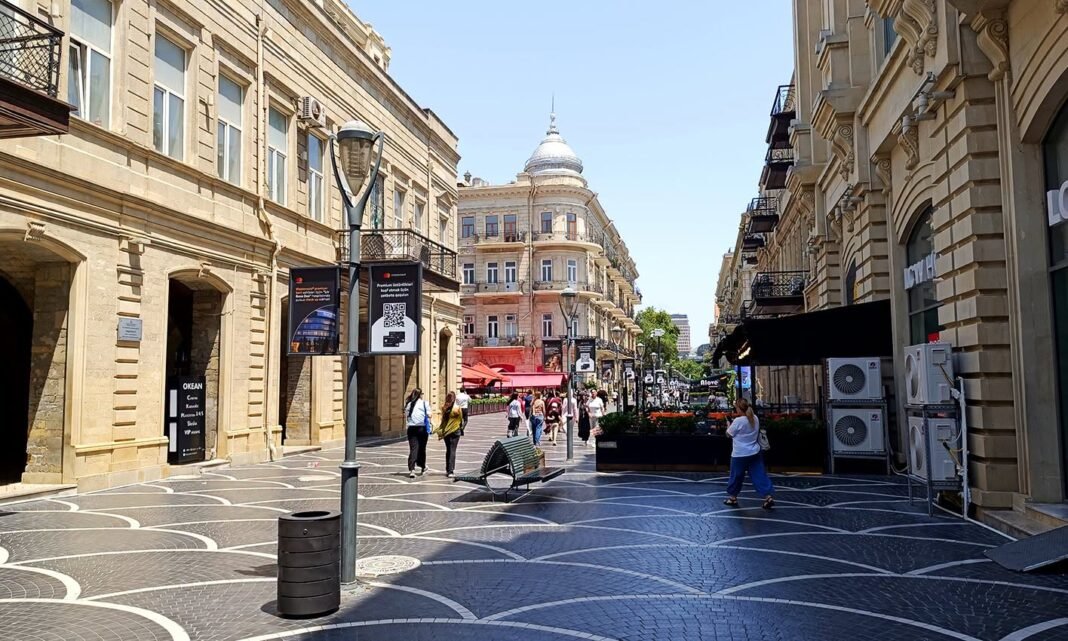
Outdoor terraces, enclosed structures, oversized planters, barriers and air-conditioning units are taking over more and more public space. What remains for pedestrians are narrow passages, overheated pavement and blasts of hot air from commercial cooling systems.
The issue was raised by prominent Azerbaijani journalist Vyacheslav Sapunov, who published a photograph on Facebook showing yet another section of Nizami Street effectively occupied by a restaurant.
The image is revealing. A large commercial structure has taken over a significant part of the pedestrian zone, including one of the most valuable public resources in Baku during summer: shade.
The restaurant gets the shade. The public gets the sun.
In a city where summer temperatures frequently approach 40 degrees Celsius, shade is not a luxury reserved for paying customers. It is an essential part of a safe urban environment, especially for elderly residents, pregnant women, parents with small children and people with health conditions.
“It Was Not Given Away. It Was Sold”
Sapunov’s post triggered a wave of angry responses from Baku residents.
Many said they now avoid Nizami Street because of crowding, noise, restaurant odors, hookah smoke, heat and increasingly restricted pedestrian access.
One comment summarized the suspicion shared by many residents: “It was not given away. It was sold.”
Others noted that the problem extends far beyond Nizami Street. Commercial terraces and makeshift structures are also narrowing pedestrian areas on Mammad Amin Rasulzade Street, Abdulkarim Alizade Street, Zarifa Aliyeva Street, Nikolai Gogol Street and other central parts of Baku.
The obvious question is: who authorizes these structures?
Who approves their size? Who measures the width of the remaining walkway? Who checks whether a person using a wheelchair or a parent pushing a stroller can pass safely? Who verifies that emergency services can still reach the area?
And how many more meters of Nizami Street can be handed over to private businesses before it stops being a pedestrian street altogether?
Restaurants Cannot Privatize the City
Restaurants, cafés and shops are a natural part of central Baku. They create jobs, attract visitors and contribute to the local economy.
But there is a major difference between placing a few outdoor tables and effectively privatizing a public sidewalk.
What is happening on Nizami Street increasingly resembles the construction of permanent commercial extensions rather than temporary summer terraces. Black walls, bulky barriers and oversized planters block historic façades and damage the visual character of one of the city’s most recognizable streets.
The external air-conditioning units are another symbol of the problem. Businesses cool their interiors while releasing heat, noise and vibration directly into the pedestrian zone.
The message is hard to miss: comfort is reserved for customers, while discomfort is imposed on everyone else.
Where Are the Permits?
The Baku City Executive Authority and relevant district administrations should publicly explain on what legal basis businesses are occupying substantial portions of Nizami Street.
The public deserves to see the permits, the approved dimensions of the terraces, the duration of any lease agreements and the amount paid into the city budget.
If the necessary permits do not exist, then this may amount to the unauthorized seizure of public space.
If permits were issued without proper consideration for pedestrian access, emergency safety and the architectural character of the area, then questions must be directed at the officials who approved them.
Several commenters openly alleged corruption. Those claims have not been independently verified. Still, secrecy inevitably creates suspicion. When residents do not know who transferred part of a central street to a private business, under what terms and for whose benefit, they naturally begin to suspect private deals and official favoritism.
The easiest way for city authorities to dispel those suspicions is simple: publish the documents and conduct a transparent inspection.
Baku Is Becoming One Large Outdoor Dining Hall
Many residents say they have stopped walking along Torgovaya altogether.
A street once associated with architecture, evening walks and Baku’s distinct urban atmosphere is increasingly becoming a corridor between restaurant terraces.
That should alarm anyone who cares about the capital.
Restaurants are not the face of Baku. The face of Baku is its architecture, balconies, stone façades, trees, public squares, open streets and people.
When every available meter is converted into a commercial seating area, the city loses more than space. It loses its identity.
Nizami Street must not be allowed to become a giant outdoor dining hall where residents are expected to squeeze between barriers, tables and air-conditioning units.
The street does not belong to restaurant owners. It does not belong to officials signing permits behind closed doors.
It belongs to Baku and its people.
If the city authorities truly see themselves as guardians of the capital, they must protect public streets from commercial encroachment, not stand by while they are sold off meter by meter.
AZE.US