By AZE.US Editorial Team
Bilateral trade remains modest, but the larger economic prize lies in lower transport costs and a new commercial map for the South Caucasus
The economic benefits of normalization between Azerbaijan and Armenia are often measured in terms of future bilateral trade. The first figures, however, suggest that the real value of peace will not initially be found on supermarket shelves. It will emerge through lower political risks, shorter transport routes and new regional connections.
Azerbaijan exported goods worth $17.37 million to Armenia in January-July 2026, according to customs data. That represented only about 0.09% of Azerbaijan’s total exports. Exports stood at $5.76 million in the first quarter, meaning shipments expanded noticeably during the following four months.
The number is historically significant, but economically modest. It marks the creation of a trade route rather than the emergence of a major market.
Trade in the opposite direction has barely begun. Azerbaijani statistics recorded just $960 in imports from Armenia in March. Customs officials later clarified that the shipment consisted of Dutch-origin roses transported through Armenia. In other words, genuine Armenian exports to Azerbaijan remained virtually nonexistent.
The imbalance is not surprising. Azerbaijan entered the new commercial relationship with an immediate advantage in the sector Armenia needs most: energy.
What Azerbaijan Can Sell
Petroleum products are the most obvious category. Armenia depends on imported fuel, and access to an additional nearby supplier could strengthen the resilience of its domestic market while improving its bargaining position with traditional partners.
For Azerbaijan, the Armenian market is small. Even a significant increase in gasoline and diesel exports would not materially transform the country’s overall trade balance. Yet the strategic value of these shipments exceeds their dollar value.
By supplying essential commodities, Azerbaijan can establish itself as an important economic partner for Armenia. This would generate commercial revenue while creating mutual interests that make a return to confrontation increasingly costly.
Petrochemicals represent another potential export category. Azerbaijan could supply polymers, lubricants, fertilizers and industrial feedstock to Armenian manufacturers.
Electricity may eventually become an even more important area of cooperation. Baku and Yerevan have discussed connecting their energy systems to enable cross-border power trade. For Armenia, this would provide another source of electricity. For Azerbaijan, it would create an additional market and offer greater flexibility in balancing power generation.
Azerbaijani companies could also supply cement, glass, steel structures and other construction materials for regional infrastructure projects. In this sector, the peace dividend would come not only from selling goods but also from obtaining contracts for roads, railways, power lines, warehouses and logistics centers.
What Armenia Can Offer
Armenia’s first substantial exports to Azerbaijan are likely to come from the food and agricultural sectors.
Potential products include fruits, vegetables, processed foods, mineral water, alcoholic and nonalcoholic beverages, and freshwater fish raised in Armenian lakes and farms. Armenia already exports many of these goods to Russia and Georgia.
But producing a marketable product does not automatically guarantee access to Azerbaijani consumers.
Armenian suppliers would have to compete with established producers from Turkey, Russia, Iran, Georgia and Central Asia. These countries already have distribution networks, recognized brands and commercial relationships in Azerbaijan.
Agricultural and food exports would also require agreed sanitary and phytosanitary standards, veterinary certification, labeling rules and mechanisms for recalling defective products. Alcoholic beverages would face additional excise, licensing and branding requirements.
Armenia could potentially export jewelry, products made from nonferrous metals and certain industrial components. The viability of these categories would depend on transparent rules governing the origin of raw materials, reexports and supply chains.
Access to Azerbaijan’s market may be particularly valuable to Armenia as it seeks to reduce its dependence on Russia. Moscow accounted for approximately 35% of Armenia’s foreign trade in 2025, compared with about 11% for the European Union.
Russian restrictions have already affected Armenian exports of fruits, vegetables, fish, flowers, alcohol and mineral water. Azerbaijan cannot replace the Russian market, but it could provide Armenian producers with an additional outlet and reduce their exposure to a single trading partner.
Trade Requires an Infrastructure of Trust
The main barriers are no longer located in factories or farms. They stand between sellers and buyers.
Businesses need functioning bank transfers, recognized commercial documents, cargo insurance, dispute-resolution procedures and clear compensation rules. The two countries must determine where contractual disputes will be heard, which authorities will certify products and who will cover losses when goods are damaged or delivery deadlines are missed.
Without these mechanisms, bilateral trade will remain dominated by governments and large companies capable of absorbing political and financial risks.
Small and midsize businesses will enter the market only after standard contracts, banking guarantees, insurance products and reliable transport routes become available.
That means the first major beneficiaries of normalization may not be farmers or retailers. They may be rail operators, trucking companies, warehouse owners, customs brokers, banks and insurers.
The Most Valuable Commodity Is Transit
Even under favorable conditions, direct trade between Azerbaijan and Armenia will remain small compared with Azerbaijan’s commerce with Turkey, Italy, Russia and China.
It would therefore be a mistake to judge the economic value of normalization only by the quantity of goods the two countries sell each other.
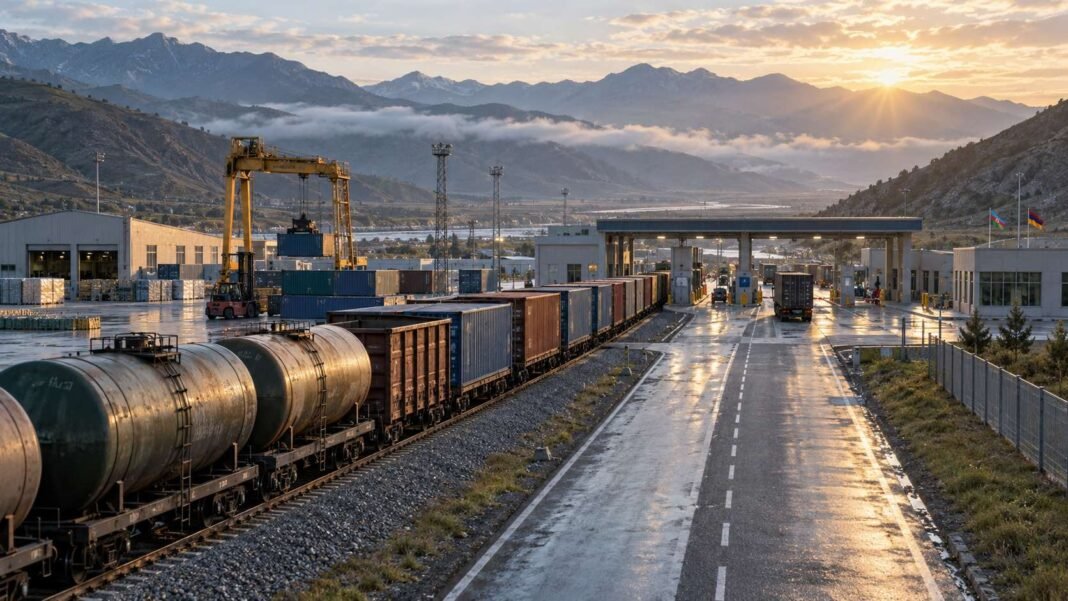
The much larger dividend will emerge if reopened borders turn Azerbaijan and Armenia into components of an integrated regional transport system.
Azerbaijan would gain a shorter land connection to Nakhchivan and, from there, to Turkey. Armenia could gain access to Azerbaijani railways, the Caspian Sea and routes leading toward Central Asia. Turkey, Georgia and Central Asian countries would receive additional options for transporting goods between Europe and Asia.
At that point, the central question would no longer be how many bottles of mineral water or tons of gasoline cross the border. What would matter is the cost of moving every container through the South Caucasus.
But transport corridors generate sustainable revenue only when they are predictable. International shippers will not commit large volumes of cargo to a railway that could be closed during the next political dispute. Route selection depends not only on price but also on delivery times, insurance costs and confidence that the rules will remain stable.
The Peace Dividend Is Not Automatic
The first $17.37 million in Azerbaijani exports is primarily a political and symbolic milestone. It demonstrates that the transition from conflict to commerce is technically possible.
Fuel shipments alone, however, will not create irreversible economic interdependence.
That will require direct land connections, transparent customs rules, mutual recognition of certificates, banking arrangements and enforceable investment protections. Both governments must also avoid turning ordinary commercial disputes into interstate crises.
In the short term, Armenia may receive more visible benefits: alternative fuel supplies, additional export opportunities and new transport options for a landlocked economy.
Azerbaijan’s immediate commercial gains may appear smaller, but its strategic reward could be considerably larger. A direct connection to Nakhchivan and a central role in an emerging regional transport network would strengthen the country’s position between Central Asia, the Caspian, Turkey and Europe.
The true economic value of peace should therefore not be sought in the bilateral trade balance alone. It will appear when the border stops generating costs and begins creating value.
Azerbaijan and Armenia have started exchanging goods. The real peace dividend will come when both countries begin earning from the simple fact that they are neighbors.
AZE.US