By AZE.US
The dispute between Moscow and Yerevan is no longer limited to diplomatic rhetoric.
Armenia is seeking to reshape the foundations of its relationship with Russia, while the Kremlin is trying to preserve its influence over the country’s security, transportation and energy infrastructure.
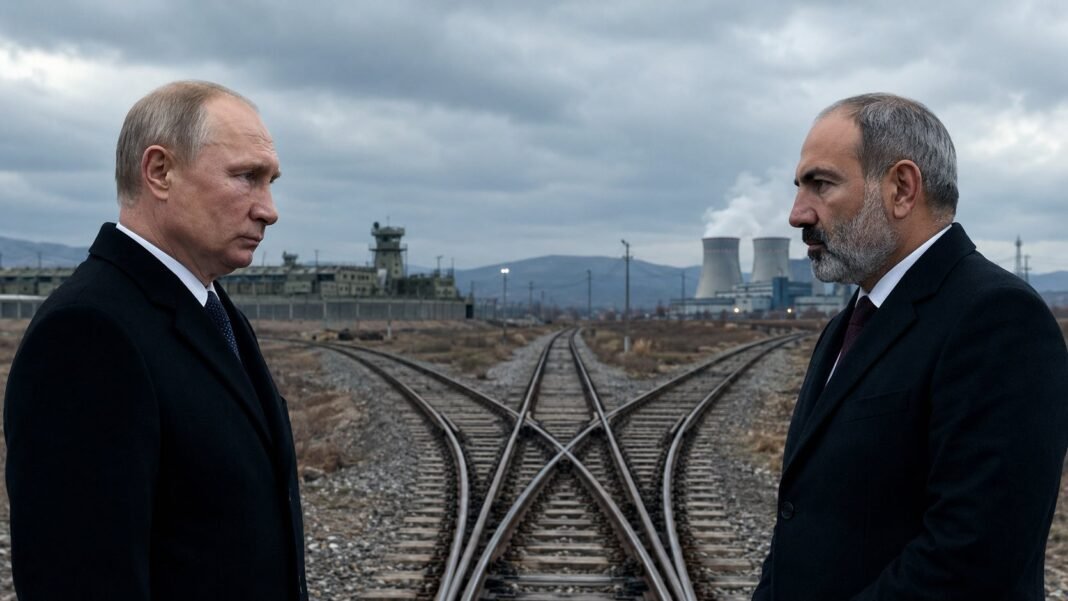
The latest meeting between Armenian Prime Minister Nikol Pashinyan and Russian President Vladimir Putin in Bishkek brought those tensions into public view.
The two leaders discussed Armenia’s potential choice between the European Union and the Eurasian Economic Union, the future of Russia’s military base in Gyumri, the concession governing Armenia’s railways and plans for a new nuclear power plant.
Tigran Grigoryan, head of the Regional Center for Democracy and Security, told CivilNet’s “Week in Review” that the disagreement over EU and EAEU membership may be a public cover for more immediate disputes.
In his assessment, the most consequential issues are control of Armenia’s railway system and the country’s choice of a partner for its next nuclear power project.
Armenia Wants to Rewrite the Relationship
For decades, Russia was viewed in Armenia as the country’s principal security guarantor. That perception has changed sharply following the crises of recent years and Moscow’s failure, in the view of the Armenian government and many Armenian analysts, to fulfill its expected security role.
The resulting collapse in confidence pushed Yerevan to diversify its foreign policy, defense partnerships and economic ties.
Pashinyan said after the Bishkek talks that he may visit Russia again soon. He also indicated that the two sides had agreed to conduct what amounted to an inventory of bilateral relations - determining which parts of the existing framework should remain and which need to be revised.
The two governments, however, appear to have different objectives.
For Yerevan, restructuring the relationship means gaining greater freedom to cooperate with the EU, the United States and other partners. Moscow’s priority is to retain the political and economic leverage it has accumulated in Armenia since the collapse of the Soviet Union.
EU-EAEU Debate May Be a Smokescreen
Putin has emphasized that Armenia will eventually have to choose between deeper integration with the EU and continued membership in the Russian-led EAEU. He suggested that the question should be decided through a referendum.
Grigoryan described that argument as potentially misleading.
Armenia adopted legislation launching a process of European integration more than a year ago. If Moscow had immediately interpreted the law as an informal application to leave the EAEU, he argued, its current demands and warnings could have been issued at that time.
The delayed reaction suggests that the dispute is driven by more immediate disagreements over rail infrastructure and nuclear energy.
Armenia’s membership in the EU is not a realistic near-term prospect. The country would have to meet the bloc’s political and economic accession criteria, while the EU itself is moving cautiously on further enlargement.
The EU-EAEU question nevertheless gives Moscow a politically defensible way to express its dissatisfaction and exert economic pressure on Yerevan.
Railway Talks Appear Deadlocked
Armenia’s railway network is operated by a Russian company under a long-term concession agreement. That arrangement has become increasingly important as Armenia, Azerbaijan and international partners discuss reopening regional transportation routes.
Several missing or damaged railway sections would have to be restored to support new cross-border cargo traffic, including infrastructure associated with the Trump Route for International Peace and Prosperity, or TRIPP.
Putin indicated that Russia would be willing to invest in modernizing Armenia’s railway system once cargo volumes and bilateral trade increase.
That condition creates a practical impasse: significant cargo traffic cannot begin without functioning infrastructure, while Russia does not want to finance the infrastructure until greater traffic is guaranteed.
At the same time, Moscow appears unwilling either to surrender the railway concession or allow a third party to assume control of the system.
Grigoryan said the dispute could lead to months of inconclusive negotiations. Armenia may eventually attempt to finance the reconstruction of missing sections itself, but it would still have to address the existing concession.
Russia, meanwhile, is likely to seek a direct or indirect role in TRIPP and other emerging regional transportation projects.
The outcome matters to Azerbaijan because rail connections through southern Armenia could become part of the planned transit link between mainland Azerbaijan and the Nakhchivan Autonomous Republic, while also opening wider east-west trade routes.
Russian Military Base Is No Longer Untouchable
The future of Russia’s 102nd military base in Gyumri has also entered the public debate.
Putin said Russia would be prepared to withdraw the base if Armenia concluded that it was no longer needed. Pashinyan responded that Armenia had no vital need for the base and would not object if Moscow itself decided to remove its forces.
Such an exchange would have been almost unimaginable only a few years ago, when the Russian presence was treated as a central pillar of Armenian national security.
Pashinyan has adopted a similar position regarding the Collective Security Treaty Organization. When Russian officials raised the possibility that Armenia could be expelled from the CSTO, the prime minister suggested that Yerevan would welcome such an outcome.
Armenia has nevertheless stopped short of formally demanding that Russian troops leave or completing its withdrawal from the CSTO.
Yerevan appears concerned that unilateral action would be interpreted by the Kremlin as a geopolitical challenge and trigger retaliation in other areas.
Nuclear Plant Decision Carries Geopolitical Weight
Armenia must also decide who will build its next nuclear power plant.
Russia wants to remain involved, but Yerevan has simultaneously expanded discussions with the United States over nuclear technology. Armenia has examined the possibility of using small modular reactors and has held negotiations with Washington on a Section 123 agreement, the legal framework required for U.S. civilian nuclear cooperation.
Armenian officials say the final choice will be based on safety, cost and technological quality. Grigoryan, however, argued that the project cannot be viewed as purely commercial.
A new nuclear plant would operate for decades and could either preserve Armenia’s energy dependence on Russia or become a major instrument of diversification.
Small modular reactors remain a developing technology and have not yet been deployed on a broad commercial scale. Because nuclear energy requires proven safety standards and long-term operational support, Armenia could still select a Russian proposal if Moscow offers an attractive and technically reliable package.
EU Trade Access Cannot Replace Russian Gas
The European Union is moving to liberalize trade conditions for approximately 80% of Armenian exports to the bloc.
Grigoryan called the planned measure politically significant, noting that Armenia is not an EU candidate and remains a member of the EAEU. He said the decision reflects Armenia’s growing importance to Brussels, particularly as relations between the EU and Georgia have deteriorated.
Expanded market access, however, will not automatically transform Armenia’s trade.
Armenian producers still face high transportation costs, logistical barriers and limited brand recognition in European markets. Greater access can help individual industries, but it cannot immediately replace the Russian market.
Energy presents an even more serious challenge. Armenia remains heavily dependent on Russian gas. Yerevan has strengthened cooperation with Iran and is seeking to increase alternative supplies, but the capacity of that route is limited.
As a result, energy remains one of Moscow’s strongest levers over Armenia.
Yerevan Warned to Prepare for Pressure
Grigoryan said the crisis still has considerable potential to deepen.
Possible Russian pressure could include higher gas prices, restrictions on money transfers and tighter rules for Armenian citizens working in Russia, including deportations.
Armenia is not prepared to absorb all those measures simultaneously, he warned, and should begin developing crisis-management plans before any escalation occurs.
The EU may be able to offset some trade losses and provide political assistance, but Brussels cannot quickly replace Russia’s role in Armenia’s energy sector, transportation network and several other strategic industries.
Armenia has therefore declared a European direction without yet acquiring the economic and infrastructure alternatives required for a decisive break with Moscow.
The Bishkek meeting demonstrated that the previous model of Russian-Armenian relations is nearing exhaustion. What replaces it will depend less on political declarations about Europe and more on whether Yerevan can reduce Russian control over its railways, energy supplies and security architecture.
AZE.US