By AZE.US Editorial Team
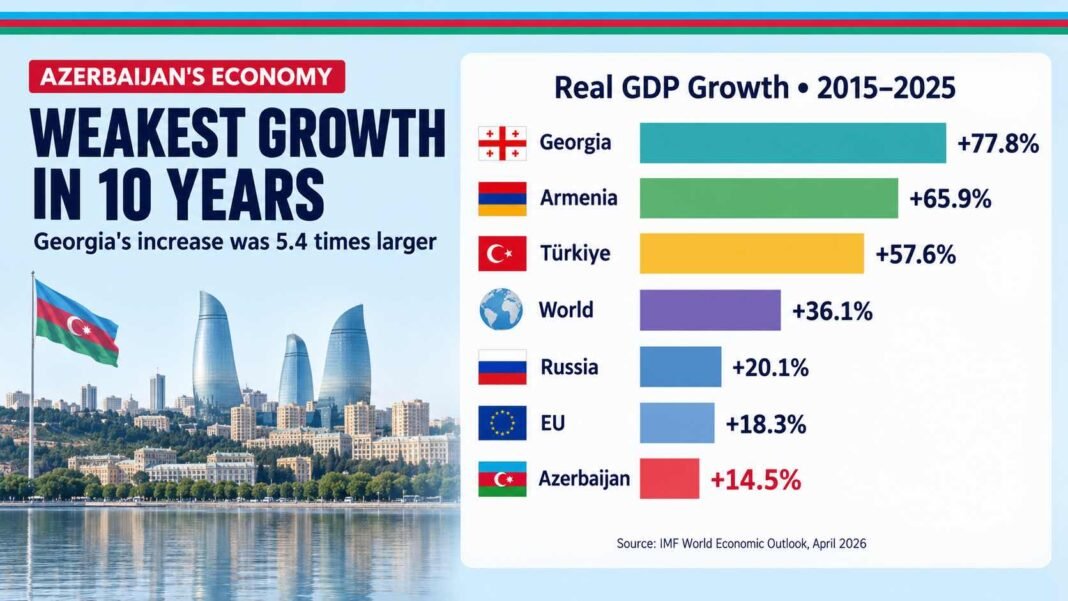
Over the past decade, Azerbaijan’s economy expanded by just 14.5%.
During the same period, Georgia recorded cumulative growth of 77.8%, Armenia 65.9% and Türkiye 57.6%.
Georgia’s increase was more than five times Azerbaijan’s, while Armenia’s was four and a half times larger.
The global economy grew by 36.1% – two and a half times Azerbaijan’s rate.
The figures come from the International Monetary Fund’s April 2026 World Economic Outlook database and measure real economic growth between 2015 and 2025. Inflation and changes in commodity prices are excluded.
Real GDP Growth From 2015 to 2025
| Country or Region | Cumulative Real GDP Growth |
|---|---|
| Georgia | 77.8% |
| Armenia | 65.9% |
| Türkiye | 57.6% |
| World | 36.1% |
| Russia | 20.1% |
| European Union | 18.3% |
| Azerbaijan | 14.5% |
If the size of each economy in 2015 is set at 100, Georgia reached nearly 178 by 2025, Armenia 166 and Türkiye 158. Azerbaijan reached only 114.5.
The gap is too wide to be blamed on a single recession, the pandemic or the 2020 war. It reflects a deeper problem with Azerbaijan’s economic model.
Why Oil Revenue Did Not Produce Faster Growth
Azerbaijan remains dependent on an industry that can no longer expand at its previous pace.
When oil prices rise, the country receives more export revenue. The state budget and the State Oil Fund benefit, while Azerbaijan’s foreign reserves increase.
But higher oil prices do not necessarily produce real economic growth.
Real GDP measures the volume of goods and services that a country produces. For the oil sector to expand in real terms, Azerbaijan must increase the physical volume of its production – not simply sell the same number of barrels at a higher price.
Production at Azerbaijan’s mature oil fields has been declining. New natural gas projects have partly offset that decline, but they have not replaced the powerful oil-driven growth of earlier decades.
The result is a paradox: Azerbaijan can accumulate billions of dollars while the physical size of its economy expands very slowly.
In 2025, Azerbaijan’s GDP grew by only 1.4%. The oil and gas sector contracted by 1.6%, while non-hydrocarbon growth slowed from 6.5% in 2024 to 2.7%, according to both the State Statistical Committee and the International Monetary Fund.
The slowdown outside the energy industry is particularly important. It suggests that Azerbaijan’s formally non-oil economy is still heavily influenced by oil revenue.
When energy income and public investment weaken, construction, trade, transportation and other sectors also lose momentum.
You May Like
Azerbaijan Risks Losing the South Caucasus Economic Race
What Georgia and Armenia Did Differently
Georgia and Armenia have serious economic weaknesses of their own, including poverty, migration, political uncertainty and dependence on external markets. Their growth should not be romanticized.
But both countries developed several engines of expansion rather than relying on one dominant resource.
Georgia invested in tourism, transportation, trade, education and digital services. Its economy grew by another 7.5% in 2025, supported by information technology, education and retail trade. Real wages rose by 11.5%, according to the World Bank.
Armenia received an extraordinary boost after 2022 from the arrival of businesses, workers and capital, as well as increased trade and re-exports. Some of that growth may prove temporary.
However, Armenia had already been expanding its technology, services, construction and small-business sectors. In 2025, its economy grew by 7.2%, while construction activity surged by 21%.
Türkiye endured high inflation and severe currency instability, but continued producing automobiles, appliances, clothing, food and construction materials. Its large domestic market, manufacturing sector and diversified exports kept the economy expanding.
Azerbaijan largely continued selling oil and gas and distributing the resulting revenue throughout the domestic economy.
When the energy engine began losing power, no comparable replacement was ready.
Stability Without Speed
It would be unfair to describe the past decade as a complete failure.
Azerbaijan built roads, power infrastructure and public facilities while financing the large-scale reconstruction of Karabakh and East Zangezur. By the end of 2025, the combined reserves of the Central Bank and the State Oil Fund had reached $85 billion.
Neither Georgia nor Armenia has a comparable financial cushion.
But reserves and economic growth are not the same thing. Reserves protect a country during a crisis. Growth creates new businesses, jobs, incomes and opportunities.
Azerbaijan has built substantial protection against financial shocks, but it has allowed its neighbors to move far ahead in expanding their economies.
The country has stability. What it lacks is speed.
Why Private Business Has Not Become the New Engine
Azerbaijan has discussed economic diversification for years. The government has established industrial parks, agricultural parks, tax incentives and programs intended to support entrepreneurs.
Real diversification, however, begins when private companies can grow without depending on government contracts, oil-financed spending or administrative support.
That transition has not yet been completed.
Many entrepreneurs still struggle to obtain affordable financing, enter major markets, participate in public procurement or compete with state-owned enterprises and powerful business groups.
Capital therefore tends to move toward property, retail trade and imports, where returns can be faster. Manufacturing, technology and export-oriented businesses require larger investments and carry more risk.
The IMF estimates that Azerbaijan’s total investment fell to 15.7% of GDP in 2025. Private-sector investment accounted for only 4.5% of GDP – a troubling figure for a country seeking industries capable of replacing declining oil production.
The IMF has called on Azerbaijan to improve access to finance, develop capital markets, raise labor productivity, reduce informal employment, reform state-owned companies and expand the role of the private sector.
Without such changes, the Fund expects Azerbaijan’s medium-term growth to remain at around 2.5% – too low to begin closing the gap with its neighbors.
What Must Change
Azerbaijan should stop treating all non-oil growth as evidence of successful diversification.
A construction company dependent on a state contract may officially belong to the non-oil economy, but it still relies on revenue generated by hydrocarbons. The same applies to trade and services driven primarily by public spending.
The real test is whether private companies can produce competitive goods and services, export them and create well-paid jobs without permanent state support.
That requires fair competition, accessible credit, stronger property protection, reliable courts, better education and clear rules for investors.
A peace agreement with Armenia and the opening of regional communications could also create new opportunities. Azerbaijan could become a transportation, manufacturing and service hub linking Central Asia with Türkiye and Europe.
But transporting goods produced by other countries will not be enough. Azerbaijan must also produce and export more of its own.
Another Decade Cannot Be Lost
Azerbaijan’s weak performance has legitimate explanations: the oil price collapse, the 2015 devaluations, the banking crisis, the pandemic, the 2020 war and declining crude production.
But other countries also endured wars, political crises, population movements and external shocks. Their economies still grew substantially faster.
The IMF comparison does not mean Azerbaijan is poorer than Georgia or Armenia. It shows that its neighbors are expanding more quickly and gradually closing the economic gap.
Oil gave Azerbaijan money and time. Much of the money was preserved, but the time is running out.
Unless the economic model changes, the question ten years from now will no longer be why Azerbaijan’s neighbors are growing faster.
It will be why a country with far greater natural and financial resources allowed smaller economies to leave it behind.
AZE.US