
By AZE.US Editorial Team
Azerbaijan, Armenia and Georgia had almost identical GDP per capita levels in 2020. Today, the two neighboring economies are pulling ahead. The reason is not only declining oil production, but the structure of Azerbaijan’s economic model.
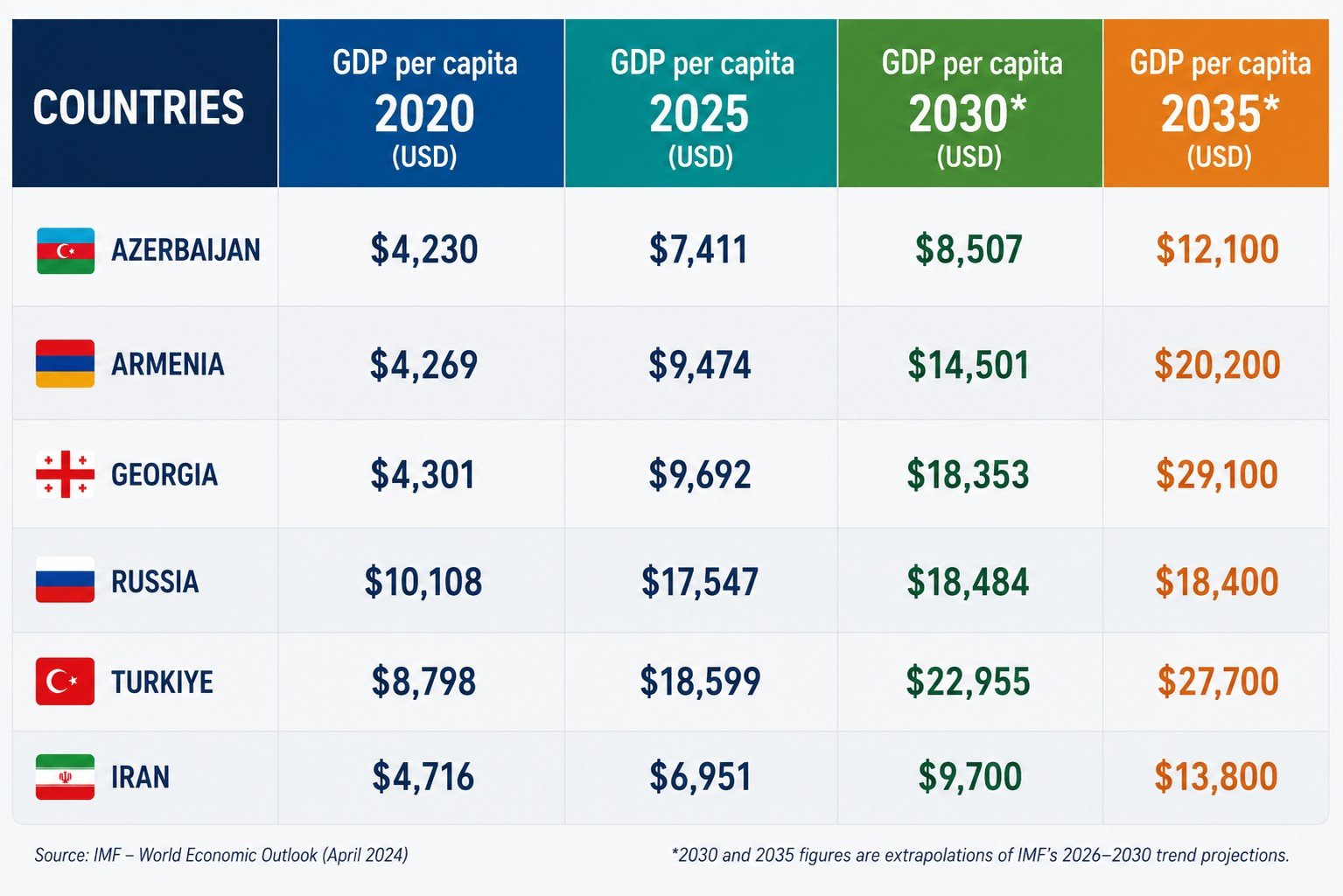
In 2020, GDP per capita stood at approximately $4,230 in Azerbaijan, $4,269 in Armenia and $4,301 in Georgia. The three South Caucasus countries were starting from almost the same point.
Several years later, that balance has changed. Armenia and Georgia now have noticeably higher GDP per capita figures, while their economies continue to expand faster than Azerbaijan’s.
A table circulating on social media projects that by 2035 GDP per capita could reach $12,100 in Azerbaijan, compared with $20,200 in Armenia and $29,100 in Georgia.
The 2030 and 2035 figures are not official International Monetary Fund forecasts. They are extrapolations based on earlier trends and should therefore be treated with caution.
But the direction shown in the table reflects a real problem: Azerbaijan’s economy is growing more slowly than those of its neighbors.
Why is a country with oil, gas and tens of billions of dollars in financial reserves beginning to fall behind?
Declining Oil Production
The first and most obvious reason is the long-term decline in oil production.
For two decades, oil was the main engine of Azerbaijan’s growth. It generated export revenues, supplied foreign currency and financed major government projects.
But the country’s largest oil fields are aging, while new production has not been sufficient to fully offset the decline.
Natural gas exports remain strategically important, especially for supplying European markets. Yet gas has not produced the same economic expansion that the oil boom delivered during the 2000s.
Azerbaijan’s traditional growth engine is therefore losing power, while no equally strong replacement has yet emerged.
The Non-Oil Economy Still Depends on the State
Official reports frequently point to growth in the non-oil sector. However, a substantial part of that activity remains connected to government spending.
Road construction, reconstruction projects, public investment and state-owned companies support employment and domestic demand. But they do not necessarily create competitive private businesses capable of selling products and services abroad.
In practice, the state earns money from energy exports and redistributes part of it through the budget.
That model can maintain economic activity, but it differs from an economy in which thousands of independent companies create technology, manufacture export goods and compete in international markets.
As long as government spending remains one of the main sources of growth, the non-oil sector will struggle to replace the oil industry.
Weak Competition Holds Back Business
Another major problem is limited competition.
In many sectors, markets are dominated by a small number of large companies. New businesses often find it difficult to compete with firms that enjoy better access to financing, government contracts or administrative support.
As a result, much of Azerbaijan’s small and medium-sized business sector remains concentrated in retail, restaurants and relatively basic services.
There are still too few private companies capable of investing in advanced manufacturing, technology or high-value exports.
Weak competition also reduces the incentive to innovate. A company that can remain profitable without modernizing, improving productivity or fighting for customers has little reason to take risks and invest.
Financial Resources Are Not Becoming Technology
Azerbaijan has built substantial financial reserves, modern roads, airports, ports and energy infrastructure.
But infrastructure is a foundation for development, not development itself.
Ports and transport corridors create greater value when they generate warehouses, manufacturing facilities, insurance services, logistics companies and regional corporate headquarters.
Renewable energy becomes transformative when it supports domestic engineering, equipment production and technology companies – not only electricity exports.
Armenia has expanded its information technology, engineering and digital services sectors. Georgia has developed tourism, financial services, logistics, education and international business services.
Azerbaijan has also announced plans in technology, transit, renewable energy and manufacturing. But these sectors have not yet created enough high-paying jobs or export revenue to fundamentally change the structure of the economy.
Human Capital Remains a Constraint
Economic diversification also depends on people.
A modern economy needs engineers, programmers, researchers, skilled technicians and professional managers. Yet Azerbaijani employers regularly report shortages of qualified workers, despite the large number of university graduates.
The problem is not simply the number of diplomas. It is the quality of education, professional training and the connection between universities and the labor market.
Many highly skilled Azerbaijanis prefer to work abroad or for foreign companies. Meanwhile, economic opportunity remains heavily concentrated in Baku, while wages and private-sector activity in the regions remain limited.
Without stronger education and workforce development, Azerbaijan will find it difficult to build industries that can compete internationally.
Reserves Provide Security, Not Growth
Azerbaijan remains the most financially secure country in the South Caucasus.
The State Oil Fund and central bank reserves help protect the manat, finance strategic projects and reduce the impact of external crises.
But reserves are an insurance policy, not an economic engine.
They can prevent a sudden collapse. They cannot, by themselves, create productive companies, raise labor efficiency or generate new export industries.
That requires private investment, genuine competition, predictable regulation, protection of property rights and confidence that businesses can plan for the long term.
Azerbaijan has not yet lost the South Caucasus economic race. It still has greater financial resources than its neighbors, a strategically important location and access to major energy and transport routes.
But the period when oil wealth automatically guaranteed regional economic leadership is ending.
The central risk is not simply that Armenia or Georgia may rank higher in a future statistical table. It is that they may build more productive economies that raise incomes faster, while Azerbaijan remains tied to declining oil production and state-funded domestic growth.
Changing that trajectory will require more than another diversification strategy or government program.
It will require a genuine shift from an economy supported by oil revenues to one driven by competitive private businesses, skilled workers and products that the rest of the world is willing to buy.
AZE.US