AZE.US
Turkey seeks to shape a new security architecture in the Black Sea in which neither Russia nor NATO can unilaterally determine the rules.
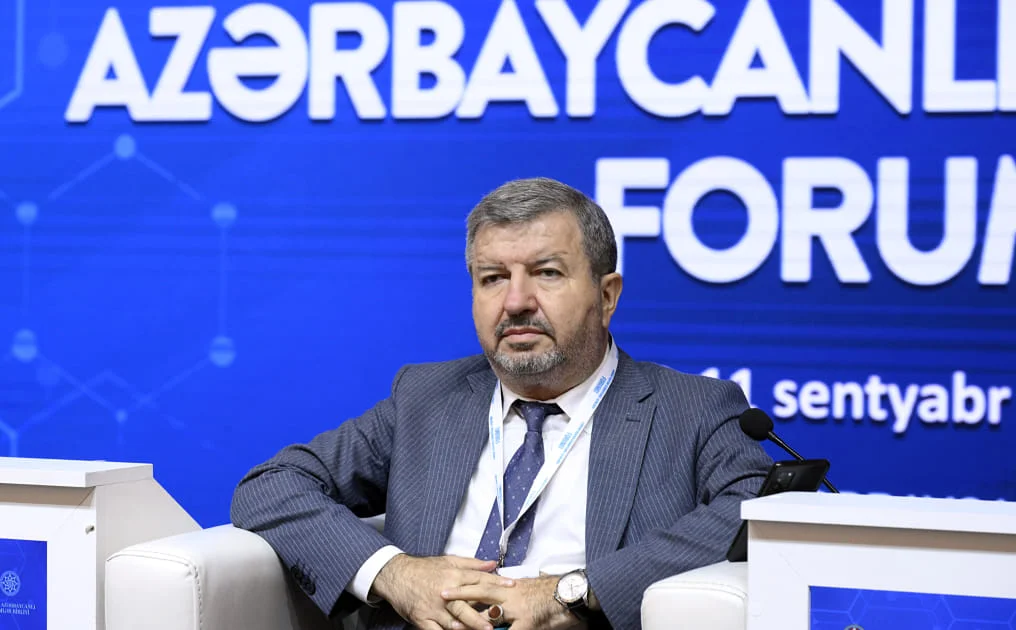
Turkish political scientist and professor Toghrul Ismail made the remarks in an interview with the YouTube channel Geopolitics with Barvinenko.
According to Ismail, Ankara’s refusal to publicly define its “red lines” should be viewed not as a sign of weakness, but as a deterrence strategy designed to preserve its freedom of action.
“Any public declaration of red lines automatically restricts the room for maneuver. If Turkey announces in advance how it will respond in a particular situation, the other side will begin calculating its actions based on that expected response,” he explained.
Ismail said Ankara wants to retain the ability to communicate simultaneously with Kyiv, Moscow, Washington and European capitals. Turkey is interested neither in allowing the Black Sea to become a Russian-dominated region nor in seeing it transformed into an arena of direct Western military control.
However, he warned that strategic ambiguity can remain effective only up to a certain point. If Turkey’s allies begin to interpret it as indecision, while its rivals see it as an opportunity to increase pressure, the strategy could eventually begin working against Ankara.
Turkey therefore signals its priorities through actions rather than public declarations, including its control over the Turkish Straits, diplomatic engagement, military presence, relations with Black Sea states and policies toward Russia and Ukraine.
“The Black Sea is becoming a test of Turkey’s strategic autonomy. If Ankara can preserve the balance, prevent excessive militarization of the region and protect its own interests, its role as an independent geopolitical center will grow considerably,” Ismail said.
The political scientist stressed that Turkey cannot establish a sustainable Black Sea security system entirely without NATO. Turkey itself is a member of the alliance, while Bulgaria and Romania are both NATO members with Black Sea coastlines.
At the same time, he argued that no lasting regional security architecture can be built without taking Russia’s interests and military capabilities into account.
“Building a sustainable architecture directed against Russia is practically impossible. But Russia also cannot determine the rules in the Black Sea on its own. The current war has already demonstrated that,” Ismail said.
In his view, the future security framework should be based not on the principle of “Russia versus NATO” or “NATO versus Russia,” but on a managed balance of power.
One of Ankara’s most important instruments remains the Montreux Convention, which gives Turkey authority over the passage of warships through the Bosporus and Dardanelles.
“Turkey wants to create an architecture in which neither Russia nor NATO can dictate the rules alone. Turkish strategy is not about choosing between Moscow and Washington. It is about preserving the ability to speak with both sides,” the expert noted.
Under such a system, NATO would remain a collective defense mechanism, Russia would continue to be a major military and geopolitical power, and Ukraine would remain an important element of regional security. Turkey, meanwhile, would seek to become the central actor capable of connecting these elements and managing the regional balance.
Ismail also highlighted Ankara’s dual role. Turkey is attempting to serve as a mediator between Russia and Ukraine while simultaneously strengthening its position as an independent regional power.
He described mediation not simply as a diplomatic service offered to Moscow and Kyiv, but as a source of geopolitical influence. Turkey’s ability to maintain communication with both sides allows it to shape developments instead of merely observing them.
That policy nevertheless has limits. Moving too close to either Russia or Ukraine would undermine Ankara’s credibility as a mediator. At the same time, maintaining neutrality for too long when Turkey’s national interests are directly affected could raise doubts about its ability to act as a genuine regional power.
“The central principle of Turkish strategy can be expressed simply: Turkey does not want to be neutral, but it also does not want to become a party to the conflict,” Ismail said.
According to the professor, Ankara’s main test will not be whether it chooses Russia or the West. It will be whether Turkey can preserve its strategic autonomy as both sides increasingly pressure it to choose a camp.
AZE.US