By AZE.US Editorial Team
Nikol Pashinyan’s election victory in Armenia is being widely read as more than a domestic political result. For many observers, it is also a political defeat for Moscow in the South Caucasus.
The Armenian prime minister survived military defeat, the loss of Karabakh, fierce attacks from pro-Russian opposition forces and years of pressure from the Kremlin’s media and political orbit. For most politicians, such a record would have ended a career. For Pashinyan, it became part of a new political narrative.
He managed to convince a large part of Armenian society that the choice was not simply between him and his rivals. It was a choice between war and peace, between returning to old dependencies and trying to build a different future with Armenia’s neighbors.
That message worked.
Pashinyan campaigned on peace with Azerbaijan, normalization with Turkey, new trade routes and a gradual reduction of Armenia’s dependence on Russia. His opponents tried to turn the loss of Karabakh into the central issue of the campaign. But many Armenian voters appeared more concerned about avoiding another war than reopening a painful chapter that has already changed the region irreversibly.
That is why the outcome looks like a blow to Moscow. Russian pressure, political warnings and support for anti-Pashinyan forces did not stop him from holding power. The Kremlin’s old instruments of influence in Armenia are no longer working the way they once did.
But this does not mean Armenia has fully broken away from Russia.
The country’s economic, energy and migration ties with Moscow remain deep. For decades, Armenia relied heavily on the Russian market, Russian loans, Russian investments and remittances from Armenian citizens and ethnic Armenians working in Russia. Europe can offer political support, grants, trade opportunities and a long-term path toward closer integration. But it cannot quickly replace the Russian economic space.
That is Pashinyan’s main challenge after the election. He has won the vote, but now he has to prove that his Western-facing and peace-oriented agenda can deliver more than slogans.
Moscow is unlikely to watch quietly. Relations between Russia and Armenia are already in deep crisis. Yerevan has effectively frozen its participation in the Collective Security Treaty Organization, while Russian officials increasingly warn Armenia to clarify its future in Moscow-led military and economic blocs.
Pressure could grow. Russia may use trade restrictions, energy leverage, problems for Armenian goods on the Russian market and political support for opposition forces inside Armenia. But there is a risk for Moscow as well: the harder it pressures Armenia, the more many Armenians may see that pressure as proof that the country needs to reduce its dependence on Russia.
Yet the hardest issue for Pashinyan is not Moscow. It is peace with Azerbaijan.
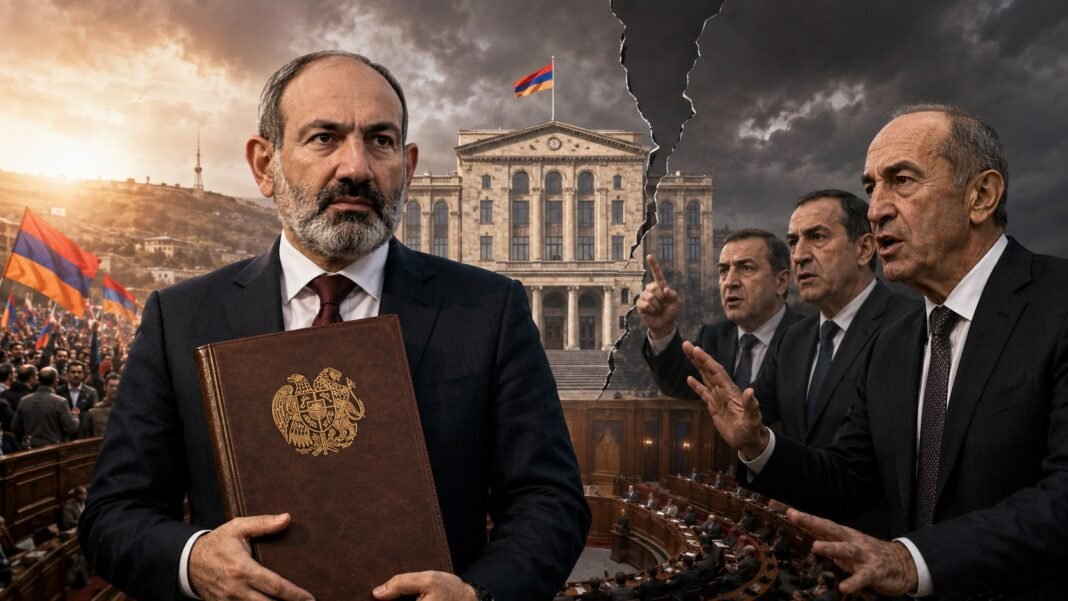
Baku has repeatedly said that a final peace agreement requires Armenia to change its Constitution and remove provisions Azerbaijan views as a legal basis for territorial claims. For Pashinyan, this is the most important and most dangerous political step.
It could open the door to a real peace deal. But it could also trigger fierce resistance inside Armenia.
The problem is that Pashinyan’s party did not secure a constitutional majority in parliament. That makes any constitutional reform far more difficult. He would need broader parliamentary support to move toward a referendum, and much of the opposition is unlikely to back a process that could be seen as Armenia’s final abandonment of the Karabakh agenda.
This is where Russia may still have room to act.
If Moscow failed to prevent Pashinyan’s victory at the ballot box, it may try to slow down or block the constitutional changes needed for a final peace deal with Azerbaijan. By supporting opposition forces or exploiting public fears, Russia can still complicate the peace process.
Pashinyan says he remains committed to signing and ratifying a peace agreement with Baku. His calculation appears to be that infrastructure projects, rail links, highways, energy lines and regional trade can gradually create a new reality between Armenia and Azerbaijan.
In other words, even if a formal peace treaty is delayed, practical normalization may continue through roads, transport corridors and economic links.
For Azerbaijan, however, the constitutional issue remains fundamental. Without removing legal grounds for future territorial claims, Baku will not see peace as fully guaranteed. That is why Armenia’s Constitution has become the central test of Pashinyan’s post-election agenda.
Armenia now faces a choice far bigger than foreign policy alignment. This is not only about Russia, Europe or the United States. It is about whether Armenia can finally move beyond the logic of conflict and accept the new regional reality.
Pashinyan won the election. Moscow lost influence. But peace with Azerbaijan is still not guaranteed.
The Armenian prime minister’s hardest political battle begins now. He must withstand Russian pressure, keep domestic stability, convince society that peace with Azerbaijan is necessary and find a way to pursue constitutional change without holding a constitutional majority.
If he succeeds, Pashinyan may be remembered as the leader who changed Armenia’s course after defeat. If he fails, his latest victory could become only another stage in a long crisis between Yerevan, Moscow and Baku.
AZE.US