By AZE.US Editorial Team
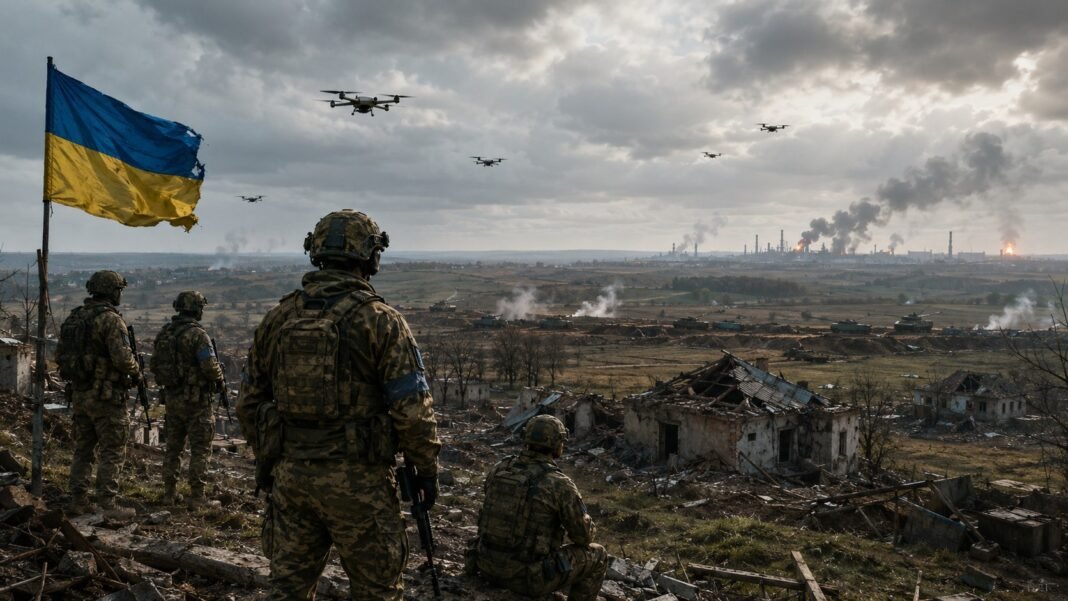
Ukraine says its forces have retaken 26 settlements and more than 745 square kilometers of territory in one of Kyiv’s most notable battlefield gains of 2026.
Only a few months ago, such figures would have seemed difficult to imagine amid the prevailing narrative that Russia was steadily advancing while Ukraine could do little more than slow its progress.
That picture is now more complicated.
The real question is therefore not whether Ukraine recaptured 26 settlements. It is whether the logic of the war itself is beginning to change.
The 26-Settlement Claim
President Volodymyr Zelensky said on August 12 that Ukrainian forces had regained control of 26 settlements and 745 square kilometers during an operation that began in late January, primarily around the junction of the Dnipropetrovsk, Donetsk and Zaporizhzhia regions.
The same development was discussed by Azerbaijani political analyst Zaur Mammadov, who argued that Ukraine has increasingly shifted toward a more offensive approach both along the front and against targets inside Russia.
Independent battlefield assessments have been somewhat more conservative than Kyiv’s figures, but they broadly confirm that meaningful Ukrainian advances have taken place.
That distinction matters.
This is not simply a political claim from Kyiv. Ukraine has genuinely regained territory. The debate is over the scale and strategic significance of those gains.
This Is Not Another 2022 Counteroffensive
The recovery of 745 square kilometers is significant in a war where recent advances have often been measured in individual villages, tree lines and a few kilometers at a time.
But it is nowhere near enough to suggest a strategic collapse of Russian forces or a return to the kind of rapid Ukrainian offensive seen in the Kharkiv region in 2022.
What matters more is that Russia’s spring and summer offensive has so far failed to produce the operational breakthrough Moscow had sought.
Russian forces continue to advance in some areas, but the pace has slowed significantly compared with earlier phases of the war.
For Ukraine, the immediate objective may no longer be a dramatic drive toward the Sea of Azov.
A more realistic goal is to destroy the perception that Russian territorial gains are inevitable.
On several parts of the front, Kyiv appears to be doing exactly that.
Ukraine Is Taking the War Deeper Into Russia
The second part of Kyiv’s strategy is becoming even more important.
Ukraine is increasingly striking industrial and energy facilities hundreds, and in some cases more than a thousand kilometers, from its border.
Recent Ukrainian attacks have targeted Russian oil refining and petrochemical infrastructure far from the battlefield.
This is changing the geography of the war.
During the first years of the invasion, Russia could wage war across Ukrainian territory while most of its own industrial infrastructure remained largely beyond Ukraine’s reach.
That advantage is gradually disappearing.
Ukraine cannot match Russia in ballistic missiles, combat aircraft or the size of its defense industry. Instead, Kyiv is trying to create an asymmetric advantage through relatively inexpensive long-range drones.
The strategy forces Russia to spread air defense systems across an enormous territory while increasing the economic cost of continuing the war.
In that sense, an oil refinery deep inside Russia may now matter as much to the broader war effort as a small village on the Donbas front.
It would nevertheless be
Russia Still Holds a Dangerous Advantage
a mistake to conclude that the strategic initiative has fully shifted to Ukraine.
Russian forces continue offensive operations and remain capable of gaining ground.
More importantly, Russia retains a major advantage in long-range missile warfare.
Ukraine continues to face shortages of Western air-defense interceptors, particularly for Patriot systems, while Moscow has intensified its use of ballistic missiles.
That imbalance could become one of the decisive factors heading into the next winter.
Ukraine may be increasingly capable of creating problems for Russia on the ground and striking energy infrastructure deep behind Russian lines.
But the balance in the air remains considerably more favorable to Moscow.
A Different Kind of War Is Emerging
There is another development worth watching.
Even as Kyiv expands its attacks on Russian territory, Ukraine has shown interest in limiting strikes on civilian shipping and infrastructure in the Black Sea.
There is no contradiction here.
Ukraine is increasingly trying to separate areas where continued military pressure may provide strategic leverage from areas where mutual escalation imposes excessive economic costs.
Russian attacks on Ukrainian ports have badly affected grain exports and logistics.
For Kyiv, therefore, limiting attacks on civilian maritime infrastructure while continuing strikes against Russian military and energy targets can be entirely consistent.
The war is gradually becoming less about a single front line and more about multiple interconnected arenas: land warfare, drones, energy infrastructure, ports, logistics and economic pressure.
Why the 26 Settlements Matter
Not because they transform the map of Europe.
And not because they mean Ukraine can now recover all occupied territory by force.
Their importance is psychological and strategic.
For much of the war, Moscow’s central argument has been simple: time is on Russia’s side.
Russia has more manpower, more artillery shells, more missiles and a larger defense-industrial base. Therefore, the assumption went, the front would continue moving westward until Ukraine and its allies eventually tired of the war.
The events of 2026 have not disproved that argument.
But they have made it far less automatic.
Russian advances have slowed. Ukraine has regained territory. Russian oil and industrial facilities far from the border are increasingly exposed to Ukrainian drones.
Moscow must now defend not only occupied territory and border regions but also strategic infrastructure deep inside Russia.
That may ultimately prove more important than the number of Ukrainian flags raised over individual villages.
Too Early to Call It a Turning Point
The war is nowhere near over.
There is still no meaningful peace process capable of bridging the enormous gap between Moscow and Kyiv.
Russia continues to pursue territorial objectives that Ukraine rejects, while both sides still appear to believe that further military pressure can improve their position before any serious negotiations.
For that reason, it is just as premature to declare a Ukrainian victory today as it was to describe a Russian breakthrough as inevitable several months ago.
The recovery of 26 settlements is not a turning point. It is a signal. A signal that the war has become less predictable again.
Ukraine has demonstrated that it can still do more than defend. Russia has demonstrated that it retains enormous destructive power and can continue imposing heavy costs on Ukraine.
The central question for the second half of 2026 may therefore no longer be when Ukraine loses a war of attrition.
It may be something very different: Which side will be the first to conclude that the cost of continuing the war has become greater than the cost of negotiating?
AZE.US