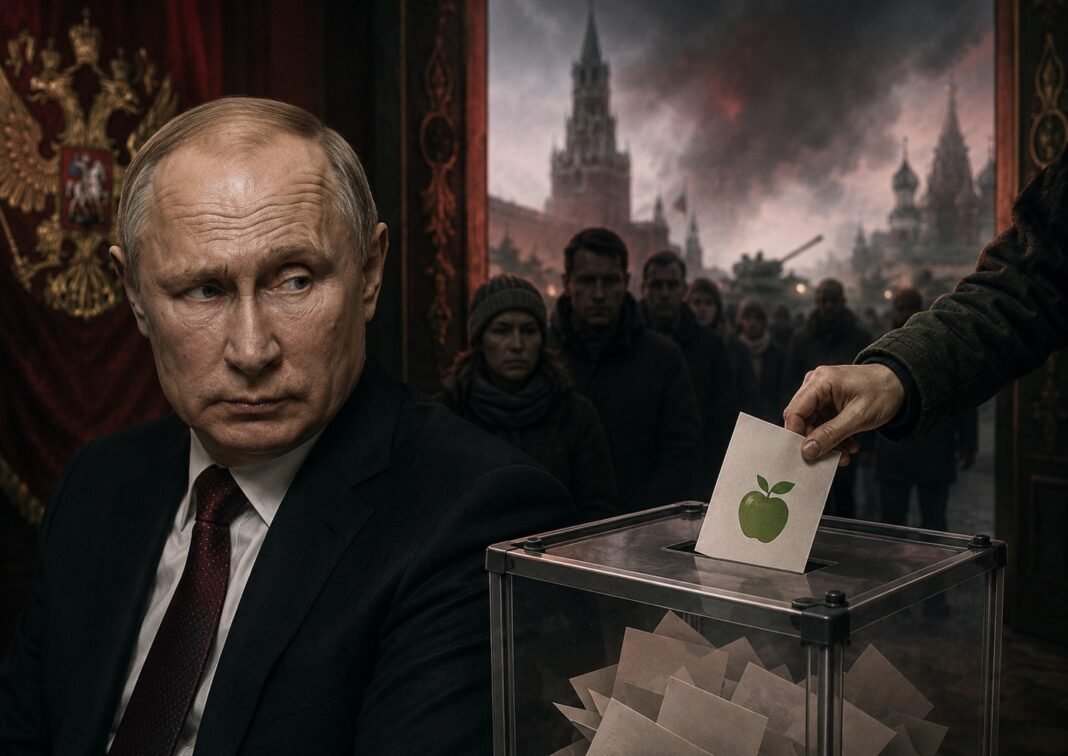
By AZE.US Editorial Team
Vladimir Putin has spent years cultivating the image of a leader who fears no one.
Russia has nuclear weapons, a vast security apparatus, a tightly controlled parliament, state television and an increasingly restricted political system. The Kremlin routinely presents Putin as a man willing to confront NATO, the United States and Europe without hesitation.
Yet the controversy surrounding the Yabloko party tells a very different story.
Russia’s Supreme Court on Aug. 10 canceled the registration of Yabloko’s federal list for the State Duma elections following a lawsuit filed by the Rodina party. Yabloko has appealed the ruling.
The most revealing part of the case, however, is not the legal technicalities.
It is the identity of the supposed threat.
Yabloko is not a revolutionary movement. It does not command millions of disciplined supporters. It has spent years on the margins of Russian electoral politics and has long been treated as little more than a symbolic home for liberal and anti-war voters.
And yet, suddenly, even Yabloko appears too dangerous to tolerate.
Why?
Because the Kremlin may no longer be afraid of Yabloko itself.
It may be afraid of giving Russians a clear way to vote against the war.
That distinction matters.
For years, Russia’s political system allowed limited competition precisely because the outcome remained predictable. Communists, nationalists, liberals and other parties could appear on the ballot as long as the basic architecture of power was never seriously threatened.
A confident authoritarian system can afford weak opponents.
An insecure one begins eliminating even symbolic alternatives.
The source material behind this argument points to a striking transformation: Yabloko, once a party accustomed to receiving around 1.5% of the vote, is now being treated as a potential political risk.
That should raise an obvious question.
If the overwhelming majority of Russians truly support the war, why not allow an anti-war party to run?
If support for the Kremlin’s course is as solid as state television claims, Yabloko should simply lose.
It might receive 1%, 2% or 3%.
Then the Kremlin could point to the result as proof of its legitimacy.
But when the state instead moves to narrow the ballot, it sends a different message: the authorities themselves may not trust the public consensus they claim exists.
This is where the word cowardice becomes relevant - not as a judgment about Putin’s personal courage, but as a description of political behavior.
Political courage means allowing citizens to make a choice even when the result cannot be completely guaranteed.
Political cowardice begins when a government with an army, nuclear weapons, intelligence services and near-total control over national television becomes frightened by a ballot paper.
The danger of Yabloko is therefore not necessarily Yabloko.
The danger is the possibility of a simple option appearing in front of Russian voters:
No.
No to the war.
No to permanent militarization.
No to the growing power of the security services.
No to the idea that Russia’s future can be decided only from above.
No to a political system in which elections exist mainly to confirm decisions that have already been made.
Nobody can know with certainty how many Russians would choose such an option in a genuinely competitive election.
That uncertainty is precisely what makes it dangerous to the Kremlin.
The underlying analysis goes even further, arguing that any legal anti-war option could potentially attract voters far beyond the traditional Yabloko electorate - people motivated less by loyalty to a particular party than by the opportunity to register opposition to the country’s current course.
The exact percentage is impossible to know.
But the larger principle is difficult to dismiss.
A government confident in its popularity does not need to fear counting votes.
Putin can threaten NATO.
He can boast about Russia’s weapons.
He can move armies across maps and describe the confrontation with the West as an existential struggle.
But there is a much simpler test of political confidence:
Put an anti-war party on the ballot and let Russians decide.
That is where the system suddenly appears much less fearless.
The contradiction is almost absurd.
The Kremlin says Russia can withstand the pressure of the entire Western world, yet it appears unwilling to risk even a modest opening for domestic electoral dissent.
It claims millions of Russians stand united behind the president, yet seeks to reduce the chances that those same millions will be offered a meaningful choice between war and peace.
It speaks constantly about national sovereignty while showing growing anxiety about the sovereign political choice of Russian citizens themselves.
The war was supposed to strengthen Putin’s system. According to the source analysis, the opposite has happened: repression has expanded, the security services have gained enormous influence, and even previously harmless opposition has become intolerable.
That is not what political strength looks like.
A genuinely strong government can survive criticism.
It can survive opposition parties.
It can survive losing seats in parliament.
And above all, it can survive citizens voting for someone else.
What authoritarian systems fear most is not always a famous dissident, a foreign government or a street protest.
Sometimes it is simply the moment when a voter stands alone with a ballot and realizes that there is an alternative.
That is why the Yabloko case matters far beyond the party itself.
The real question is no longer whether Yabloko can enter the State Duma.
The question is why a nuclear-armed state with one of the world’s largest security establishments should be afraid of letting its own citizens vote for a small party opposed to the war.
Perhaps because the Kremlin is considerably less certain about Russian support for the war than it wants the outside world - and Russians themselves - to believe.
If so, the Yabloko controversy is not primarily a story about the weakness of Russia’s opposition.
It is a story about the vulnerability of the system confronting it.
Putin may portray himself as a leader unafraid of presidents, armies or international pressure.
But if his political system cannot tolerate even the possibility of millions of votes against the war, there is one opponent the Kremlin may genuinely fear:
the Russian voter.
AZE.US