By AZE.US Editorial Board
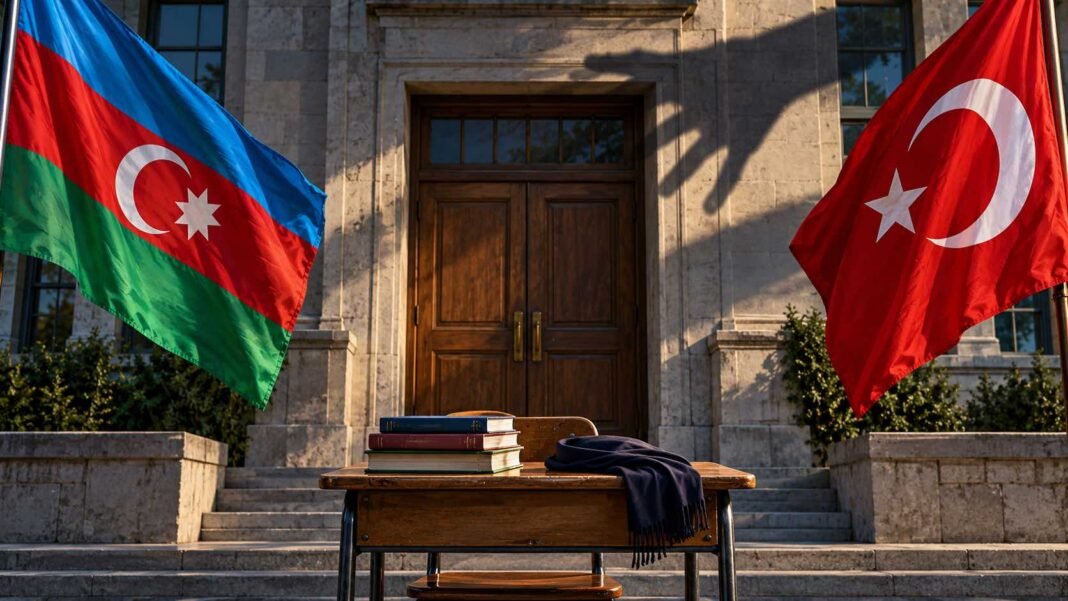
Azerbaijan-Turkey relations are undergoing a test of equality. A dispute over school dress has shown how readily some politicians are prepared to move from talk of brotherhood to public demands that a neighboring state change its domestic decisions.
When Turkish presidential adviser Oktay Saral speaks out against restrictions on religious clothing in Azerbaijani schools, his words carry the weight of his office. The response from the New Azerbaijan Party, which called such statements populist and irresponsible, drew a necessary boundary: The closeness of the two countries does not give Turkish officials authority to determine Baku’s education policy.
Azerbaijani citizens have the right to debate school uniforms. Parents have the right to ask questions, demand explanations and defend their children’s interests. But when a politician from another country enters that debate from a senior government position, he must understand the consequences of his words. He changes the scale of the dispute and gives an internal debate an external patron.
Brotherhood Requires Mutual Respect
The Azerbaijan-Turkey alliance is too important to be turned into a tool for ideological instruction. Its value lies in trust, cooperation and the ability to take a partner’s interests into account.
If Baku is required to prove its loyalty to brotherhood by carrying out the wishes of individual Turkish politicians, a dangerous substitution takes place. Azerbaijan’s right to make its own decisions becomes conditional: We support you only as long as you act as we believe you should.
That logic is destructive to any alliance. Today, the issue is school dress. Tomorrow, it could be relations with Israel, the content of textbooks or personnel decisions. Once an ally is granted a right of oversight, the boundaries of that right will begin to expand.
Turkish society, like Azerbaijani society, is not monolithic. The position of one adviser or lawmaker should not automatically be attributed to all of Turkey. But public officials have a special duty to choose their words carefully because their personal convictions can create problems between states.
Schools Must Not Become an Arena for Outside Politics
In the television report that framed this debate, the dispute over uniforms was already presented as part of a broader information confrontation: statements from abroad, protests outside diplomatic missions, emotional publications and the circulation of false claims.
The greatest danger in such escalation is that children gradually disappear from the discussion. Their education becomes an argument in an adult political confrontation. Some need angry parents, others need loud accusations, and still others seek views and influence.
A responsible approach requires returning the discussion to schools. How are the rules applied? Are they clear to families? How are disputed cases reviewed? How can a child’s education continue without exposing that child to humiliation?
The state must give clear answers to those questions. Consistent enforcement of rules and accessible appeal mechanisms strengthen its position far more than anger directed at anyone who disagrees.
Citizens’ religious beliefs deserve respect. They also should not become grounds for outside political forces to claim the right to speak for Azerbaijani families.
Baku Determines Its Relations With Israel
In the same report, tensions over school dress appeared alongside attacks on Azerbaijan’s cooperation with Israel. Combining these issues in public debate creates a particularly troubling picture: Baku is being challenged simultaneously over its domestic order and its foreign relationships.
Azerbaijan has its own security, economic and diplomatic interests. It is not obliged to reproduce Turkey’s foreign policy, just as Turkey is not obliged to copy Azerbaijan’s decisions.
Coordination is useful. A demand for political uniformity leads to dependency. Recognition of that distinction is especially important for two states that constantly emphasize the closeness of their relationship.
Support for Azerbaijan during difficult periods has been enormously important. But helping an ally does not create a permanent right to dispose of its independence.
Diplomacy Must Stop the Escalation
On Oct. 15, Azerbaijani President Ilham Aliyev received Turkish Foreign Minister Hakan Fidan. The official statement explicitly said the two sides exchanged views on developments recently observed in Azerbaijan-Turkey relations. The inclusion of that phrase shows that the issue has become the subject of interstate discussion.
This is where diplomacy must do its work: identify sensitive issues, explain positions and prevent public polemics from overwhelming cooperation.
Baku has reason to defend firmly its right to make independent decisions. Ankara has every opportunity to demonstrate that respect for that right is the foundation of the alliance. That requires restraint from officials and a refusal to mobilize public outrage against a partner.
It is also not in Azerbaijan’s interest to answer every provocation with generalizations about Turkey or the Turkish people. That only widens the dispute and helps those who want it to continue.
The meaning of the phrase “one nation, two states” lies in both parts. Common identity brings the countries closer. Statehood establishes responsibility and limits of authority.
Friendship with Azerbaijan requires respect for its independence even when some in Turkey dislike Baku’s decisions. It is precisely in such moments that the strength of brotherhood is revealed.
Vesti Baku
Original editorial: Vesti Baku.