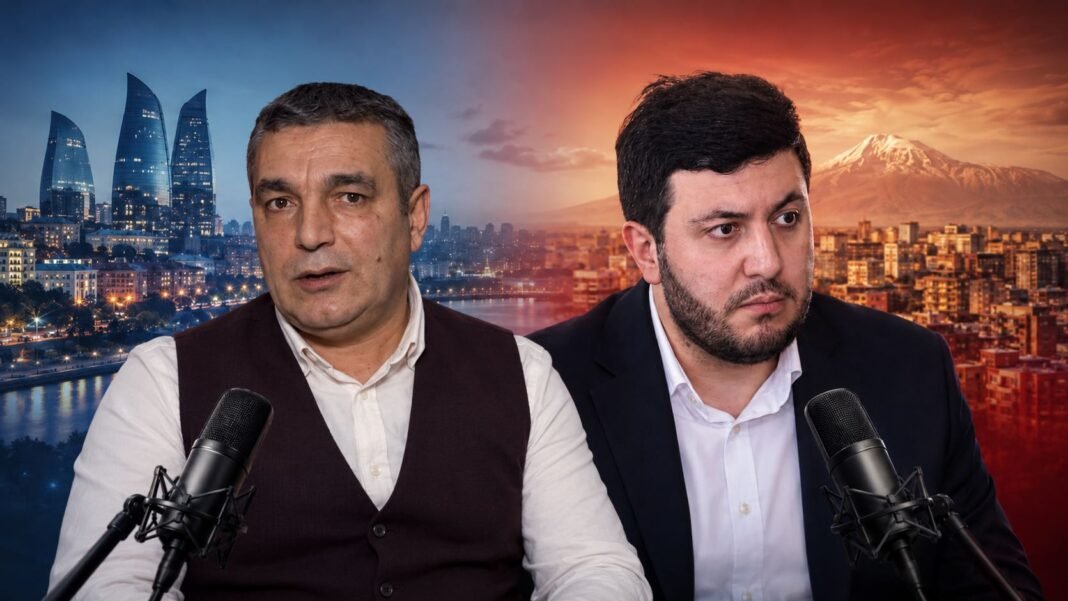
A possible break with Russia would force Armenia to restructure its economy, find new markets and reopen transport links, making completion of the Baku-Yerevan peace process more urgent, Azerbaijani economist Natig Jafarli said.
Jafarli made the comments during a Weekly Review discussion on Pressclubs TV with Armenian expert Areg Kochinyan. The two discussed the Trump Route for International Peace and Prosperity, or TRIPP, Armenia’s relations with Russia and prospects for regional peace.
Jafarli said the economic consequences of a sharp deterioration in Armenian-Russian relations would be significant because the dependence had developed over decades.
“It will be a painful transition or a painful divorce,” he said.
He said leaving Russia-led integration organizations would not automatically end Armenia’s trade with Russia. Azerbaijan and Uzbekistan, he noted, maintain economic relations with Moscow without belonging to the Eurasian Economic Union.
The main question, Jafarli said, is how quickly Armenia could broaden its network of trading partners.
“To restructure, you need communications, roads, new connections and new trading partners,” he said.
He linked that task to final normalization between Azerbaijan and Armenia, saying an unfinished peace process leaves outside powers with additional leverage in the region.
Kochinyan said he sees Armenian-Russian relations moving toward a rupture that could affect the economy, infrastructure, military cooperation and Armenia’s participation in Moscow-led organizations.
“In effect, Russia wants either everything or nothing,” Kochinyan said.
Kochinyan said possible Russian pressure through the EAEU could include restrictions on Armenian exports, creating conditions in which membership loses its economic value for Yerevan.
Jafarli said economic pressure could also have a domestic political aim: slower growth and worsening public sentiment could influence Armenia’s next election cycles.
TRIPP Construction Timeline
The experts also discussed implementation of TRIPP. Jafarli described progress on legal procedures as a positive sign but said the next major step should be the start of physical construction.
Kochinyan said work could begin around March if the creation of a joint company, preparation of technical documents and selection of contractors proceed without delays.
He said the railway and electricity-transmission components would be easier to build than the highway. On some sections, a road parallel to the railway would be complicated by the narrow strip of land between cliffs and the Araz River. A more northerly route has been discussed as an alternative, he said.
Both experts said reopening transport links and signing a peace agreement should be treated as separate processes.
Elections, Turkey and Europe
Kochinyan linked discussion of a possible early Armenian election to the need to secure a parliamentary majority before putting a new constitution to a referendum. Jafarli said such a strategy was possible but warned that any election carries risks, including for the peace agenda.
Jafarli also said some Azerbaijani media had misinterpreted references to 2031 as a decision to postpone a peace agreement until that year.
On Azerbaijan-Turkey relations, Jafarli said recent frictions would not develop into a serious confrontation between the allies. Kochinyan said opening the Armenia-Turkey border would help normalize Armenia-Azerbaijan relations, while acknowledging that Ankara would take Baku’s position into account.
The experts also pointed to growing European interest in South Caucasus transport routes. Jafarli said European investment in Central Asia increases the importance of links connecting that region to European Union markets. Kochinyan said European partners could participate in parts of TRIPP as regional communications begin operating.
Originally published in Russian by Vesti Baku.