By AZE.US Editorial Team
The first train between Azerbaijan’s mainland and Nakhchivan would be more convincing evidence of normalization than another declaration that peace is drawing closer. But only on one condition: It must be followed by a second train, a third and a hundredth, without political bargaining, sudden restrictions or dependence on the next crisis in Yerevan.
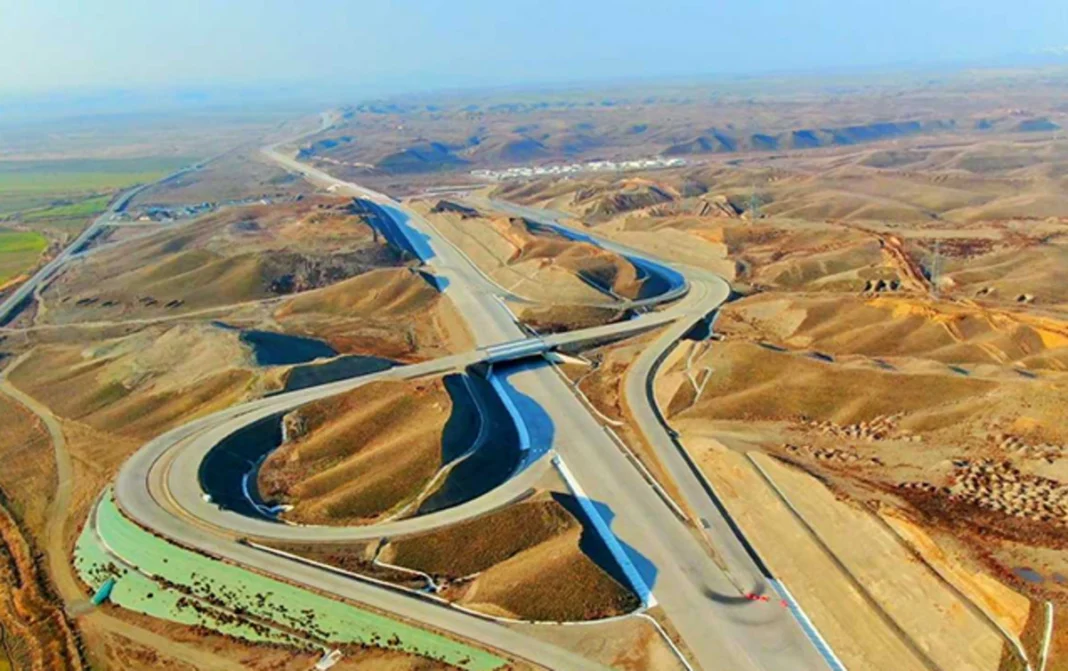
That is the central question surrounding the Zangezur route and the Trump Route for International Peace and Prosperity, or TRIPP. Building the road is not enough. The parties must agree on how it will operate, who will be responsible for carrying out the commitments and what will happen if one side tries to turn transit into an instrument of pressure.
Sovereignty and Reliability Must Work Together
The published U.S.-Armenia framework agreement explicitly preserves Armenia’s sovereignty and jurisdiction over project areas on its territory. The involvement of an American company does not by itself transfer state powers to that company.
Recognizing sovereignty, however, does not settle the question of reliable access.
For Azerbaijan, the route to Nakhchivan has special importance because it would connect two parts of the same country. Baku is entitled to seek an arrangement under which a carrier knows the transit conditions in advance and passengers do not become hostages to political disagreements.
These goals are compatible. A state can retain jurisdiction while accepting specific transit commitments. But the obligations must be written clearly enough that they cannot be reinterpreted arbitrarily after a change of government or another deterioration in relations.
It is unacceptable to use the word “sovereignty” as a justification for arbitrary action while leaving the term “unimpeded” without a clear meaning.
An American Operator Is No Substitute for an Agreement
It matters who will meet passengers or receive a carrier’s documents. Electronic data exchange, advance clearance and service through an operator could reduce opportunities for conflict.
An American nameplate, however, will not automatically solve the problem.
If a company services the route while its operating rules can be changed at any moment by political decision, the dependence remains. Only the interface changes.
Baku therefore needs practical answers: How long will procedures take? What are the grounds for inspection or refusal? How can fees be changed? Under what conditions may traffic be suspended temporarily? A dispute-resolution mechanism is also needed that can produce a result before delayed cargo loses its commercial value.
These are proposals for structuring the future link, not a claim that such guarantees have already been agreed.
The less room the documents leave for arbitrary decisions, the less the project will have to depend on personal trust between leaders.
Peace Cannot Be Deferred From One Political Cycle to the Next
On Oct. 22, Armenian Prime Minister Nikol Pashinyan said a peace treaty could be signed in 2027 or 2028. He explained that his earlier reference to 2031 reflected the government’s five-year mandate rather than a confirmed signing date. The 2027-2028 period is therefore a political target identified by the prime minister, not a guaranteed timetable.
For the region, however, the habit of discussing peace in terms of years of further waiting has itself become a problem.
Baku is demanding the removal of constitutional language that it considers a basis for territorial claims. Yerevan disputes that interpretation and says constitutional reform is an internal matter. Pashinyan has even raised the possibility of an early election to advance the constitutional agenda.
Armenia’s domestic political difficulties are real, but they cannot indefinitely substitute for carrying out agreements. If the authorities link the country’s future to regional peace, they will have to explain to the public both the specific cost of further delay and the concrete benefits of opening transport connections.
The Test Will Be Daily Operations
The Armenian parliament is scheduled to debate ratification of the U.S.-Armenia TRIPP framework agreement on Oct. 27. That is an important stage, but a parliamentary procedure is not the same as an operating route.
American participation should not be treated as permanent insurance. Washington’s interest may support the project, attract investment and raise the political cost of disrupting it. But the route’s durability must rest on agreements, economic demand and functioning institutions that can survive changes of administration.
Baku also needs to measure success by results. A formula that sounds like a diplomatic victory will mean little if carriers face uncertainty and delays.
The key to the Zangezur route should lie in agreed rules that bind every participant.
Peace will become more durable when stopping a train because of a political dispute is harder than allowing it to pass.
This editorial is the English counterpart of the Vesti Baku editorial.