Aze.US
Nearly four years after the start of the war in Ukraine, the strategic question is no longer what Moscow hoped to gain, but what it has already lost.
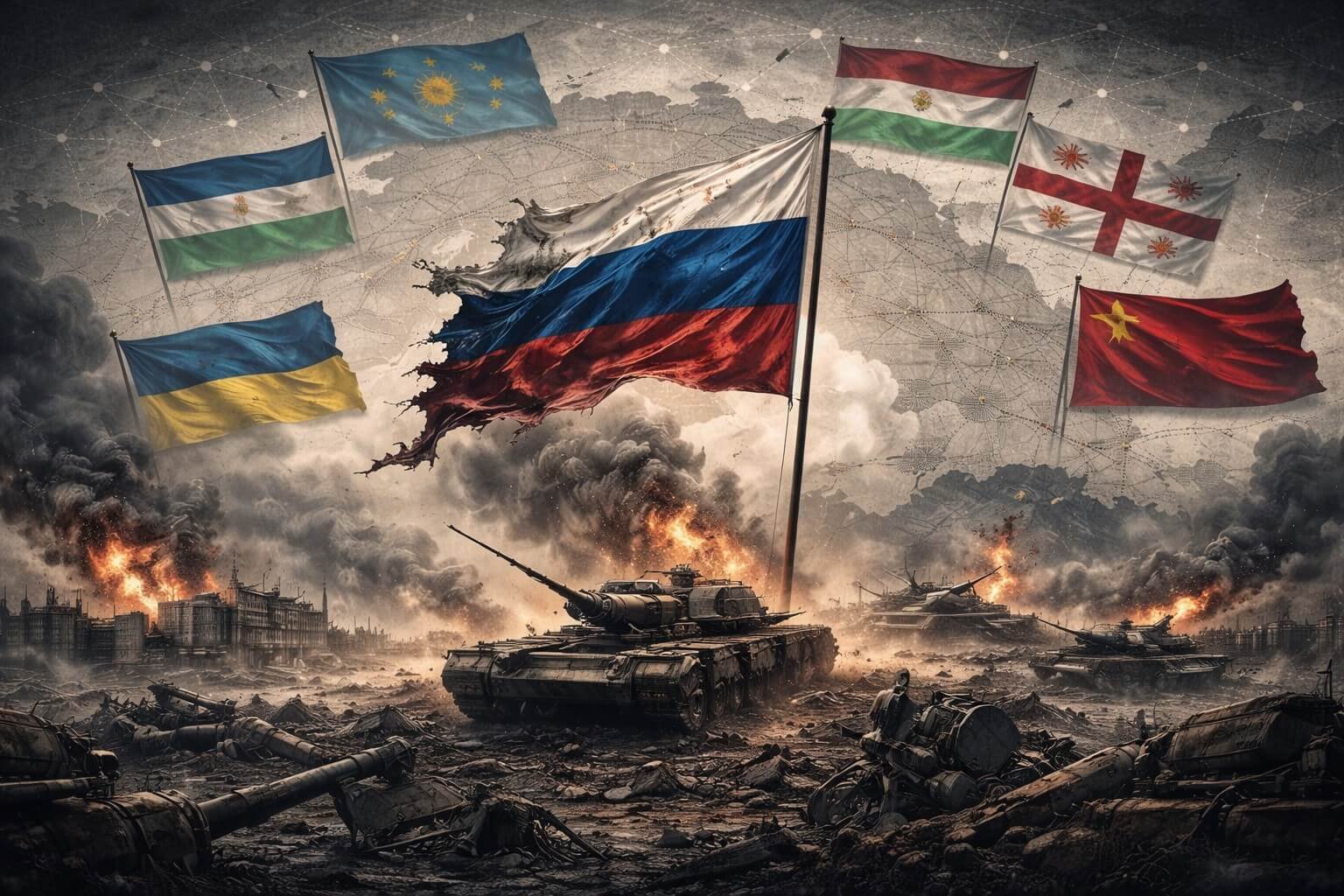
The answer is becoming increasingly clear: beyond battlefield costs, Russia is steadily losing influence across the geopolitical space that once formed its uncontested periphery.
The South Caucasus No Longer Revolves Around Moscow
For decades, Russia functioned as the primary security arbiter in the South Caucasus. Questions of war and peace, borders, negotiations, and transport routes ultimately passed through Moscow’s political filter.
The war in Ukraine changed that hierarchy.
Military focus, financial resources, and political attention concentrated on a single фронт. Everything outside that theater began to drift.
What followed was not a dramatic rupture but a gradual realignment. Regional actors started searching for alternative balances – through Türkiye, Western engagement, and growing self-reliance.
Influence was not taken from Russia overnight. It simply stopped being exclusive.
Central Asia Is Quietly Hedging Its Future
Far from the headlines, Central Asian states are accelerating structural shifts:
-
transport corridors that bypass Russian territory
-
diversified energy and trade links
-
increasingly multi-vector diplomacy
This is not open defection. It is strategic insurance.
History shows that such quiet adjustments often reshape geopolitics more profoundly than loud declarations.
The Paradox of Great-Power Status
Perhaps the most striking image of the current moment is symbolic rather than military.
The world’s second nuclear power now measures battlefield progress in the capture of small settlements that previously held no strategic meaning in grand doctrine or political rhetoric.
This is not a media narrative. It is a question of historical scale.
When the horizon of strategy narrows to trench lines, the surrounding geopolitical space inevitably begins to move on its own.
A War Without Visible End
The central strategic problem is not sanctions, casualties, or even territory. It is the absence of an endpoint.
No rapid victory.
No stable peace.
No clear resolution.
Long wars rarely conclude with triumph. More often, they end in exhaustion and redistribution of influence.
That redistribution is already underway around Russia’s borders.
What This Means in Structural Terms
Major powers do not always lose position through decisive defeat. More often, erosion occurs during prolonged conflicts without resolution.
The South Caucasus is drifting from its traditional orbit.
Central Asia is expanding strategic autonomy.
Regional alignments are adjusting faster than the war itself is evolving.
The most consequential losses, in other words, may occur not on the battlefield,
but in the geopolitical space left unattended while the war continues.