AZE.US
The South Caucasus is entering a new political phase, with the United States expanding its regional role while Russia increases pressure on Armenia ahead of a critical election.
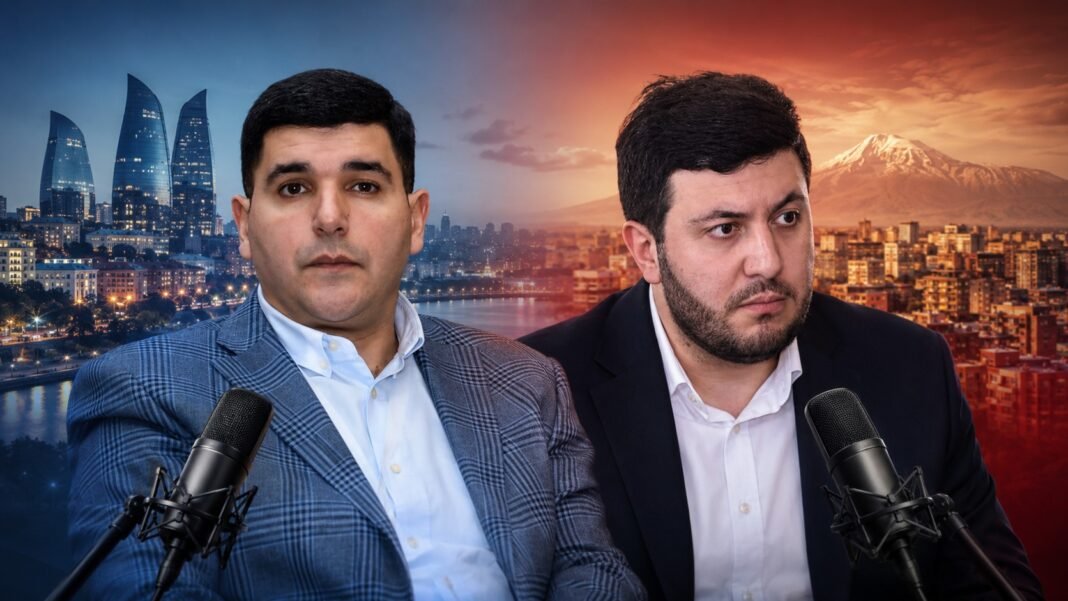
That was the central theme in a new edition of “Events of the Week” on Press Clubs TV, where Farhad Mammadov from Baku and Areg Kochinyan from Yerevan discussed transport routes, Armenia’s military parade, U.S.-Armenia documents, the TRIPP project, the Eurasian Economic Union and Moscow’s pressure on Yerevan.
One of the first topics was the reported opening of the Akhalkalaki-Kars railway route for exports from Armenia and imports into Armenia.
Mammadov said the opening of borders with Armenia would require more than a political decision. It would also need roads, border checkpoints, customs infrastructure and bureaucratic preparation.
He noted that the Georgian section of the railway has special regional importance because it was financed by Azerbaijan and is operated by an Azerbaijani-Georgian company. In his view, the step fits into the wider peace agenda and the gradual moves being taken in the region.
Kochinyan said the current trade format through Georgia should not be seen as a breakthrough. He described it instead as Turkey synchronizing its approach with Azerbaijan.
According to Kochinyan, Ankara is likely to continue coordinating its steps toward Armenia with Baku. He also pointed to Armenian Prime Minister Nikol Pashinyan’s remarks about restoring northern railway links, including the Ijevan-Kazakh direction and a possible Kars-Gyumri-Vanadzor-Kazakh route.
That, he said, would inevitably bring back the question of Russia’s railway concession in Armenia. If Armenia moves seriously toward rebuilding those routes, the current concession framework may no longer remain untouched after the election.
The two analysts also discussed Armenia’s military parade. Mammadov said Azerbaijan followed the event closely, especially the weapons displayed.
He said the most interesting point for Azerbaijani experts was not only Western or Indian-made equipment, but also the presence of Iranian-origin weapons. That, he said, raises questions about how Armenia plans to balance defense cooperation with the United States and France while also operating Iranian systems.
Kochinyan described the parade mainly as a domestic political event. In his view, the Armenian government was showing the public how major defense spending in recent years had been used.
He also stressed one political message from the parade: Armenia’s leadership said the armed forces would defend the country’s territorial integrity within its internationally recognized borders and would not be used outside that territory.
The discussion then turned to U.S. Secretary of State Marco Rubio’s visit to Yerevan and the documents signed by Armenia and the United States.
Mammadov said Baku had studied the documents closely. He described the upgrade in U.S.-Armenia relations as the formalization of a process that has been building for 18 to 24 months.
He said the new framework gives longer-term structure to Washington’s role in Armenia and the South Caucasus. He highlighted critical minerals, border management and transport as areas that now require closer attention from Azerbaijan.
Mammadov also linked the documents to broader U.S. interest in the South Caucasus and Central Asia, including trans-Caspian projects, energy routes and east-west connectivity.
Kochinyan said the reference to the Kars-Gyumri railway should be read mainly in political terms. Washington, he said, has long been interested in opening the Armenia-Turkey border, and that issue is now returning as part of a larger American strategy in the region.
He described the new comprehensive strategic partnership between Armenia and the United States as a step beyond previous formats. According to him, the document gives more space to security, border management, military education and defense cooperation.
Kochinyan also focused on TRIPP, the Trump Route for International Peace and Prosperity.
He said the project appears to offer a technical answer to the issue of “unimpeded” movement through simplified procedures, electronic declarations and a division between a service “front office” and Armenian state bodies that would retain decision-making authority.
In his view, Washington does not see TRIPP only as a route between mainland Azerbaijan and Nakhchivan. It also sees the project as part of a wider trans-Caspian logic linking Central Asia, the Caspian Sea, the South Caucasus, Turkey and Western markets.
The final part of the discussion focused on Armenia’s strained relations with Russia and the Eurasian Economic Union.
Mammadov said Moscow appeared to have pushed for a tough message toward Armenia at the EAEU level. But he said Russia is unlikely to immediately use the gas lever against Yerevan, because doing so could trigger a deeper break and weaken Russia’s own economic presence in the region.
He said Moscow currently appears to be targeting specific political and business circles linked to Armenia’s authorities rather than the whole country. Gas, in his view, remains a last-resort instrument.
Kochinyan agreed that the pressure has a clear pre-election context. He said Moscow’s next steps would depend heavily on the result of Armenia’s vote.
He argued that Russia’s maximum goal would be to prevent Pashinyan from being re-elected. Its minimum goal, he said, would be to secure at least one-third of Armenia’s parliament for pro-Russian forces, enough to block a possible constitutional referendum.
Kochinyan also made a distinction between Russia and the EAEU. He said the trade restrictions and pressure measures so far have come mainly from Moscow on a bilateral basis, not from the union as an institution.
The discussion showed how transport, energy, security and elections are now part of one regional equation.
The United States is building a more institutional presence in the South Caucasus. Turkey is moving in coordination with Azerbaijan. Russia is trying to preserve leverage over Armenia through trade, infrastructure, energy and political pressure.
For Baku, the shift matters not only because of Armenia’s internal politics, but because the same transport and security projects will define the next stage of the regional order.
AZE.US