AZE.US
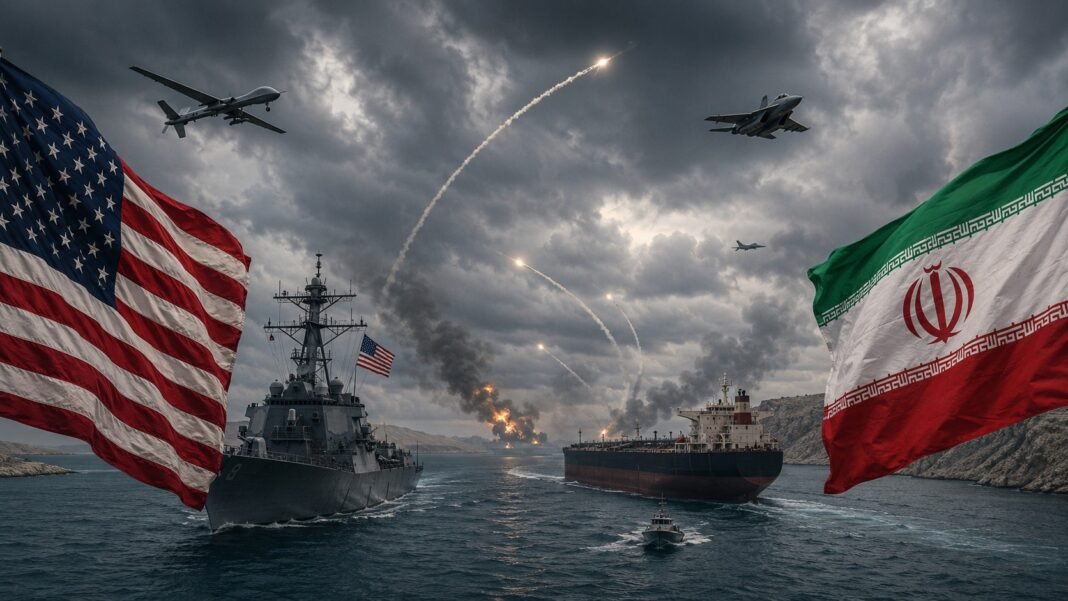
The United States and Iran traded new military blows around the Persian Gulf, deepening a conflict that has already shaken regional security and pushed oil markets higher.
AP reported that Iran fired missiles toward Kuwait and Bahrain after signs that peace efforts were faltering. According to the U.S. military, two missiles launched toward Kuwait broke apart in flight, while missiles aimed at Bahrain were intercepted by U.S. and Bahraini forces.
Washington then carried out a strike on an Iranian military control station on Qeshm Island, near the Strait of Hormuz, one of the world’s most sensitive shipping corridors.
Iran’s Islamic Revolutionary Guard Corps said it had targeted the headquarters of the U.S. Fifth Fleet in Bahrain, an airbase and helicopters in another regional country, according to Reuters and Iranian media reports.
The IRGC said the attacks were retaliation for what it described as a U.S. strike on Iranian infrastructure south of Qeshm Island. It also claimed its navy targeted a vessel identified as Panaya after an alleged U.S. projectile strike damaged the engine room of an Iranian tanker near the Strait of Hormuz.
The competing claims underline how fragile the situation has become. Each side says it is responding to the other. Each side is also trying to frame the latest escalation as defensive rather than a deliberate widening of the war.
Diplomacy is moving, but barely.
Reuters reported that Iran is reviewing a possible agreement to halt the war, while Iranian media said communication with Washington had paused. U.S. President Donald Trump rejected that account and said talks were continuing.
Secretary of State Marco Rubio told Congress that Washington is not offering sanctions relief simply in exchange for reopening the Strait of Hormuz. He said any easing of sanctions would have to be tied to Iran’s nuclear program.
That leaves the crisis stuck between two tracks: military escalation at sea and a diplomatic process that neither side appears ready to abandon completely.
The economic pressure is also rising. Reuters reported that Brent crude climbed to $96.81 a barrel, while U.S. West Texas Intermediate reached $94.67, as traders reacted to fresh hostilities and uncertainty around the Strait of Hormuz.
The strait remains the key pressure point. Any sustained disruption there would carry consequences far beyond the Gulf, affecting energy prices, shipping routes and the broader global economy.
For now, the latest exchange suggests that the war has not broken out of control, but it is also not moving clearly toward settlement. The Gulf is again in the familiar and dangerous space between negotiation and escalation, where one failed interception or one misread strike can change the whole direction of the conflict.
AZE.US