By AZE.US Editorial Team
Armenia is moving away from Russia faster than at any point in recent memory. The harder question is where exactly it is going - and how much the transition will cost.
In recent days, Yerevan became one of Europe’s main political stages. Armenia hosted the European Political Community summit, followed by the first-ever EU-Armenia bilateral summit. For Prime Minister Nikol Pashinyan, it was a powerful image: European leaders in Yerevan, French President Emmanuel Macron at his side, and repeated statements about partnership, investment and Armenia’s new role.
Symbolically, it looked like a historic shift. Europe is openly backing Yerevan, speaking about connectivity, infrastructure, digital projects, resilience and democracy. Billions of euros in investment promises are being discussed.
But politics does not end with a strong photograph.
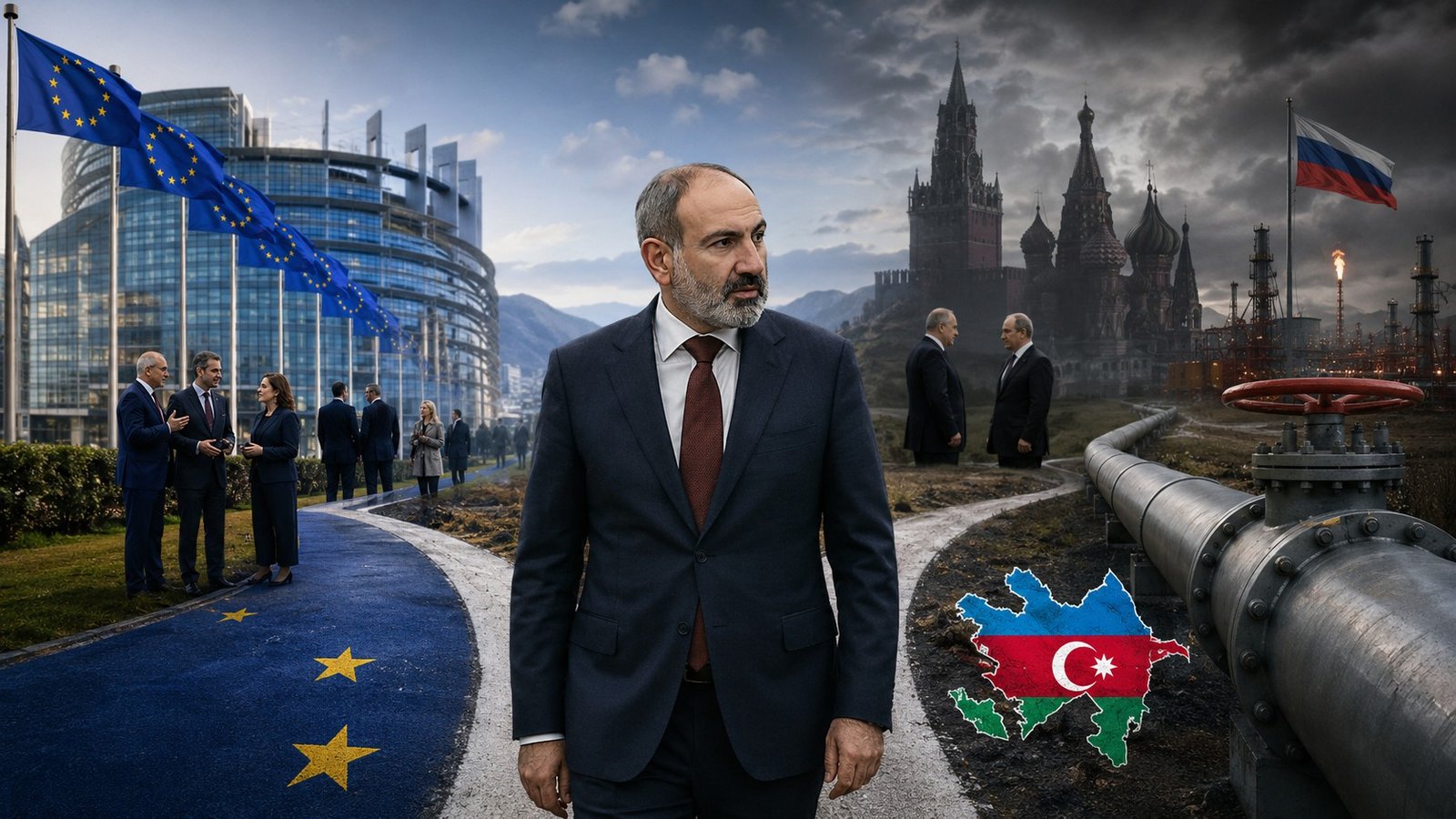
Pashinyan now has a European showcase. Armenia, however, still has a Russian utility bill.
That is the central tension. Yerevan can speak about a European future, host EU leaders and try to move out of Russia’s shadow. But Armenia still receives gas from Russia. Trade ties with Moscow remain important. Armenia remains a member of the Eurasian Economic Union, even as its political direction increasingly points westward.
Moscow understands this. That is why Russia’s response is not limited to diplomatic statements. It is also a reminder of the price of old dependence.
Cheap Russian gas is not just an economic factor for Armenia. It is leverage. The closer Yerevan moves toward Brussels, the more often that leverage will be displayed.
Pashinyan wants European legitimacy, political protection from Russian pressure and external support ahead of a difficult domestic period. But such choices usually come with a bill. Sometimes not immediately. Sometimes through tariffs, markets, migration channels, logistics, borders, internal protests or energy conditions.
Yerevan is not simply trying to sit on two chairs. It is trying to move from one chair to another without falling between them.
Russia has already made clear that it does not like this balancing act. Ukrainian President Volodymyr Zelenskyy’s appearance in Yerevan became a separate irritant for Moscow and produced another round of diplomatic tension. For Pashinyan, the episode was especially uncomfortable: he wanted Armenia to look like a new European platform, but instead received another clash with Russia.
The question is no longer whether Pashinyan is tired of Moscow. The harder question is whether Armenia is ready to pay the full price of the shift.
Europe knows how to make attractive promises. It can offer money, experts, programs, missions, statements and political images. It can help with cybersecurity, reforms, election monitoring and infrastructure projects.
But none of that equals security guarantees.
If Moscow decides to pressure Armenia seriously - through gas, markets, migration channels, pro-Russian forces, military presence or economic tools - Brussels is unlikely to quickly replace the entire Russian system of influence.
That is the hard reality for Yerevan.
For decades, Armenia lived inside Russia’s security, economic and energy architecture. Pashinyan is now trying to exit that system without a sharp collapse, without a domestic explosion and preferably under European applause. That is rarely how such transitions work.
Armenia’s European turn accelerated after Yerevan became convinced that Russia would not save the Armenian side in Karabakh. But there is a painful paradox. Russia did not save Armenia where Yerevan expected protection, yet Russia can still create problems where Yerevan wants independence.
Pashinyan appears to be betting that Moscow is overloaded by the war against Ukraine and cannot punish Armenia too harshly. There may be some logic in that calculation. But it remains a risky one. A weakened Russia is not the same as a Russia without tools.
Against this background, Pashinyan’s continued break with the old Karabakh ideology is especially important. His remarks describing the movement for Karabakh’s unification with Armenia as a fatal mistake show that he understands one thing clearly: without abandoning revanchism, Armenia cannot secure peace, open borders or a real place in new regional routes.
For Baku, that is an important signal. For Armenian domestic politics, it is a major risk.
The further Pashinyan moves away from Russia and the old Karabakh agenda, the louder his opponents will say that he has surrendered everything: Karabakh, the alliance with Moscow, security and the old identity. That is why European support is not only foreign policy for him. It is also part of an internal political struggle.
Macron in Yerevan, European leaders in Yerevan, Zelenskyy in Yerevan - all of this was meant to show Armenian voters that Pashinyan is not alone and that Europe stands behind him.
But voters may ask a simpler question: who will pay for the gas?
Slogans cannot answer that.
Armenia has every sovereign right to seek a European future. But a European future for a landlocked country with deep energy dependence on Russia and difficult geography cannot be built in a single summit.
Geography does not change with applause. An economy does not transform after Macron sings. A gas pipeline does not disappear after a statement about democracy.
Pashinyan is not really choosing between “good Europe” and “bad Russia.” His real choice is sharper: cheap dependence or expensive independence.
Russian gas is cheaper. European freedom is more expensive.
If Armenia has truly decided to move toward Europe, it will have to admit that the price will rise. Not only in tariffs, but also in political risks, Russian pressure, domestic conflict, the need to finally close the Karabakh chapter and the end of waiting for an outside savior.
Pashinyan can win this round if he honestly explains the cost of transition to society. But if the European course is sold as a celebration without a bill, disappointment will come quickly.
For now, Armenia looks like a country that has left the Russian room but has not yet found a European home. It is standing in the corridor - holding European promises in one hand and facing a Russian gas meter behind its back.
AZE.US