AZE.US
The growing visibility of LGBT issues in Western politics, media and entertainment has fueled renewed debate in Azerbaijan over traditional family values, national identity and the influence of foreign cultural trends on younger generations.
The discussion intensified after Dutch Prime Minister Rob Jetten traveled to Turkey without his fiancé. The absence drew international media attention and revived wider debate over openly gay politicians holding senior government positions in Europe.
Jetten is not the first European politician to publicly identify as gay while serving in a senior state role. Former Luxembourg Prime Minister Xavier Bettel, former Irish Prime Minister Leo Varadkar and former Belgian Prime Minister Elio Di Rupo are among the most prominent examples.
In recent years, LGBT themes have also become increasingly common in films, television series, advertising and content distributed by major streaming platforms, including Netflix.
Supporters describe this trend as broader representation of different social groups. Critics, however, argue that it forms part of a wider ideological campaign that could weaken the traditional family and reshape established social norms.
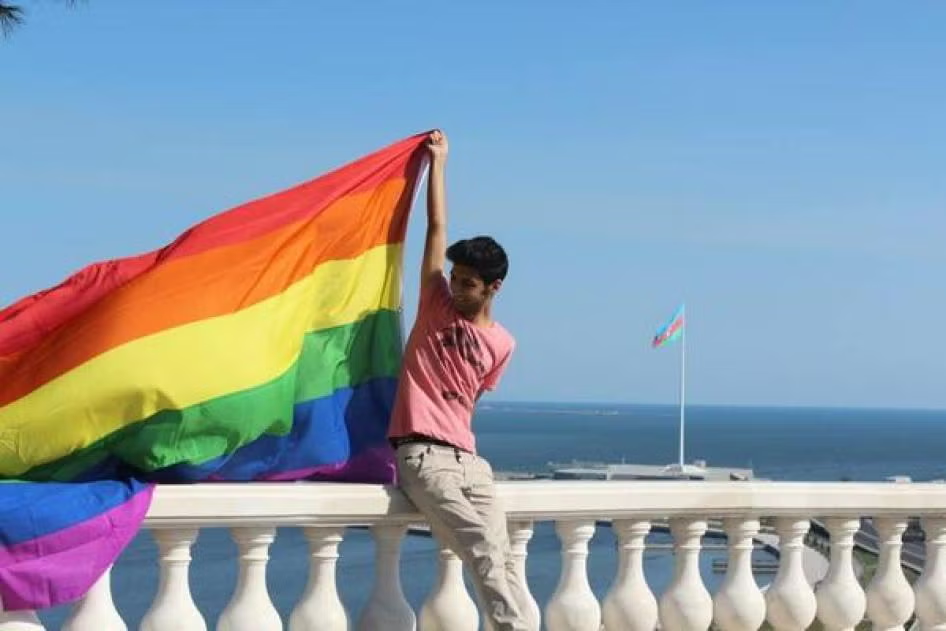
The issue has also periodically surfaced in Azerbaijan. Attempts to display LGBT symbols in public spaces, slogans voiced during some demonstrations and the spread of related content on social media have triggered strong reactions from parts of society.
Critics are particularly concerned about the possible impact of such content on children and teenagers.
Political analyst Zuriya Garayeva said the election of openly gay politicians to senior positions reflects the growing separation of private life from political activity in Western democracies.
“In a number of European countries, voters pay more attention to a candidate’s governing abilities, economic program, security policy and social agenda than to their sexual orientation,” she said.
According to Garayeva, the presence of openly gay politicians in parliaments and governments reflects the application of legal equality and anti-discrimination principles in Western political systems.
She noted, however, that the issue remains highly controversial even in Western countries.
“Many political parties and public groups support the expansion of LGBT rights, while conservative forces argue that this affects the institution of the family and traditional values,” Garayeva said.
She added that openly presenting the private lives of such politicians has become not only a matter of personal choice, but also part of a broader struggle over political and cultural values.
Garayeva said the issue remains one of the main ideological conflicts between supporters of equality and inclusion and those defending traditional social norms.
Elchin Bayramli, chairman of the Healthy Society Movement, took a much more critical position.
He argued to globalinfo.az that international ideological trends are placing growing pressure on the traditional family, national moral values and the established way of life of different societies.
“Various financial, media and communication resources are being used in this direction,” Bayramli said. “Societies must pursue a more active policy to protect national and moral values, the institution of the family and the healthy upbringing of the younger generation.”
He said the promotion of ideological views related to biological sex, family models and moral values among children and teenagers has become a serious public concern in many countries.
“Azerbaijan must proceed from its own national interests in this matter,” Bayramli said. “The political course of the state is aimed at developing the country on the basis of national and moral values.”
He called for the preparation of a comprehensive state program to protect traditional values.
According to Bayramli, schools, media organizations, cultural institutions and civil society groups should coordinate their work in this area.
He also urged stronger measures to protect children from harmful content on television and digital platforms.
“Legal measures should be taken against destructive propaganda that could weaken national identity, the institution of the family and moral values,” he said.
Bayramli argued that the upbringing of young people in the spirit of patriotism, Azerbaijani identity and national values should remain a state priority.
He said government institutions, the media, civil society and families must work together to protect Azerbaijan’s national interests and moral foundations.
AZE.US