AZE.US
The peace process between Azerbaijan and Armenia is moving, but it has not yet reached the point where peace feels irreversible.
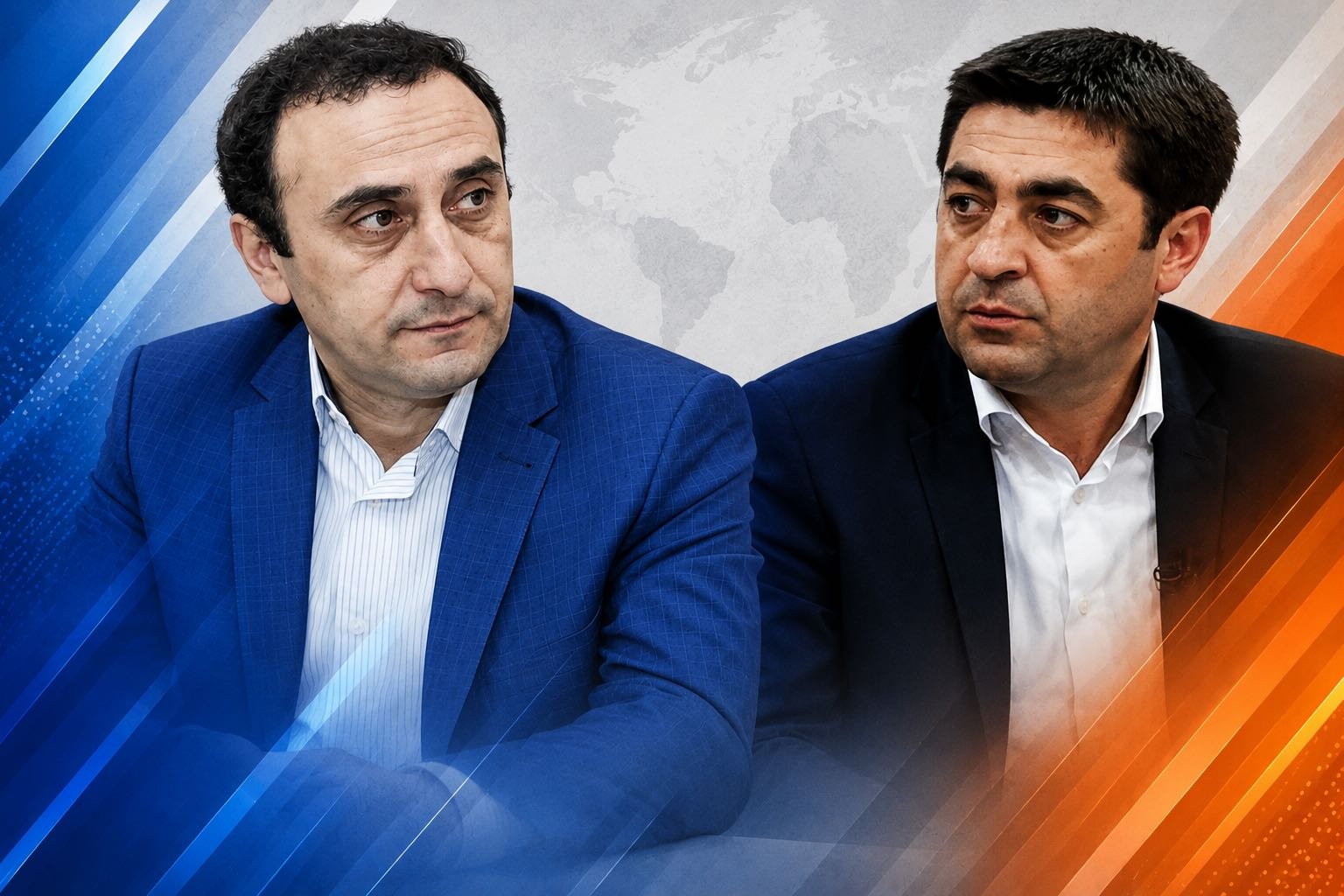
That was the central impression from a wide-ranging discussion on Echo Baku between Arsen Kharatyan, a conflict analyst and head of the Lava Media project, and Rizvan Huseynov, historian and director of the Center for Caucasus History. The conversation was not framed as a formal diplomatic debate. It quickly moved into the harder territory behind the official statements: trust, public opinion, the role of outside powers, the phrase “Western Azerbaijan,” the Zangezur route and even the names used for cities and regions.
Kharatyan struck a cautious note from the start. In his view, the two countries have not yet crossed a point of no return in the peace process. What exists today, he suggested, is the absence of war - and that is not the same thing as peace.
That distinction matters. A ceasefire, a quiet border or a diplomatic track can reduce the risk of renewed fighting, but they do not automatically create trust between societies that have lived through decades of conflict. Peace, in this sense, is not only a document. It is a political and social habit that has not yet fully formed.
Huseynov approached the issue from a different angle. He argued that the main breakthroughs since 2020 came when Baku and Yerevan spoke directly, without outside actors shaping the agenda. In his assessment, many foreign mediators were less interested in resolving the conflict than in managing it - keeping it alive in a controlled form that preserved their influence in the South Caucasus.
That argument reflects a broader Azerbaijani reading of the postwar period: the region can only become more stable if its two central actors negotiate directly and stop outsourcing their future to Moscow, Paris, Brussels or Washington. For Baku, the bilateral format has become more than a diplomatic preference. It is a test of regional agency.
Yet direct dialogue does not make the difficult questions disappear.
One of them is Armenian public opinion. Asked whether Armenian society is ready for peace with Azerbaijan on the basis of mutual recognition of territorial integrity, Kharatyan avoided speaking on behalf of the entire country. He said the mood inside Armenia is not uniform and that upcoming political processes will show how much support there is for the peace agenda promoted by the current government.
His point was important: even support for Prime Minister Nikol Pashinyan does not necessarily mean full public acceptance of every part of his policy on Karabakh. For many Armenians, the issue remains emotionally charged, and no political statement can instantly remove that burden.
The discussion then turned to one of the most sensitive phrases in the current debate - “Western Azerbaijan.” For many in Armenia, the term sounds less like historical memory and more like a political threat. Kharatyan said such language does not help the peace process and warned that if both sides want a durable settlement, they will need to be more careful with words that deepen fear on the other side.
Huseynov offered a different reading. He said the phrase is connected to the memory of Azerbaijanis whose families were displaced, expelled or forced to leave the territory of present-day Armenia in different periods of the 20th century. He also argued that Azerbaijan’s actions matter more than rhetoric: if Baku had wanted to pursue a military scenario toward Zangezur in 2021 or 2022, he said, it had opportunities to do so but did not.
This is where the peace process enters a more complicated zone. Azerbaijanis have memories of homes in Armenia. Armenians have memories of homes in Azerbaijan. Neither society can simply be told to forget. But if every memory becomes a political instrument, the room for compromise narrows quickly.
The same problem appears in the dispute over place names.
Khankendi or Stepanakert. Shusha or Shushi. Yerevan or Irevan. Zangezur or Syunik. These are not just words in the South Caucasus. They carry identity, grievance and political claims.
Kharatyan said that for Armenians, Stepanakert will remain Stepanakert and Artsakh will remain Artsakh. At the same time, he acknowledged that language in conflict settings is loaded and can irritate the other side. Huseynov said no one can impose one vocabulary on people who carry inherited memories of place, though he suggested that names from the Soviet period, especially those associated with Bolshevik figures, should be discarded.
The exchange revealed a deeper truth: peace between Baku and Yerevan will not be built only through border delimitation, transport agreements or summit communiques. It will also depend on whether both societies can develop a language that does not reopen the conflict every time it is used.
Outside powers were another dividing line in the discussion.
Huseynov sharply criticized France and parts of the U.S. Democratic establishment, saying their actions at different stages complicated the negotiation process and gave Russia a chance to reinsert itself into the region. Kharatyan pushed back against a sweeping version of that argument, recalling that active negotiations between the Armenian and Azerbaijani foreign ministers also took place in Washington during the Biden administration.
This disagreement reflects two different experiences of the same diplomatic landscape. From Baku, many Western statements about Karabakh, displaced Armenians or the former Armenian population of the region are seen as attempts to return a closed issue to the international agenda. From Yerevan and parts of the Armenian diaspora, some of the same language is presented as humanitarian or political advocacy.
For the peace process, however, the result is often the same. Every statement from Paris, Brussels, Moscow or Washington can be turned into domestic ammunition by forces that do not want normalization to move forward.
The Zangezur route was another key part of the debate. Some experts have argued that recent crises around Iran may slow or undermine the project. Both speakers, however, leaned toward the opposite conclusion.
Kharatyan said the process could face delays in the short term, especially if the issue is no longer a top U.S. foreign-policy priority. But he also suggested that if Iran remains unstable or difficult for Western investment and strategic access, a route bypassing Iran may become more important.
Huseynov went further. He argued that the road through Zangezur has become even more relevant, not less. In his view, Iran will be focused for years on the Persian Gulf and the Strait of Hormuz, making the South Caucasus a secondary direction for Tehran. He also framed the route as part of a wider transport logic linking Azerbaijan, Nakhchivan, Türkiye, Kars, Black Sea ports and broader regional trade.
For Azerbaijan, the route is not only about access to Nakhchivan. It is about positioning the country inside a larger east-west transit architecture. Even if one format slows down, the idea itself is unlikely to disappear.
The Echo Baku discussion showed that the Armenia-Azerbaijan peace process is now operating on several levels at once. There is the official track, where leaders and diplomats discuss documents. There is the security track, where transport routes, borders and outside powers matter. And there is the social track, where words, memories and unresolved grief can still pull both societies backward.
The war no longer dictates every move. But peace has not yet become normal.
For that to happen, Baku and Yerevan will need more than signatures. They will need a direct conversation that can survive disagreement - including disagreement over Karabakh, Zangezur, history and names. That is the harder test. And for now, the region is still somewhere between the end of war and the beginning of a real peace.
AZE.US