By AZE.US Editorial Team
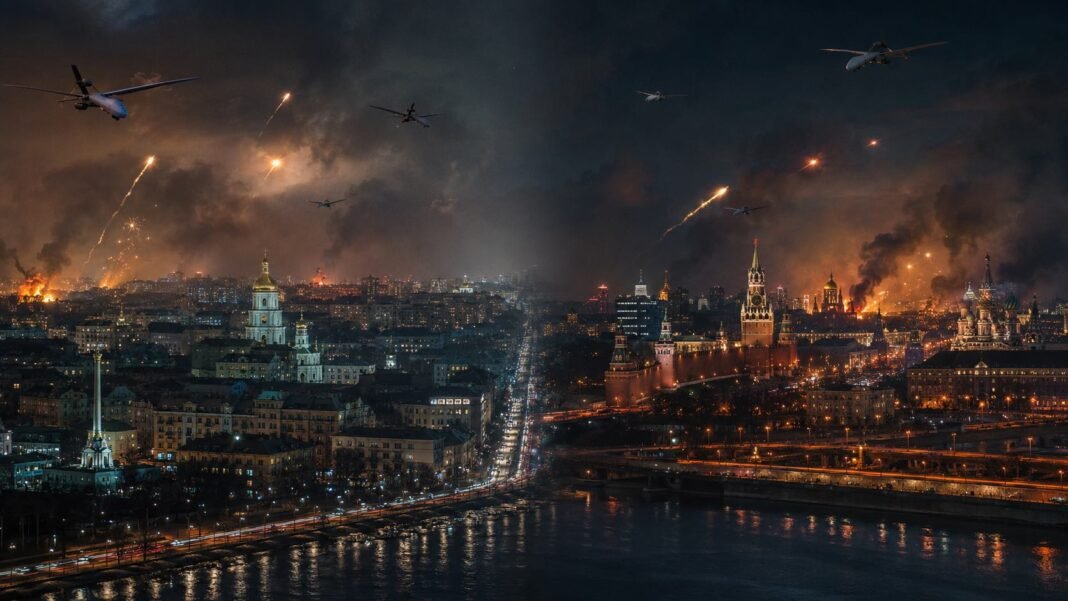
The Russia-Ukraine war is no longer confined to trenches, artillery lines and armored assaults. It is increasingly becoming a war of drones, where the battlefield stretches from the front line to oil refineries, airfields, logistics hubs and capital cities.
This is the central reality of the conflict today: both sides can hit more, see more and destroy more, but neither side has found a decisive way to break through.
Drones have changed the logic of movement. Bringing troops forward is dangerous. Moving armored vehicles in the open is dangerous. Supplying a position by road is dangerous. Concentrating forces for an offensive is dangerous. Once a target is detected, it can quickly be attacked by an FPV drone, a reconnaissance-and-strike system, a missile, or a longer-range unmanned aircraft.
That has helped freeze the war. Not because there is no fighting, but because movement itself has become expensive. A modern battlefield covered by drones is not friendly to large columns, exposed armor or predictable supply routes. It rewards concealment, dispersion and constant adaptation. It punishes mass.
Russia has used drones and missiles to keep pressure on Ukrainian cities and infrastructure. Reuters reported that Russia carried out its largest two-day aerial attack of the war in mid-May, with Ukrainian President Volodymyr Zelenskyy saying Moscow launched 1,567 drones from the start of Wednesday, while officials reported at least 27 civilians killed over two days.
Ukraine, meanwhile, has expanded its own long-range campaign deep into Russia. Ukrainian drones struck the Syzran oil refinery in Russia’s Samara region, more than 800 kilometers from Ukraine’s border, according to Reuters and AP. The attack was part of a wider campaign against Russian oil infrastructure, a key source of state revenue and military fuel.
The pattern is clear. Russia strikes Kyiv, Dnipro, Kharkiv, Odesa and Ukraine’s energy grid. Ukraine strikes Russian refineries, military-linked factories, logistics sites and areas near Moscow. Both sides are trying to impose costs beyond the immediate battlefield.
That does not mean both campaigns are morally or legally identical. Russia launched the full-scale invasion and continues to attack Ukrainian cities. Ukraine is striking back against a larger aggressor and trying to degrade the military and economic system sustaining the war. But militarily, the direction is unmistakable: the rear is becoming part of the front.
The danger is that this form of war can continue for a long time.
Drones are cheaper than aircraft. They are easier to replace than trained pilots. They can be produced, modified and deployed at scale. Even when many are intercepted, enough can get through to damage a refinery, a depot, a radar site, an air-defense system, or a city district. Reuters reported this week that Ukrainian drone strikes had affected Russian oil refining, including disruptions at major facilities such as NORSI and other sites in central Russia.
At the same time, Russia has shown it can keep launching large waves of drones at Ukraine despite sanctions, losses and Ukrainian air defenses. The result is a war in which both sides are learning to absorb strikes while building the next wave.
This is why the drone war looks less like a path to quick victory and more like a mechanism for prolonged attrition. It makes offensive operations harder, but it makes punishment easier. It prevents movement, but encourages retaliation. It reduces the cost of striking, but increases the political cost of stopping.
For Ukraine, long-range drone strikes are one of the few tools that can offset Russia’s advantages in size, manpower, territory and resources. Kyiv cannot easily match Moscow shell for shell or missile for missile, but it can hit refineries, logistics nodes and military industry deep inside Russia. Moscow’s recent complaint that fuel supplies remain stable despite refinery attacks shows exactly why Ukraine keeps targeting that system: even when Russia denies strategic damage, it must spend resources defending and repairing its energy network.
For Russia, mass drone attacks remain a way to exhaust Ukrainian air defense, terrorize cities, damage energy infrastructure and signal that Ukraine will pay a continuing price for resistance. The strategy does not require a dramatic breakthrough on the ground. It requires pressure, repetition and fatigue.
That is the stalemate.
The war has not stopped. It has become more distributed. The front line remains deadly, but the deeper contest is now about systems: production, air defense, electronic warfare, intelligence, logistics, repair capacity and public endurance.
The old question was whether one army could break the other’s line. The newer question is whether one state can exhaust the other’s ability to keep fighting.
This is a darker kind of balance. Drones do not necessarily bring negotiations closer. They can make war easier to sustain and harder to end. Each attack produces a reason for another. Each successful strike becomes proof that the campaign should continue. Each civilian impact narrows the space for compromise.
The most likely outcome is not a single decisive battle. It is a longer phase in which both countries build more drones, deploy more interceptors, expand electronic warfare and keep moving the war deeper into each other’s rear.
That does not mean the conflict is frozen. It means it is stuck in motion.
Russia and Ukraine are both adapting quickly. But adaptation is not the same as resolution. A war fought by drones can become more precise in some places and more indiscriminate in others. It can destroy tanks and refineries, but it can also keep cities under permanent threat. It can weaken an enemy’s logistics without forcing political surrender.
The brutal lesson is that drones have not replaced war. They have made it more persistent.
They have made it harder to advance, harder to hide, harder to supply, harder to defend the rear and harder to tell societies that the war is far away. For Ukraine, that has been reality since the first day of Russia’s invasion. For Russia, the growing number of drone strikes near Moscow and across industrial regions is slowly erasing the illusion of distance.
This is where the conflict stands now: not at peace, not at a decisive turning point, but in a technological war of exhaustion where both sides can hurt each other, neither can easily stop, and the front line is no longer only on the map.
AZE.US