By AZE.US Editorial Team
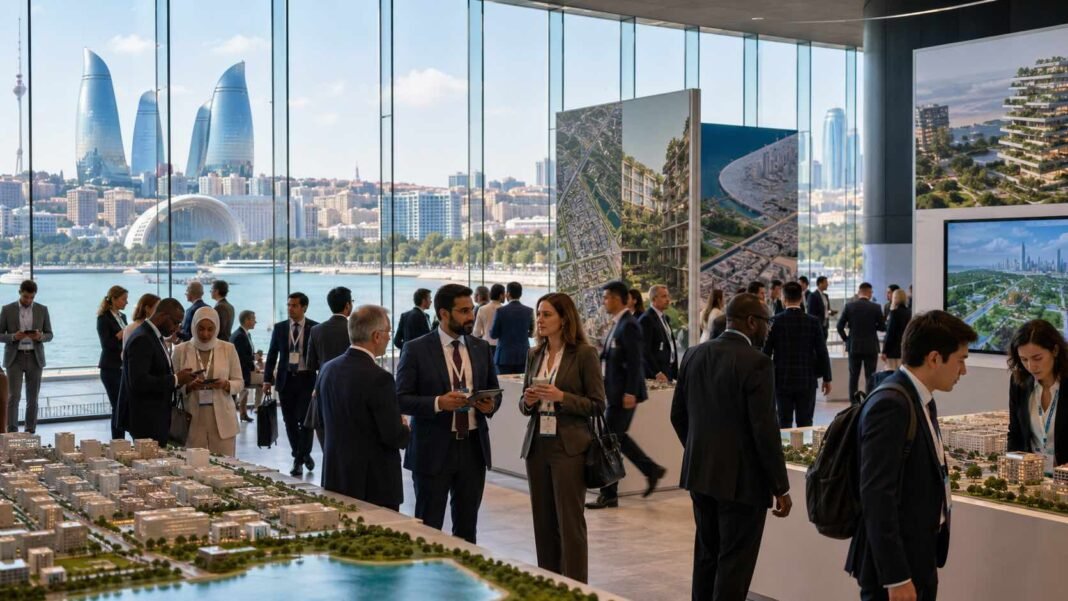
The 13th session of the World Urban Forum has ended in Baku. For Azerbaijan, the question now is not whether the event looked impressive. It did. The more serious question is what it actually gave the country.
The answer is more important than the usual language of successful hosting, high-level guests and international attention. WUF13 gave Azerbaijan something more durable: a chance to move part of its international image away from oil, war and transport corridors, and toward the language of cities, housing, reconstruction and long-term development.
That matters.
The World Urban Forum, convened by UN-Habitat, is the United Nations’ main global platform on urbanization. Its 13th session was held in Baku from May 17 to 22 under the theme “Housing the World: Safe and Resilient Cities and Communities.” The official WUF13 platform described the forum as a discussion on housing, land use, urban planning, governance, participation, affordable housing, informal settlements, rebuilding and climate resilience.
For an ordinary reader, that may sound technical. For Azerbaijan, it was strategic.
Azerbaijan has spent years explaining itself to the outside world through conflict, energy and geography. Karabakh, gas pipelines, the Middle Corridor, relations with Russia, Iran, Turkey and the West - these are the usual frames. WUF13 allowed Baku to present a different side of the country: not as a state only managing security and geopolitics, but as a country dealing with the very practical question of how people live, move, return, rebuild and belong.
That is especially important after the war.
For Azerbaijan, reconstruction in Karabakh and Eastern Zangezur is not an abstract policy file. It is one of the largest state-building projects of the postwar period: roads, housing, schools, hospitals, utilities, jobs, public services and the return of displaced people. WUF13 placed that domestic task inside a global conversation. The subject was not simply “liberated territories.” It was recovery after crisis, safe housing, resilient communities and the rebuilding of places where normal life had been destroyed.
That is a much stronger international language.
The scale also matters. UN-Habitat said WUF13 brought together more than 57,000 participants, including online participants, from 176 countries, with more than 150 ministers and deputy ministers, 580 sessions and more than 74,000 visits to the Urban Expo. UN-Habitat described it as the largest World Urban Forum to date.
For Azerbaijan, this was a continuation of a larger diplomatic pattern. After COP29, Baku again showed that it can host major international gatherings with complex logistics, global participation and institutional weight. In modern diplomacy, this is not a small thing. Countries are judged not only by what they say, but also by whether they can become a place where others gather to talk about global problems.
WUF13 also left Baku with something symbolic but useful: the Baku Call to Action.
UN-Habitat said the forum concluded with the presentation of the Baku Call to Action, a stakeholder-driven document focused on accelerating action on housing and sustainable urban development. The document urges renewed commitment to the global housing crisis and calls for stronger cooperation around adequate housing.
This is not just a nice phrase. International forums often disappear from public memory after the flags are folded and the delegations leave. But documents, initiatives and named outcomes can survive. “Baku Call to Action” means the city’s name remains attached to a global urban agenda. It will appear in reports, references, expert discussions and future institutional language.
That gives Baku a form of soft power.
Another important legacy is the Baku Urban Award. UN-Habitat said the award, launched during WUF13, will become the only international award officially presented within the structural framework of the World Urban Forum. It is intended to recognize initiatives in sustainable urban development and adequate housing.
This is more than ceremony. If the award develops properly, Baku’s name will return at future forums not only as a past host city, but as part of the forum’s continuing architecture. That is a clever form of institutional memory. Not loud, not flashy, but potentially long-lasting.
There is another layer. WUF13 gave Azerbaijan a chance to speak more naturally to the Global South. Housing pressure, fast urban growth, climate risks, informal settlements, infrastructure gaps and post-crisis recovery are not distant academic themes for much of Africa, Asia, the Middle East and parts of Europe. They are daily reality.
Azerbaijan’s own story gives it an entry point into that conversation. It is not a large Western donor lecturing others. It is a country that has dealt with displacement, war damage, rapid urban growth and the need to rebuild territory almost from scratch. That does not automatically make Azerbaijan a model. But it does give Baku a credible reason to be in the room.
Still, the forum also creates a challenge at home.
It is easy to host a global discussion about safe and resilient cities. It is harder to apply those principles consistently in one’s own capital, towns and new settlements. Azerbaijan still faces serious urban questions: pressure on Baku, traffic, parking, dense construction, housing affordability, public transport, green space, the quality of new residential districts and the balance between development and livability.
That is where WUF13 becomes more than foreign policy.
If Azerbaijan speaks internationally about people-centered cities, then the same standard will eventually be applied domestically. The test is not only how many guests came to Baku, or how many panels were held. The test is whether the ideas discussed at WUF13 influence the way Azerbaijani cities are actually planned and governed.
This is especially true for Baku.
The capital is both Azerbaijan’s strongest urban brand and its biggest urban headache. It has the Caspian waterfront, modern architecture, major event infrastructure and a recognizable skyline. But it also has congestion, uneven planning, pressure on public space and constant tension between commercial construction and everyday comfort. The city can impress foreign visitors and exhaust its own residents at the same time. That is not a contradiction. That is Baku’s urban reality.
WUF13 did not solve that. No forum could.
But it gave Azerbaijan a mirror. A useful one.
The country can now say it hosted the largest World Urban Forum in history. It can point to the Baku Call to Action. It can point to the Baku Urban Award. It can say that the world came to Baku to discuss housing, resilience and the future of cities. All of that is true.
But the deeper question is what happens next.
Will the language of WUF13 remain a diplomatic souvenir? Or will it become part of how Azerbaijan thinks about Baku, Karabakh, regional cities, housing policy and quality of life?
For Azerbaijan, the forum’s real value will not be measured by the closing ceremony. It will be measured later - in whether new settlements are built for communities rather than statistics, whether Baku becomes more livable rather than only more expensive, whether reconstruction produces real towns rather than symbolic showcases, and whether urban policy starts with people, not concrete.
WUF13 gave Azerbaijan visibility. That is useful.
But it also gave Azerbaijan responsibility. That may matter even more.
AZE.US