AZE.US
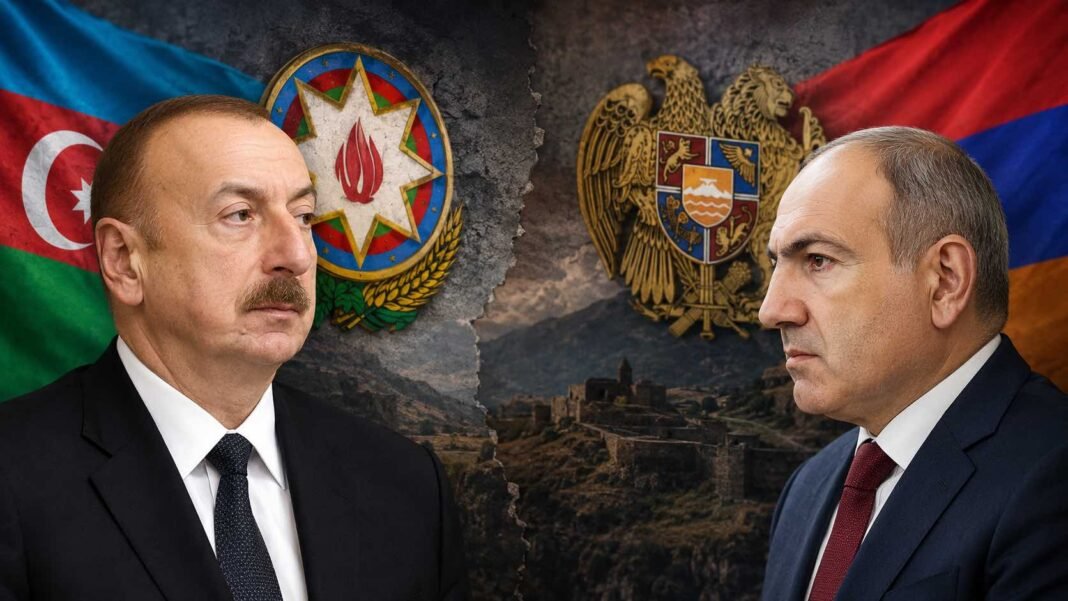
Azerbaijan says Armenia must remove territorial claims from its Constitution before the long-awaited peace agreement between the two countries can be signed.
Azerbaijani Foreign Minister Jeyhun Bayramov said Baku has already fulfilled its obligations regarding the finalization of the peace treaty and that the text of the agreement has been initialed and made public.
According to Bayramov, the remaining obstacle is Armenia’s constitutional framework, which Azerbaijan says still contains references that amount to territorial claims against Azerbaijan.
“Our expectation is that Armenia removes territorial claims against Azerbaijan from its Constitution. After that, the peace agreement can be signed,” Bayramov told journalists.
He said Azerbaijan’s position on the issue has been consistent and principled, and has repeatedly been outlined by President Ilham Aliyev.
The constitutional issue has long been one of the central sticking points in the peace process. Baku objects to references linked to Armenia’s 1990 Declaration of Independence, which cites a 1989 decision on the unification of Armenia and Nagorno-Karabakh. Azerbaijan views such references as incompatible with a peace treaty based on mutual recognition of sovereignty and territorial integrity.
Bayramov said that once this issue is resolved, there would be no further obstacles to signing the peace agreement.
The foreign minister also said that work continues on border delimitation and demarcation between Azerbaijan and Armenia. According to him, nearly 13 kilometers of the state border have already been delimited, and demarcation work was carried out on that section in a short period of time.
Bayramov added that the two sides have agreed that the delimitation process will continue from north to south, starting from the point where the borders of Azerbaijan, Armenia and Georgia meet and moving toward the point where the border reaches Iran.
He said issues related to enclave villages would also be addressed within this process.
The minister also commented on the TRIPP project, known in Azerbaijan as the Zangazur Corridor. He said work is underway on the section of the route that would pass through Armenia, with negotiations primarily taking place between the United States and Armenia because the relevant segment lies on Armenian territory.
At the same time, Bayramov noted that both the entry and exit points of the route are located on Azerbaijani territory. For that reason, he said, Baku is being regularly informed by its American partners about the progress of the talks.
According to Bayramov, the project could include not only railway and road infrastructure, but also electricity cables and, in theory, pipeline infrastructure. He said Azerbaijan expects further announcements in the coming months.
The broader peace process gained new momentum after the August 2025 Washington summit, where the leaders of Azerbaijan and Armenia met with U.S. President Donald Trump. As part of that process, the foreign ministers of Azerbaijan and Armenia initialed the draft peace agreement, while a U.S.-backed framework was announced for reopening regional transportation links.
Armenian Prime Minister Nikol Pashinyan has said his government remains committed to the “institutionalization of peace,” but has described constitutional reform as Armenia’s internal political process rather than a direct negotiating item with Azerbaijan.
Pashinyan has also said Armenia cannot abandon the issue of enclaves and exclaves, pointing to the village of Artsvashen, which Yerevan considers part of Armenia’s sovereign territory under the 1991 Alma-Ata framework.
For now, the peace agreement remains agreed in text but unsigned. Azerbaijan says the next move depends on Armenia’s constitutional changes.
AZE.US