AZE.US
The victory of Armenian Prime Minister Nikol Pashinyan’s party in the parliamentary elections has not resolved all questions surrounding the peace process with Azerbaijan, but it has created conditions for talks to continue. The main signal after the vote is that Baku and Yerevan are not taking a pause, but are returning to direct political dialogue.
One of the clearest signs was the meeting between Azerbaijani presidential aide Hikmet Hajiyev and Armenian Security Council Secretary Armen Grigoryan in Dilijan. The meeting took place soon after the elections and became the first major contact between the sides in the new political environment.
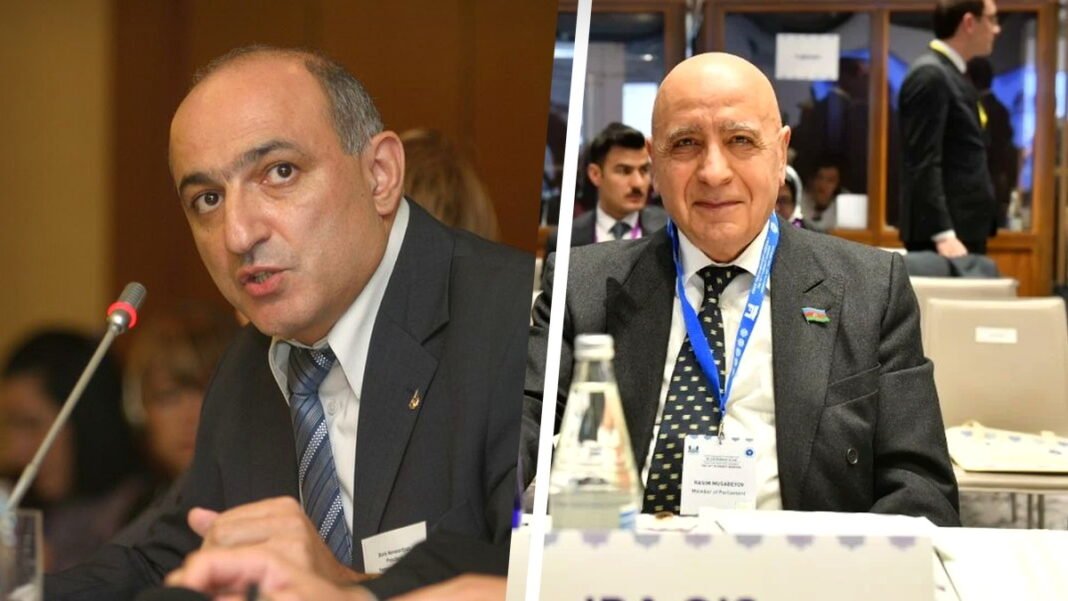
In a discussion on Press Club TV, Azerbaijani MP and political analyst Rasim Musabekov and Boris Navasardyan, honorary president of the Yerevan Press Club, assessed what Armenia’s election results mean for the peace agreement, constitutional reform, border delimitation and future regional formats.
What Changed After The Elections
According to Navasardyan, the fact that Hajiyev and Grigoryan met so soon after the elections shows that the sides are ready to continue normalization. Before the vote, the process had effectively slowed down, as both Baku and Yerevan were waiting to see what mandate Pashinyan would receive.
In his view, the space for further steps remains open. Attempts by the Armenian opposition to challenge the election results are unlikely to seriously change the situation. A repeat vote, even if it were possible, would only prolong domestic confrontation and delay practical steps toward normalization.
Musabekov also believes there will be no repeat elections. He noted that the results have already been recognized by international observers and many external actors. He described attempts to challenge the outcome as part of the inertia of domestic political struggle and an effort by Moscow to maintain pressure on Pashinyan.
The Constitution Remains A Difficult Issue
One of the central issues for Baku is possible changes to Armenia’s Constitution. Azerbaijan has repeatedly pointed to references linked to Armenia’s Declaration of Independence, which contains language related to Karabakh.
Musabekov argues that excessive public pressure on this issue could complicate the process inside Armenia. In his view, the peace agreement could be signed first, while Azerbaijan could link ratification to the later adoption of a new Armenian Constitution.
Such an approach, he believes, would prevent the process from remaining indefinitely suspended. A signed treaty would also narrow the room for revanchist forces. If future political forces in Armenia tried to revive territorial claims, they would first have to denounce an existing agreement, placing themselves in a vulnerable political position.
Navasardyan points to another aspect. A two-thirds majority required to move a constitutional issue toward a referendum does not necessarily have to belong to a single party. In theory, such a majority can be formed by lawmakers from different factions if the proposed constitutional document is strong enough.
For Armenian society, he says, the issue is not only the preamble or the peace agreement with Azerbaijan. The quality of the Constitution will also depend on how it addresses the judiciary, local self-government and the balance of state institutions. That means the fate of constitutional reform will depend not only on external pressure or parliamentary arithmetic, but also on the content of the document itself.
The Peace Agenda Goes Beyond Pashinyan’s Voters
Both experts broadly agree that support for peace with Azerbaijan in Armenia is not limited to Pashinyan’s voters. Navasardyan believes supporters of normalization can also be found among parts of the opposition electorate, even if those voters opposed the ruling party for domestic political reasons.
In his assessment, there is a relatively broad consensus in Armenia on two major directions: European integration and peace in the region. Once the tension of the election campaign fades, this could become a basis for further movement.
Musabekov also believes Pashinyan has received a sufficient mandate to move the peace agenda forward. He also suggested that some lawmakers from Samvel Karapetyan’s bloc could situationally support the government on issues requiring a broader parliamentary majority.
Border And Transport Links Become The Practical Track
Border delimitation and demarcation remain another important part of the process. The visit of an Azerbaijani delegation to Armenia through an already delimited section of the border was seen as a political signal that the process is gradually moving from symbolism to a working mechanism.
Musabekov noted that the first section had already been delimited and demarcated in the Kazakh-Ijevan area. Further efforts, he said, may focus on sections where transport routes and border crossings are expected to open.
In this context, the TRIPP project remains important. The route is expected to connect Azerbaijan with Nakhchivan through Armenian territory. Its launch will require not only technical arrangements, but also political agreements, including customs and border control mechanisms.
At the same time, Musabekov stressed that full border delimitation could take years. He pointed to the experience of Azerbaijan and Armenia with Georgia, where some border sections have still not been fully finalized. But this has not prevented countries from building relations and developing cooperation.
Diplomatic Relations Could Become An Interim Step
If the signing of a full peace treaty is delayed because of constitutional reform or other technical reasons, Baku and Yerevan may look for interim mechanisms.
Navasardyan believes one such step could be the establishment of diplomatic relations. Without diplomatic and consular infrastructure, trade, humanitarian contacts and practical cooperation could quickly face limitations.
Musabekov supports a more cautious model. The sides could begin not with full embassies, but with interest sections under the embassies of third countries. For example, an Armenian interest section could operate in Baku under the Georgian Embassy, while an Azerbaijani interest section could operate in Yerevan under the Kazakh Embassy. Such a format would allow the process to move forward without an abrupt political step.
Regional Formats Move To The Background
The discussion also touched on the 3+3 format, which includes the three South Caucasus states and three neighboring powers: Russia, Turkey and Iran. Navasardyan believes the format may remain useful as a consultative platform, but not as the main mechanism for resolving Armenian-Azerbaijani issues.
In his view, key decisions are now being made through direct dialogue between Baku and Yerevan. If external actors are needed to support implementation, their role can be helpful, but should not replace the bilateral process.
Musabekov proposed an even more flexible formula: not 3+3, but 3+. In his view, the three South Caucasus countries should strengthen their own regional framework, while external partners can be involved depending on the issue. These could include Turkey, the European Union, the United States, Central Asia or other partners.
This approach, he believes, would prevent the region from being locked into a framework shaped only by three former imperial centers of influence and would leave space for wider diplomacy.
What Comes Next
The main conclusion from the discussion is that the peace process did not stop after Armenia’s elections. On the contrary, the first contacts show that Baku and Yerevan are ready to continue direct political dialogue.
But further progress will depend not on one document alone, but on a set of steps: constitutional reform in Armenia, border delimitation, the opening of transport links, possible diplomatic mechanisms and broader contacts between the two societies.
Pashinyan has received a new mandate, but not all risks have disappeared. For Azerbaijan, it is important that the peace process has not only the signature of the Armenian government, but also a broader public and institutional foundation. That is why the coming months may show whether direct dialogue between Baku and Yerevan can move from political signals to sustainable decisions.
AZE.US