By AZE.US Editorial Team
The July 27 phone call between Armenian Prime Minister Nikol Pashinyan and Russian President Vladimir Putin should be viewed not as a routine bilateral exchange, but against the backdrop of the deepening political and economic crisis between Moscow and Yerevan.
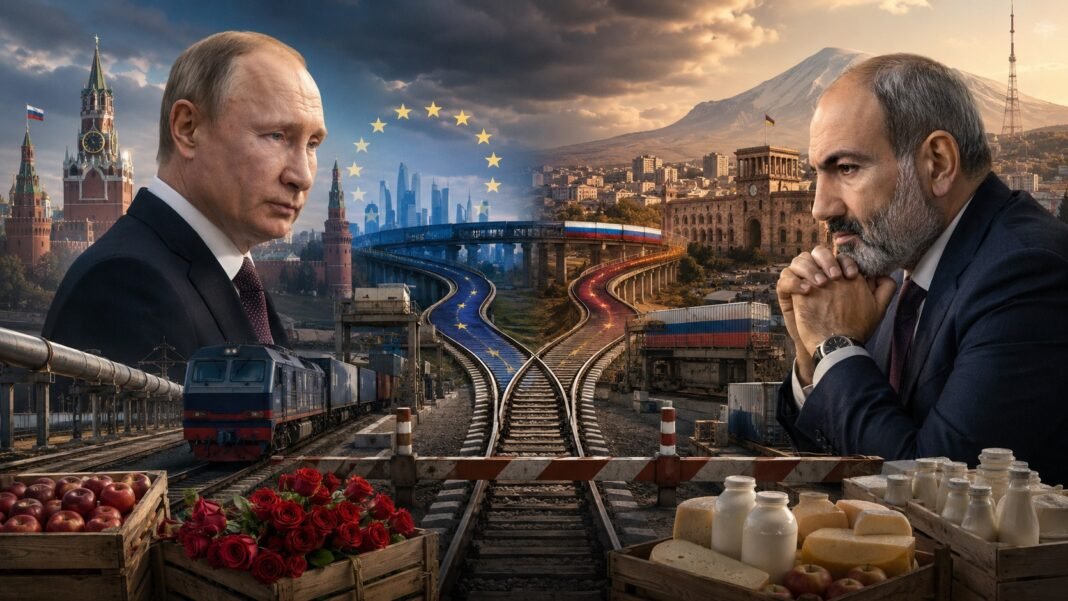
The conversation came amid growing restrictions on Armenian exports to Russia and increasingly direct signals from the Kremlin that Armenia cannot indefinitely pursue closer integration with the European Union while continuing to enjoy the economic advantages of membership in the Russian-led Eurasian Economic Union.
Kremlin spokesman Dmitry Peskov said the issue of a possible referendum in Armenia concerning its future relationship with the EAEU was raised during the call. According to Peskov, the discussion followed a recent statement adopted by the leaders of the Eurasian bloc.
The message from Moscow is becoming increasingly difficult to ignore: Armenia will eventually have to choose between the European Union and the Eurasian Economic Union.
Economic Pressure Behind the Diplomacy
The call took place in an unusually cold political atmosphere.
More than a month and a half after Armenia’s parliamentary election, Putin has yet to publicly congratulate Pashinyan on his victory. At the same time, Russian regulators have imposed or expanded restrictions affecting a range of Armenian products, including flowers, alcoholic beverages, mineral water, fruit, vegetables and dairy goods.
The latest restrictions on dairy exports are particularly damaging for Armenia’s agricultural sector.
Perishable products such as cheese, milk and other food goods cannot easily be redirected to distant European, Asian or Middle Eastern markets. Entering those markets requires new certification procedures, higher quality standards and costly logistical routes that can take months to establish.
Russia, by contrast, can replace Armenian imports with supplies from Belarus or other producers. The economic cost is therefore far heavier for Armenia than for Russian consumers.
It was in this environment that Pashinyan initiated the call with Putin.
The Armenian prime minister reportedly argued that restrictions on Armenian goods contradicted bilateral agreements and the rules of the Eurasian Economic Union. He also asked for steps to be taken to resolve the dispute.
The request revealed an uncomfortable reality for Yerevan: formal EAEU rules offer limited protection when access to the Russian market ultimately depends on decisions made by Moscow.
Armenia’s Dependence on the Russian Market
Pashinyan entered the election campaign presenting his government as firmly committed to a pro-European course. After the election, however, Armenia’s economic dependence on Russia remained unchanged.
For more than a decade, Armenian exporters built their businesses around the Russian market. Alternative markets were not developed at the same pace, while product standards and transport routes remained poorly adapted to European trade.
Armenia also failed to normalize relations with Azerbaijan and Turkey in time to fully open borders and transport links that could have reduced its dependence on Russia.
Yerevan is now attempting to pursue what it describes as a multidirectional foreign policy, maintaining relations with Russia while expanding ties with the EU, Iran and the Gulf states.
In practice, however, this approach increasingly resembles an attempt to postpone a strategic decision.
Political declarations about European integration cannot immediately rescue agricultural goods that are losing value because their traditional export route has been blocked. For Armenian farmers and businesses, access to the Russian market remains an economic necessity rather than a geopolitical preference.
Pashinyan’s call to Putin can therefore be seen primarily as an effort to protect exports and limit the damage to Armenia’s domestic economy.
Trade Restrictions as Political Leverage
Russian authorities formally justify import restrictions through veterinary, sanitary and phytosanitary regulations.
In Armenia, however, such decisions are increasingly viewed as instruments of political pressure.
Restrictions on exports can create dissatisfaction among farmers, producers and business owners. Their anger may ultimately be directed not only at Moscow, but also at the Armenian government, which promised closer ties with the West without first reducing the country’s dependence on Russia.
This gives the Kremlin a powerful form of leverage.
Economic pressure can create social tension inside Armenia, weaken confidence in the government and provide future opportunities for opposition forces.
The timing is also significant. Pro-Russian political figures and parties failed to achieve a decisive result in Armenia’s latest election. Robert Kocharyan, Samvel Karapetyan and Gagik Tsarukyan were unable to produce the political outcome Moscow may have preferred.
The defeat of pro-Russian forces showed the limits of the Kremlin’s traditional political influence in Armenia. Economic pressure may now be a more effective tool than relying on opposition parties or political proxies.
The Referendum Trap
The most important element of the Putin-Pashinyan conversation was not the dispute over specific products. It was the broader question of Armenia’s strategic direction.
Moscow is effectively telling Yerevan that it cannot move toward EU membership while indefinitely remaining inside the EAEU and benefiting from preferential trade, customs access and discounted Russian energy.
For Armenia, a referendum would create serious risks.
If voters backed European integration, Moscow could use the result as justification to reconsider customs privileges, trade preferences, energy arrangements and other economic benefits.
A vote against the European path, however, would disappoint Armenia’s pro-Western electorate and could damage relations with Brussels.
Pashinyan responded that a referendum would become practical only after Armenia formally applied for EU membership and the issue entered a concrete stage of negotiations.
That answer appears designed to buy time.
The Armenian government does not want to abandon its European course, but it is not economically prepared for an open confrontation with Moscow. By referring to legal procedures and future negotiations, Pashinyan is trying to delay the decisive moment while keeping relations with both sides intact.
That strategy may temporarily soften the crisis, but it does not resolve the underlying contradiction.
An Alliance That Increasingly Exists on Paper
The July 27 phone call once again demonstrated how deeply trust between Moscow and Yerevan has deteriorated.
Russia is showing that it is prepared to use economic tools not only to regulate trade, but also to influence Armenia’s foreign policy.
The Armenian government, meanwhile, continues to pursue closer relations with the West without possessing the economic independence necessary to disregard Russian pressure.
On the same day as the Putin-Pashinyan conversation, Russian authorities said they had stopped the attempted import of more than 39,000 Armenian roses through Belarus under allegedly misleading documentation.
The episode reinforced the broader message that Moscow intends to maintain pressure on Armenian exports.
Pashinyan is trying to preserve the current balance: continue dialogue with the EU, avoid abandoning the EAEU and persuade Russia not to escalate its economic response.
But the space for such maneuvering is shrinking.
Moscow wants a clear answer to a question Yerevan would prefer to postpone: Will Armenia remain inside Russia’s economic and political orbit, or begin an irreversible move toward Europe?
Armenia may still be able to delay that choice. It is becoming increasingly difficult to avoid it.
AZE.US