By AZE.US
Russia is interested in maintaining direct political dialogue with Azerbaijan, and the repeated contacts between Presidents Ilham Aliyev and Vladimir Putin on the sidelines of the Shanghai Cooperation Organization summit were unlikely to have been accidental, Azerbaijani political analyst Ilgar Velizade said.
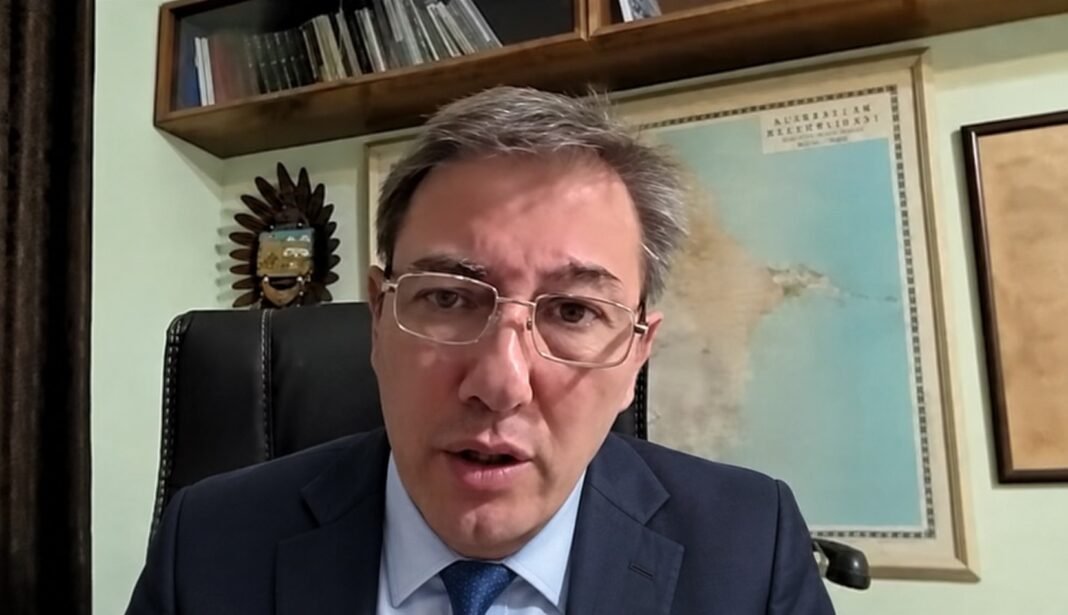
Velizade, who heads the South Caucasus Political Scientists Club, made the remarks in an interview with the Daily Europe Online YouTube channel.
Commenting on the interaction between the Azerbaijani and Russian leaders, Velizade said Putin appeared to have approached Aliyev several times during the two-day gathering. In his view, this indicated Moscow’s interest in keeping communication with Baku open.
“If we proceed from the information suggesting that Putin initiated these contacts, we can assume that the Russian side is interested in continuing the dialogue,” Velizade said.
The analyst noted that communication between Baku and Moscow at the highest political level had never been completely interrupted, despite recent tensions and hostile rhetoric toward Azerbaijan in parts of the Russian media.
“At the highest level, assessments have always remained extremely careful,” he said. “The sides are restrained in their language, bridges are not being burned, and opportunities for personal communication remain.”
Velizade cautioned against interpreting the meetings as evidence that all problems between the two countries had been resolved. The personal contact between Aliyev and Putin remains intact, he said, but the relationship cannot be described as trouble-free.
He identified a continuing disconnect between the restrained language used by Russia’s senior leadership and the aggressive campaign against Azerbaijan conducted by some Russian television hosts and political commentators.
According to Velizade, Moscow must either change this information policy or take broader steps to improve the atmosphere surrounding bilateral relations. Otherwise, dialogue at the presidential level may not produce corresponding changes in the media and public sphere.
“Russia needs Azerbaijan primarily as a gateway to the region and as a direct neighbor with which it can build a dialogue that does not depend on the wishes of third parties,” he said.
Baku and Yerevan Build an Economic Foundation for Peace
Velizade also addressed the normalization process between Azerbaijan and Armenia. He said the latest meeting between Aliyev and Armenian Prime Minister Nikol Pashinyan demonstrated that both sides remained committed to advancing the peace agenda constructively.
The analyst described the gradual development of commercial relations as particularly significant. Azerbaijani petroleum products are already being supplied to Armenia, while Yerevan has announced the beginning of Armenian exports to the Azerbaijani market.
“This creates a material and technical foundation for bilateral relations,” Velizade said. “Such a foundation should be established first, followed by political decisions.”
He said bilateral trade should operate in both directions. If Azerbaijani goods can enter Armenia, Armenian products should also be able to reach Azerbaijan when there is genuine market demand.
The range of potential imports would be determined by the needs of Azerbaijan’s economy and agreements between private companies, he added. Possible Armenian exports could include cable products, certain construction materials, agricultural goods and beverages.
Velizade stressed that the volume and composition of trade should ultimately be determined by businesses and consumers rather than political declarations.
Pashinyan’s EU Explanation Questioned
The analyst also criticized Pashinyan’s explanation of Armenia’s legislation launching the process of seeking European Union membership.
During a meeting with Putin, Pashinyan argued that adopting the law had prevented the immediate initiation of a referendum on joining the EU at a time when Armenia was not yet prepared to make such a decision.
Velizade described that reasoning as difficult to follow, noting that Armenia had not been compelled to hold an immediate referendum.
“If a country wants to join the European Union or another integration bloc, it must have the necessary resources, understand the realities surrounding it and assess its own capabilities before taking consistent steps,” he said.
Armenia has the sovereign right to choose its foreign policy direction, Velizade added, but any declared European course should be supported by practical and coherent action.
If Armenia’s leadership acknowledges that the country is not yet ready for European integration, he said, it raises questions about why the relevant legislation was adopted before the necessary conditions were in place.
Velizade nevertheless recognized that Pashinyan is attempting to navigate among Russia, the EU, Iran, Turkey and other regional powers. Europe’s limited practical support, he said, does not allow Yerevan to disregard its geographical, security and economic realities.
SCO Is Not Exclusively an Anti-Western Bloc
Turning to the Shanghai Cooperation Organization summit, Velizade described the SCO as a major forum bringing together governments with diverse and sometimes conflicting interests.
He identified China, India and Russia as the organization’s principal centers of power. Despite continuing differences between Beijing and New Delhi, he said, the three countries are seeking to coordinate their policies and prevent disagreements from developing into open confrontation.
Velizade argued that the SCO should not be viewed simply as an anti-Western alliance. Many of its members maintain extensive political and economic ties with the United States and Europe while also seeking protection against sanctions and dependence on Western-controlled financial systems.
Growing sanctions pressure has encouraged Russia, Iran, China and other countries to develop alternative payment systems, financial institutions and trade mechanisms, he said.
The analyst added that the escalating Russia-Ukraine war is disrupting international transport routes, supply chains and major economic projects. China is particularly sensitive to such instability because predictable global trade remains one of Beijing’s central priorities.
Velizade said the conflict is developing according to a pattern of reciprocal escalation, with each strike prompting a response from the other side. He expressed skepticism that deteriorating conditions inside Russia would necessarily trigger large-scale public protests capable of changing Moscow’s policy.
The broader regional picture, he concluded, shows that governments are increasingly guided by pragmatic interests rather than ideological declarations.
That helps explain Russia’s determination to maintain contacts with Azerbaijan, Armenia’s cautious maneuvering between competing power centers and Baku’s growing role as an independent regional actor.
AZE.US