By AZE.US
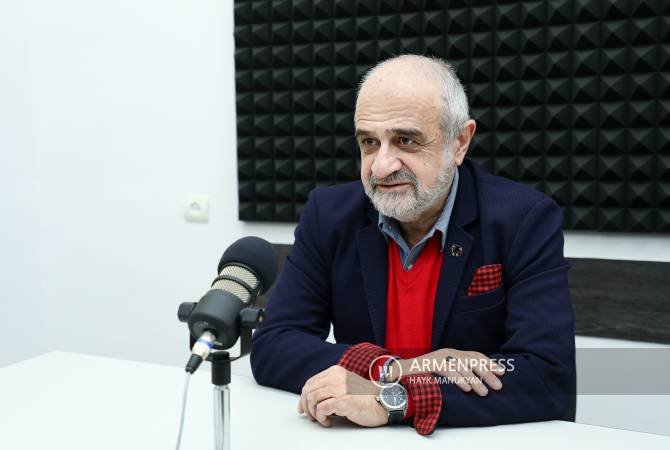
Russia is seeking to derail the Trump Route for International Peace and Prosperity, or TRIPP, by fueling Iranian concerns about a potential U.S. presence near its borders, according to Armenian professor and civil society activist Ruben Babayan.
Babayan, a professor at the State Institute of Theater and Cinema in Yerevan, artistic adviser to Armenia’s National Puppet Theater and a member of the Peace Bridge civil initiative, made the comments in an interview with the YouTube channel “Modern Conversation with Rasim Babayev.”
Commenting on Russian claims that TRIPP could be used to deploy U.S. military personnel, private military contractors or intelligence infrastructure in Armenia, Babayan described the statements as an attempt to turn Tehran against the project.
“For Russia, the shortest path to achieving this objective is to set Iran against the project. And the way to do that is to claim that Americans will be stationed there,” he said.
Babayan argued that the agreement does not provide for the presence of foreign military or political forces. He also said it is standard international practice for the principal investor in a major infrastructure project to receive a larger initial stake or preferential terms.
He compared the controversy surrounding TRIPP with Moscow’s earlier opposition to the Baku-Tbilisi-Ceyhan oil pipeline.
“People also said that project would never be implemented because Russia opposed it. But it was completed, and the pipeline is operating. I believe the same will happen with this route,” Babayan said.
He added that the project is important not only for Azerbaijan and Armenia but also for Central Asian countries seeking an additional direct connection to European markets.
“Safe Skies Over One Country Mean Security for Its Neighbors”
A significant part of the interview focused on the Armenia-Azerbaijan normalization process. Babayan said expanding economic ties should eventually help create a shared security framework for the South Caucasus.
He referred to reports that the first private commercial transaction involving Armenian goods supplied to Azerbaijan had already taken place. Baku and Yerevan have also discussed possible cooperation in the electricity sector.
“Safe skies over any one of our countries mean safe skies over its neighbors,” Babayan said. “Economic cooperation should ultimately lead to an effort to build a common security system.”
According to Babayan, the region lost decades to conflicts and mutual fears that outside powers exploited for their own interests.
“If the life of an Azerbaijani carries the same value for an Armenian as the life of an Armenian - and vice versa - we will quickly find common ground on security,” he said.
Babayan also welcomed the continuation of direct contacts between Azerbaijani and Armenian civil society representatives. He said the dialogue received state-level support through contacts involving Azerbaijani presidential aide Hikmet Hajiyev and the Armenian side.
As a member of the Peace Bridge initiative, Babayan said he had received information that another civil society meeting could take place soon. He expressed hope that Georgia would eventually join the format, bringing all three South Caucasus countries into the process.
Russian Base Called a “Weight Around Armenia’s Ankles”
Discussing Russia’s 102nd military base in Gyumri, Babayan argued that it no longer plays a meaningful role in protecting Armenia.
He said Moscow appeared to assume that the prospect of Russian troops leaving would frighten Armenian society. Babayan instead described the base as a “weight around Armenia’s ankles” on its path toward closer relations with the European Union.
He predicted that the issue of the base’s withdrawal would eventually be addressed through negotiations, although the timetable and conditions remain uncertain.
“The era of romanticism is over. The era of pragmatism has begun,” Babayan said, referring to future talks between Yerevan and Moscow.
He said Armenia should approach Russia with detailed calculations covering security, energy and trade, rather than allowing its agenda to be shaped by statements from Russian television channels and political commentators.
Babayan also rejected claims that Armenia would automatically face an economic disaster if it left the Eurasian Economic Union. He cited Azerbaijan, Georgia and Serbia as countries that remain outside the bloc while maintaining trade and customs relations with it.
In his assessment, Moscow’s reliance on pressure and threats is only pushing Armenia further away from Russia.
“It is becoming increasingly difficult to speak in the language of threats to a generation raised in an independent Armenia,” Babayan said. “This is a different generation, and reversing this process is practically impossible.”
AZE.US