By AZE.US Editorial Board
A possible war between Turkey and Israel would put Azerbaijan under pressure from both sides.
Ankara could demand an end to oil supplies to its opponent and, if sanctions or supply disruptions followed, ask Baku to redirect additional volumes to the Turkish market.
Azerbaijan would have to protect its alliance with Turkey, its strategic partnership with Israel and its own export revenue at the same time.
Azerbaijan has maintained close relations with both Turkey and Israel for years. Disagreements between Ankara and Jerusalem have complicated that balancing act but have not made it impossible.
A direct war would change the terms: decisions previously treated as commercial would be judged as support for one of the belligerents.
Oil trade would be the most immediate pressure point.
Azerbaijani crude accounted for 46.4% of Israel’s oil imports in 2025, according to Kpler data reported by Reuters. Shipments from Turkey’s Ceyhan port averaged 94,000 barrels per day. Azerbaijan is therefore one of Israel’s principal oil suppliers.
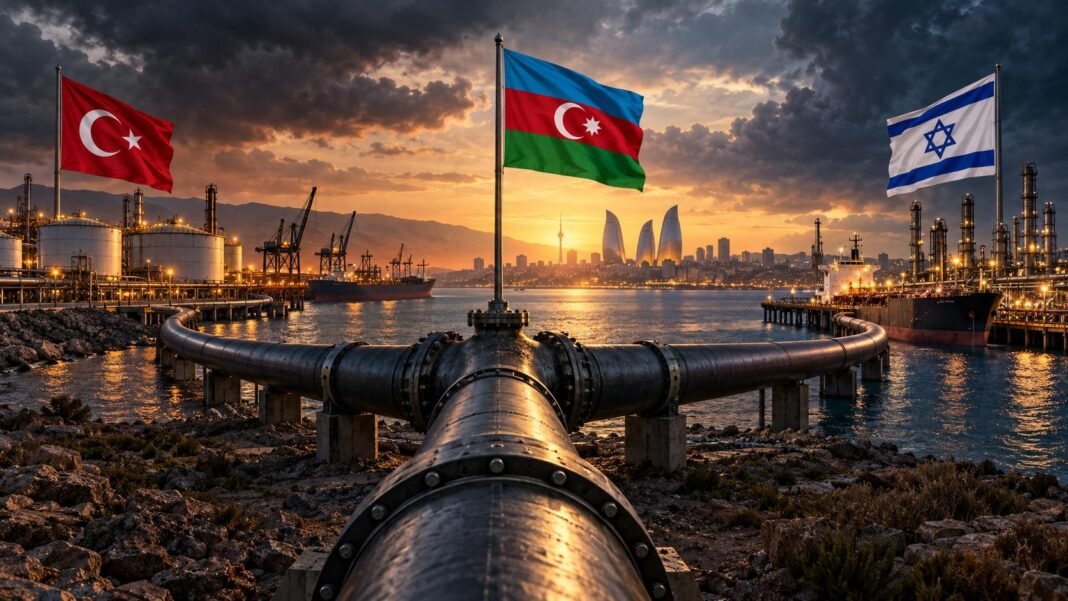
The crude reaches the Mediterranean through the Baku-Tbilisi-Ceyhan pipeline. That creates a sensitive arrangement: the oil is Azerbaijani, the buyer is Israeli and the loading port is in Turkey.
If war broke out, Ankara would struggle to explain to the Turkish public why supplies to its opponent continued through Turkish territory. A Turkish demand to halt shipments to Israel would therefore be a plausible scenario.
Pressure on Baku might not stop there.
If sanctions or military risks disrupted Turkey’s purchases, Ankara could insist that the oil be sent to Turkey instead of Israel.
Such a request would carry both economic and political arguments. Turkey would need dependable supplies, and it would expect support from an ally. Continued deliveries to Israeli buyers could be portrayed as a refusal to stand with Ankara.
For Azerbaijan, however, redirecting oil would not necessarily amount to exchanging one equivalent market for another.
If Turkish buyers offered market prices and reliable payment, additional sales could be profitable. The picture would change if allied solidarity became tied to discounts, payment deferrals or commitments to supply crude regardless of commercial terms.
Baku could then lose an Israeli customer while also reducing the profitability of sales to Turkey. Political assistance to an ally would carry a measurable price.
Azerbaijan also does not have sole control over all oil moving through Ceyhan. Multiple companies participate in the supply chain, while contracts and cargo owners’ rights remain in force. Even with a political decision in Baku, redirecting flows would require commercial and technical agreements.
That limits Azerbaijan’s freedom of action, but it also gives Baku grounds to resist demands for an immediate solution by decree.
The dependence runs both ways: Baku needs Turkey and Israel, but both also need Baku.
Israel would have to replace a substantial share of its oil supplies. It could do so, but rapidly restructuring supply during a war would take time and raise costs.
Turkey has an interest in preserving transit, investment and the reliable operation of energy facilities. SOCAR Türkiye’s STAR Refinery has annual crude-processing capacity of 13 million metric tons and, according to the company, meets about 20% of Turkey’s demand for refined petroleum products. Pressure on Azerbaijani interests could therefore also hurt Turkey’s economy.
Azerbaijan would consequently retain negotiating leverage. The question is whether Baku could use it before oil trade became a public test of loyalty.
Sanctions would complicate the situation, but their effects cannot be predetermined. The outbreak of war would not automatically bring a complete economic blockade of Turkey. The response from the United States and Europe would depend on how the conflict began, the scale of the fighting and the parties’ willingness to stop. EU sanctions require a unanimous decision by member states.
For Baku, the substance of any restrictions would matter most. Sanctions on individual officials and restrictions on banks, refining or transport would create very different trading conditions.
Even without a direct ban, transactions could become more expensive: banks might be more cautious about processing payments, insurers could raise premiums and carriers could demand compensation for additional risk. High global oil prices would not guarantee strong profits if costs rose and payment became more difficult.
Azerbaijan’s allied relationship with Turkey adds another layer of sensitivity. The Shusha Declaration provides for consultations and necessary assistance if either country faces a threat or aggression. The volume and form of assistance are to be determined through urgent discussions. Any specific demand concerning oil supplies would therefore have to be negotiated separately.
In our assessment, Baku’s first response would be to seek a ceasefire, preserve existing contracts and prevent an oil ultimatum. That policy might work in a short conflict. It would become increasingly difficult to sustain in a prolonged war.
Ankara would expect solidarity, Israel would expect a dependable supplier and commercial partners would expect contracts to be honored. None of those expectations could simply be ignored.
Azerbaijan therefore has an interest in setting out the limits of possible concessions in advance. Assistance to Turkey should not become an open-ended subsidy for its economy. Cooperation with Israel should not become a reason to destroy the alliance with Ankara.
Baku’s central task would be to preserve its right to determine the terms of its own trade. If that right were surrendered under wartime pressure, the losses could outlast the conflict: the oil would still be sold, but its price would increasingly be shaped by other countries’ political demands.
AZE.US