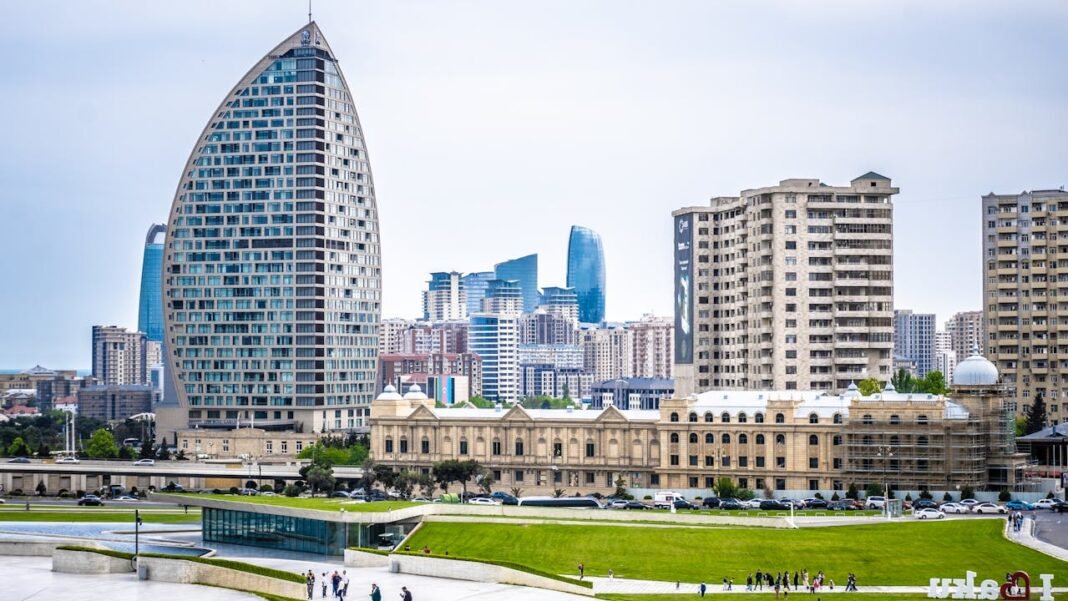
By AZE.US
Apartment prices in Baku are increasingly outpacing residents’ financial means as restrictions on new construction tighten supply and put expensive housing beyond the reach of even some potential mortgage borrowers.
Economist Farhad Parvizi warned that the trend creates risks both for investors hoping to profit from property and for young people struggling to buy a home.
Parvizi made the comments on Minval Politika’s “Search for Meanings” podcast.
Construction Costs Do Not Explain the Full Increase
Parvizi said higher construction-material prices alone cannot explain the scale of Baku’s apartment-price surge.
Various construction components have risen by roughly 20% to 40% over the past five years, he said, while the price of some properties has doubled or tripled in only three years.
Tighter rules governing gravel extraction and freight transport have added to costs. Compliance with environmental standards and limits on truck loads has increased suppliers’ expenses, according to the economist.
But Parvizi identified restrictions on new construction in the capital as one of the main forces pushing prices higher.
Efforts to ease pressure on Baku by limiting housing supply do not solve the underlying problem, he said. People continue moving to places where jobs and incomes are concentrated.
Without stronger economic opportunities in Azerbaijan’s regions, restrictions in Baku will mainly make housing more expensive and push families toward small plots and self-built homes on the Absheron Peninsula’s outskirts.
“You first have to think about what people will do outside Baku and develop the economy there so that jobs exist and people do not need to come to Baku to earn money,” Parvizi said.
“To turn Baku into Manhattan, New York, Moscow or Dubai, you would have to allow a cluster of very wealthy people to emerge here - people who would occupy all these buildings,” he said.
Listing Prices Are Not Sale Prices
Parvizi stressed that high prices in property advertisements do not necessarily mean transactions are taking place at those levels.
He criticized market assessments based mainly on listings posted on real-estate websites. Such figures reflect sellers’ expectations, he said, but do not necessarily show what buyers can afford or what they ultimately pay.
As a more meaningful benchmark, he cited published data on registered sales in 2025. The average apartment reportedly sold for about 170,000 manats, or $100,000, with an average area of 68 square meters.
He cautioned, however, that registered-sale data do not cover the entire market for homes still under construction.
Buying Before Construction Carries Added Risks
Against that backdrop, Parvizi said buyers should carefully assess offers for a 100-square-meter apartment priced at 500,000 manats, or about $294,000, while the project is still at the excavation stage.
The buyer will face additional renovation expenses, years of waiting for completion and the possibility of construction delays. During that period, the invested money remains tied up.
Parvizi also challenged the assumption that the recent rise in prices will necessarily continue. He cited White City developments advertised at 6,000 manats, or about $3,530, per square meter at the start of construction.
“Do you really think it will cost 12,000 manats in three years?” he asked.
In his assessment, the dollar value of Azerbaijani property has only returned to its 2014 level, while gold and securities markets have produced stronger gains over the same period. Apartment-price increases in manats should therefore be measured against the exchange rate and alternative investments, he said.
Why Savings Keep Flowing Into Apartments
Parvizi attributed Azerbaijanis’ preference for putting savings into apartments partly to limited financial literacy and distrust of other investment instruments.
He drew a distinction between buying gold jewelry and acquiring investment-grade bullion or coins. He also pointed to real-estate investment trusts, or REITs, as an alternative to purchasing an apartment directly. Such funds allow investors to buy shares in portfolios of income-producing properties.
People who entered Azerbaijan’s property market near the 2025-2026 price peak could find the next three years disappointing, Parvizi warned.
He described small apartments costing up to $100,000, or about 170,000 manats, as a relatively liquid part of the market. He also separated out rare premium properties, where limited supply may support prices.
Young Families Face the Greatest Pressure
Parvizi said the most serious consequences of unaffordable housing will be felt by young families. Household finances are already restricting demand, including in the mortgage segment.
If Azerbaijan cannot provide affordable housing and credible opportunities to earn a living, it risks producing a generation of young people without homes of their own or a durable connection to their future in the country, he warned.
Describing the calculation such a young person might make, Parvizi said: “Why live here in a rental? I would rather rent in Georgia or another country where I have better economic prospects.”
He argued that construction policy must be evaluated together with its consequences for employment, family formation and migration.
Measures adopted by individual government agencies to solve narrow administrative problems can create much wider social costs, Parvizi said.
Originally published in Russian by Vesti Baku.