AZE.US
Armenian Prime Minister Nikol Pashinyan’s pledge to formally seek European Union membership has exposed deep divisions over whether the country can turn toward Europe without rupturing its remaining economic and security ties with Russia.
Pashinyan told parliament on August 24 that Armenia would begin the process of submitting an official application to join the EU “in the near future.” He said Yerevan must first file the application, receive a response from Brussels and agree on a roadmap before holding a possible national referendum.
Armenia has not yet applied for membership and does not have EU candidate status.
The Armenian parliament passed legislation launching the country’s European integration process in March 2025. President Vahagn Khachaturyan signed it into law the following month. Pashinyan stressed at the time that the measure did not itself constitute a formal membership application.
Armenians Split Over Russia and Europe
The latest announcement has revived a wider debate inside Armenia over the country’s geopolitical future.
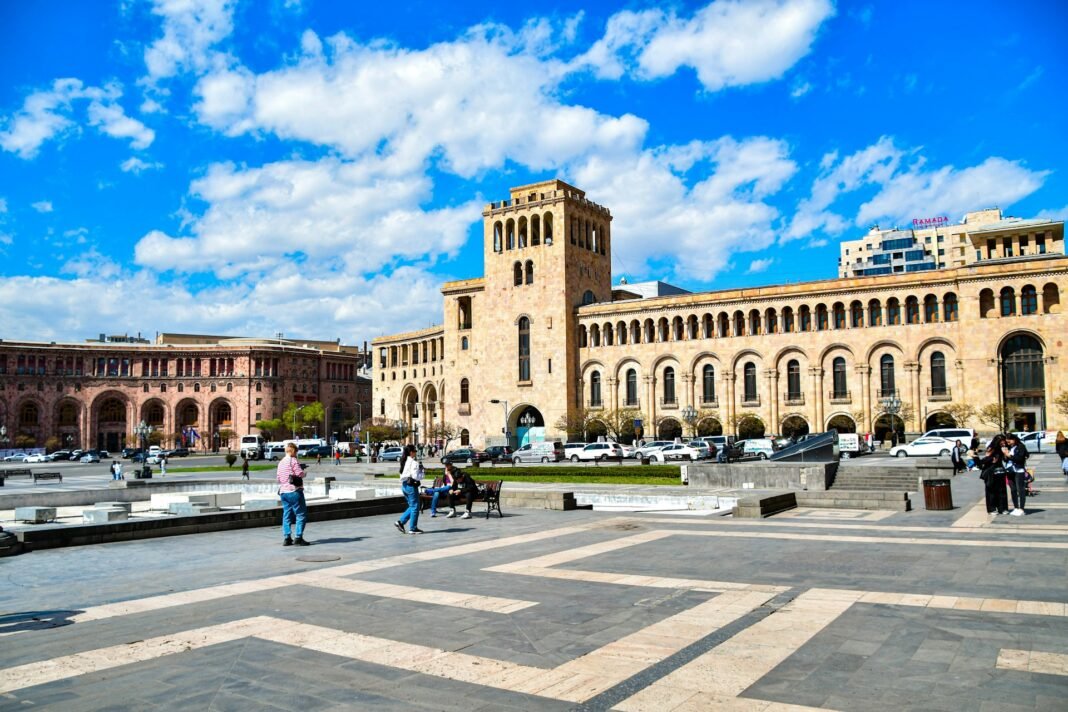
Street interviews conducted in Yerevan showed sharply conflicting views. Some residents welcomed closer integration with Europe and argued that Armenia should distance itself from Moscow.
“The farther away from Russia, the better,” one respondent said.
Others warned that Russia remains indispensable to Armenia’s security and economy. One of the opinions expressed in the report was that Armenia could not survive without Russian support.
The disagreement reflects the difficult position facing Pashinyan’s government. Public confidence in Moscow has weakened following years of tension over Russia’s response to the conflict with Azerbaijan and what many Armenians describe as its failure to fulfill allied security obligations.
Armenia suspended its participation in the Russia-led Collective Security Treaty Organization in 2024 but has not formally withdrawn from the alliance.
At the same time, the country remains a member of the Eurasian Economic Union and is heavily connected to Russia through trade, energy supplies, remittances and transportation infrastructure.
EU and Eurasian Membership Are Incompatible
A full shift toward the EU would require Armenia to make choices that Pashinyan has so far sought to postpone.
Russia and other Eurasian Economic Union members have repeatedly warned that Armenia cannot simultaneously remain inside the bloc’s common customs system and join the European Union.
Russian President Vladimir Putin has said that EU accession would require Armenia to leave the Eurasian Economic Union and surrender the economic privileges associated with membership.
The practical obstacles are also substantial. EU accession typically requires years of reforms, negotiations and the alignment of national legislation with European standards. Armenia would first need its application to be accepted before it could receive candidate status and begin formal membership talks.
There is currently no timetable for any of those stages.
Brussels Deepens Its Engagement
Despite the uncertainty surrounding membership, Armenia’s political relationship with Europe has strengthened significantly.
Yerevan hosted the European Political Community summit and the first EU-Armenia bilateral summit in May 2026. European leaders described the meetings as evidence of a rapidly deepening partnership.
The EU has also expanded its involvement in Armenia’s security, economic development, infrastructure and institutional reforms. Brussels says Armenia is closer to the European Union than at any previous point in their relationship.
Regional connectivity has become another important area of cooperation. The EU has expressed support for new transportation links across the South Caucasus, including projects associated with the Trump Route for International Peace and Prosperity, or TRIPP.
The route is expected to connect mainland Azerbaijan with the Nakhchivan exclave through Armenian territory while becoming part of a broader east-west trade network linking Central Asia with Europe.
For Azerbaijan, the direction chosen by Yerevan will matter not only politically but also economically. A more predictable Armenia integrated into regional trade routes could support the peace process and open new transportation opportunities. A disorderly confrontation between Armenia and Russia, however, could create economic pressure and fresh instability along Azerbaijan’s western border.
Pashinyan’s statement therefore marks an important political step, but not yet an irreversible geopolitical break. Armenia is moving closer to Europe while remaining economically embedded in a Russian-led bloc.
The central question is no longer whether Yerevan wants stronger ties with Brussels. It is whether Armenia is prepared to bear the economic and strategic costs of choosing Europe over Russia.
AZE.US