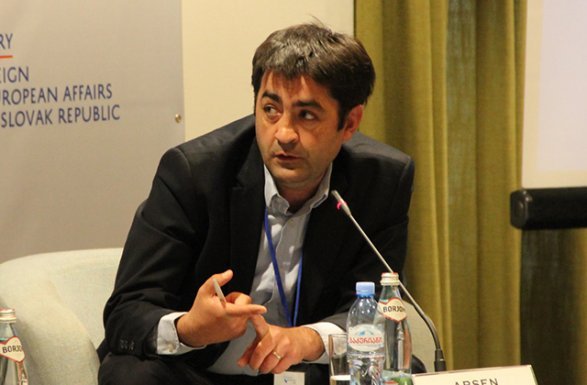
Launching the TRIPP transport project before Armenia and Azerbaijan sign a peace treaty could weaken Yerevan’s negotiating leverage if Baku secures a link to Nakhchivan and then loses some urgency to complete the broader normalization process, Armenian conflict analyst Arsen Kharatyan said.
At the same time, U.S. participation and international economic interests tied to the route could help reduce the risk of renewed conflict, Kharatyan said in CivilNet’s weekly review program.
The central question for Armenia, in his view, is whether opening the route will be accompanied by reciprocal steps to unblock the region. A connection between mainland Azerbaijan and Nakhchivan would not by itself guarantee Armenia comparable access to transport and trade opportunities.
Kharatyan said Azerbaijan is primarily interested in implementing the Trump Route for International Peace and Prosperity, or TRIPP, and could have less incentive to move quickly on a peace treaty or the final opening of other communications once that objective is achieved. He presented that as his assessment of Baku’s negotiating strategy.
He did not argue that practical cooperation should wait until a treaty is signed. Trade and transport links should be developed even without diplomatic relations and fully open borders, he said.
“Even with a peace agreement, peace will not come in one day,” Kharatyan said.
He also pointed to the weakness of direct public contacts. During visits to Armenian border communities, young people asked him how to speak with Azerbaijanis and where such communication should begin, he said. The episode illustrated the distance between political arrangements and public readiness for coexistence.
International Investment Could Lower Security Risks
Kharatyan said investment by third countries and their interest in keeping TRIPP operational could create additional deterrents against renewed fighting. External participants with economic stakes in the route could alter the security environment around the project.
Transport infrastructure, however, would not resolve the political disputes. One of the principal obstacles remains Armenia’s Constitution, which Azerbaijan says must be amended before a peace treaty can be signed.
Kharatyan said Baku wants that demand met and continues to pressure Yerevan. Armenia’s government, meanwhile, would need enough parliamentary support to submit a new constitution to a referendum.
Some opposition lawmakers could provide the required votes, he said, though he was skeptical that a broad political agreement was likely. In his assessment, the government may instead try to persuade opponents by warning of the risk of war and the possibility of snap elections.
Parliamentary Violence Complicates the Debate
The discussion comes after another physical confrontation between Armenian government and opposition lawmakers in parliament.
Kharatyan said the political response to such clashes matters as much as the incident itself. Defending or normalizing violence, he argued, risks turning it into an accepted tool of political competition.
“First of all, the political majority must restrain itself,” he said.
An atmosphere of threats and insults makes it harder to find compromises on the transport route, constitutional reform and the peace treaty, Kharatyan said. Those issues could again be subordinated to the struggle for domestic political advantage.
Sources: Vesti Baku; CivilNet.