AZE.US
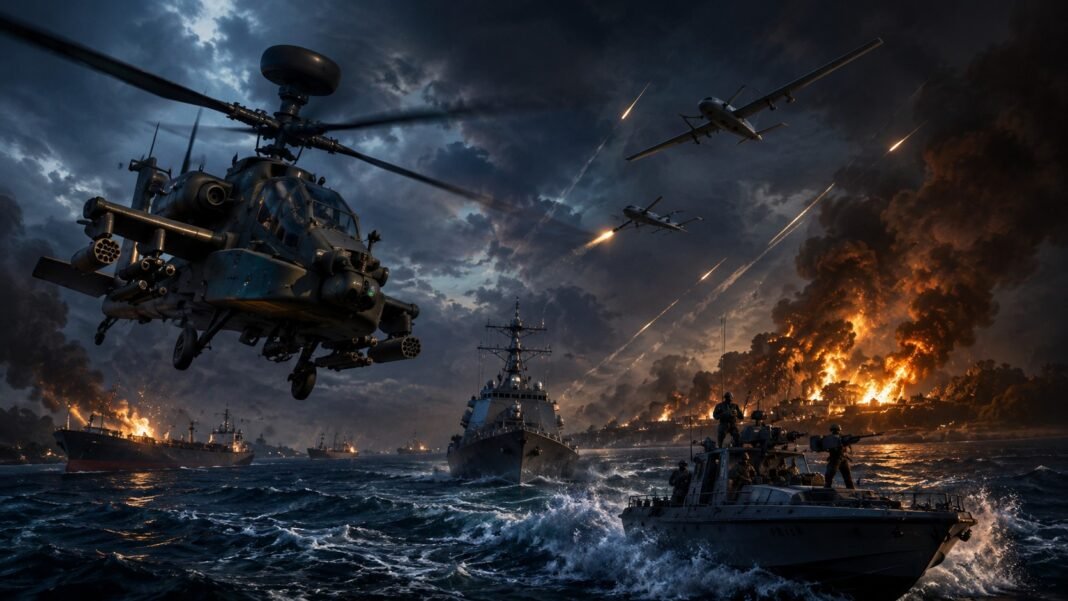
The United States launched a new round of strikes against Iran on Tuesday after an American Apache helicopter went down near the Strait of Hormuz, raising fresh doubts about efforts to end the war.
President Donald Trump said Iran had shot down the helicopter and promised a strong response.
“They shot down a helicopter, and we are responding as we speak,” Trump told ABC News.
U.S. Central Command described the strikes as a “proportional response” to what it called unjustified Iranian aggression.
The exact circumstances of the helicopter incident, however, remain unclear.
A U.S. official told The Associated Press that the AH-64 Apache crashed after colliding with an Iranian drone. The official said it was not known whether the collision was intentional. The military said the incident remained under investigation.
The helicopter went down near the coast of Oman while patrolling the strategic waterway early Tuesday.
Both crew members survived. A U.S. Navy unmanned surface vessel found them after they spent about two hours in the water. The military said they were in stable condition.
Iranian state media reported explosions on Qeshm Island in the Strait of Hormuz and said a projectile had struck near Sirik in Hormozgan province. There was no immediate official information about casualties or the full extent of the damage.
Iran’s Foreign Minister Abbas Araghchi did not directly address the helicopter incident. He said foreign military forces operating near Iran risked becoming involved in accidents or crossfire.
An Iranian military source later told state media that Iran had carried out no offensive air operations in the Strait of Hormuz during the previous 24 hours. The source warned that Tehran would respond decisively to renewed attacks.
Peace Efforts Under New Pressure
The latest confrontation came as Washington and Tehran continued indirect efforts to reach an agreement ending the conflict.
Trump had said only hours earlier that a deal could be signed within two or three days, though he provided few details and Iranian officials have questioned whether the United States is genuinely committed to negotiations.
The helicopter incident and the subsequent American strikes could further complicate talks over Iran’s nuclear program, sanctions relief and shipping through the Strait of Hormuz.
Iran has continued to restrict most maritime traffic through the waterway, which carried about 20% of the world’s crude oil and liquefied natural gas before the war.
The United States has imposed a blockade on Iranian ports.
Washington says any agreement must prevent Iran from developing a nuclear weapon. Tehran is demanding sanctions relief, access to billions of dollars in frozen assets and recognition of its security role in the Strait of Hormuz.
Israel-Iran Truce Remains Fragile
The escalation also came one day after Iran and Israel halted a renewed exchange of strikes that had placed their already fragile ceasefire under severe pressure.
Trump said he had warned Israeli Prime Minister Benjamin Netanyahu against restarting a full-scale war with Iran.
The wider regional conflict has continued in Lebanon, where Israel carried out a deadly strike on the southern city of Tyre on Tuesday.
At least eight people were killed, according to Lebanese authorities. Thousands of residents were ordered to leave parts of the city before the attack.
Iran has linked any lasting agreement with Washington to an end to Israeli operations in Lebanon. Israel says its campaign against Hezbollah is separate from the U.S.-Iran ceasefire process.
Pressure Builds in Washington
The new U.S. strikes come as opposition to the war grows in Congress.
The House of Representatives voted 215-208 last week for a resolution directing Trump to withdraw U.S. forces from the conflict unless Congress formally authorizes military action.
Four Republicans joined Democrats in supporting the measure.
The resolution is unlikely to stop the campaign immediately. It would also need Senate approval and could face a presidential veto.
Still, the vote showed growing concern in Washington about an open-ended conflict that has entered its fourth month.
For now, Washington and Tehran continue to speak about the possibility of a settlement while exchanging military strikes.
The latest incident near the Strait of Hormuz shows how quickly the diplomatic process could collapse.
AZE.US