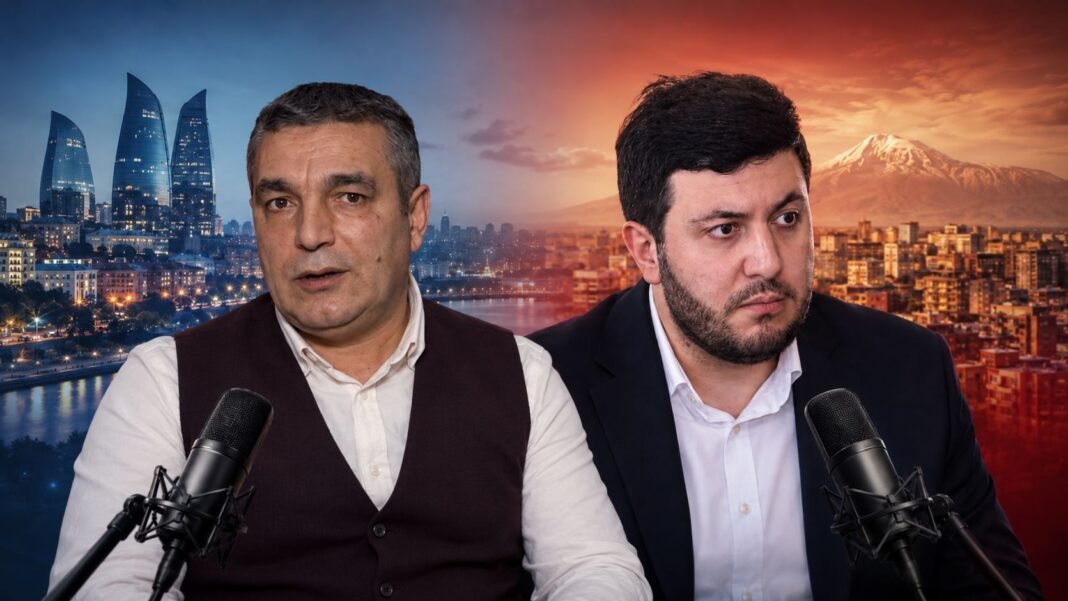
Tensions between Baku and Ankara, prospects for peace with Armenia and Iran’s conflicting position on the TRIPP transport project dominated the latest episode of PressClubsTV’s Events of the Week program.
Azerbaijani politician and economist Natig Jafarli and Armenian expert Areg Kochinyan discussed why relations between the two allies have become part of political debate in Turkey, whether talks are under way over the return of an Azerbaijani serviceman, and what could obstruct regional normalization.
Baku-Ankara Disagreements
Jafarli said the recent tension between Azerbaijan and Turkey was unlikely to develop into a prolonged crisis because relations have a strong political and social foundation. At the same time, he said recent events showed that even close allies can take different views of regional developments.
He said Azerbaijan has consistently sought to preserve an independent foreign policy while accounting for its relations with Turkey, Iran, Russia and other states.
“We are brothers and truly allied states, but we are two states, and we can have different opinions on different issues,” Jafarli said.
Jafarli argued that Turkey understands Azerbaijan’s importance to its foreign policy better than it understands Azerbaijani society. Turkish political debates do not always account for Azerbaijan’s secular character, historical experience and relations with Israel, he said.
He added that the dispute could eventually strengthen the alliance because Turkish society has become more interested in Azerbaijan, its history and its political priorities.
Jafarli also pointed to the domestic political dimension, saying relations with Azerbaijan have become an issue in Turkey’s political competition, where religious, nationalist and opposition forces hold noticeably different positions.
He said a possible visit to Azerbaijan by Nationalist Movement Party leader Devlet Bahceli could help reduce tensions.
Yerevan Says It Will Not Exploit the Dispute
Kochinyan said he saw no effort in Yerevan to exploit disagreements between Baku and Ankara.
Armenia is interested in normalizing relations with both Azerbaijan and Turkey, he said. Opening only the Turkish border would not allow Armenia to fully use the region’s transit opportunities if the border with Azerbaijan remained closed.
Kochinyan said Ankara could theoretically use the prospect of Armenian-Turkish normalization as leverage in its relations with Baku, but argued that such an approach would not provide a durable foundation for regional peace.
He suggested that Azerbaijan and Armenia should be viewed not only as former adversaries but also as states that could eventually become mutual guarantors of security.
Possible Talks Over an Azerbaijani Serviceman
The discussion also addressed an Azerbaijani serviceman being held in Armenia.
Kochinyan said the sides have developed a de facto practice of returning civilians who accidentally cross the border, citing the rapid return of an Azerbaijani shepherd under that practice.
The serviceman’s case is different because it involves an incident in which a weapon was used and a civilian was injured, he said. The case has therefore entered the criminal justice system, complicating its resolution.
Kochinyan did not rule out the possibility that Baku and Yerevan were already discussing a way out of the situation. He based that assessment on the restraint shown by official bodies in both countries and the absence of a public confrontation over the case.
Jafarli agreed that the lack of public agitation in Azerbaijan could indicate an expectation of a diplomatic solution. He expressed hope that the situation would be clarified soon, while acknowledging that the criminal case could prolong the process.
Neither participant presented official confirmation that talks on the serviceman’s fate were under way.
A Peace Treaty Would Not Erase Social Distrust
The experts also discussed the gap between political decisions by the two governments and attitudes among parts of their societies.
Kochinyan said a peace treaty should be seen not as the end of the process but as the start of a long period of social reconciliation.
The consequences of years of conflict cannot be overcome solely through diplomatic documents, he said. People in both countries have lost relatives and loved ones, while political forces opposed to normalization remain active.
Kochinyan said joint economic projects, direct trade and production chains involving companies from both countries could help gradually rebuild trust.
Jafarli said the peace process should be assessed through concrete economic and social benefits. Lower military spending could eventually allow more money to be directed to education, health care and infrastructure, he said.
He also challenged opponents of normalization to explain what practical alternative they offered to a peaceful settlement.
Iran and TRIPP
The final part of the program focused on Tehran’s position on the Trump Route for International Peace and Prosperity, or TRIPP.
The discussion followed statements by Iran’s ambassador to Armenia expressing concern about the possible presence of foreign forces along the future route.
Kochinyan said those statements conflicted with the position Armenian authorities said they had presented to Iran’s leadership. Yerevan describes TRIPP as an economic project involving the United States and Azerbaijan, without the deployment of foreign military forces.
He suggested that differing statements by Iranian representatives could reflect competing centers of influence inside the Islamic Republic.
Jafarli offered another possible explanation, saying Iran wants transport connections between mainland Azerbaijan and Nakhchivan also to pass through Iranian territory.
He cited construction of an alternative route along the Araz River that would significantly shorten travel through Iran.
Jafarli said some Iranian political circles might also use TRIPP as an additional bargaining instrument with Washington. Tehran’s sharp statements could alternate with more conciliatory rhetoric depending on the state of negotiations, he said.
He argued that the practical start of construction on the Armenian section of the route would be an important signal that the project had become irreversible and could reduce tension around it.
Jafarli separately warned of the risks of another large-scale conflict involving Iran, saying such a development would inevitably affect both Azerbaijan and Armenia.
The discussion concluded that Baku and Yerevan remain interested in maintaining an independent peace process despite disagreements among regional powers. Its durability, the participants said, will depend not only on government decisions but also on whether the two societies can gradually move from mutual distrust toward practical cooperation.
Source: Vesti Baku.