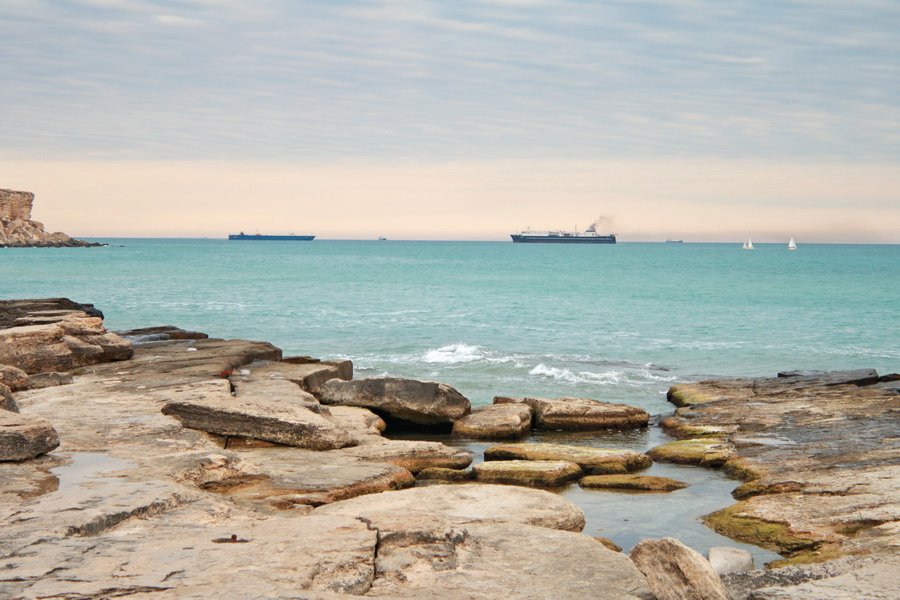
The Caspian Sea could retreat as far as 20 to 30 kilometers from the present-day Baku Boulevard by the end of the century under a worst-case climate scenario, Azerbaijani scientist Said Safarov said.
Safarov, head of the Caspian Sea Geography Laboratory at Azerbaijan’s Institute of Geography, said projections indicate the sea level could fall by 8 to 9 meters by 2100 even if international climate commitments are met. If those commitments are not fulfilled, the decline could reach 18 to 19 meters, he said in an interview with Kaspi newspaper.
The 20- to 30-kilometer estimate applies to the most severe long-term scenario and is not a forecast for the next few years. The Institute of Geography has separately said the decline may include temporary periods of rising water even as the overall trend remains downward.
Ports, Shipping and Energy Infrastructure at Risk
Safarov said a retreat on that scale would require major new coastal infrastructure and engineering projects. Ports, industrial and logistics facilities, tourism sites and marine transport would have to adapt to a dramatically different shoreline.
The shallow northern Caspian would face especially severe consequences. Its average depth is about 5 meters, and a further 18- to 19-meter decline could dry out much of the area and sharply restrict navigation between the Volga River and the sea.
Oil and gas production and transportation could also become more difficult because offshore platforms and related infrastructure were designed for existing water depths.
Measurements cited by Safarov put the Caspian at its lowest level in 48 years. Reuters reported in June that the sea had fallen about 1 meter over five years and 2.5 meters over 30 years, increasing risks to ports, shipping, fisheries, coastal tourism and offshore energy infrastructure.
Regional Coordination Needed
Experts say the five Caspian states need stronger joint monitoring, data exchange and long-term adaptation planning. For Azerbaijan, the issue involves both environmental protection and the resilience of critical economic infrastructure.
Related: Caspian Retreats 50 to 150 Meters as Hydrologist Warns of Risks
Source: Vesti Baku