AZE.US
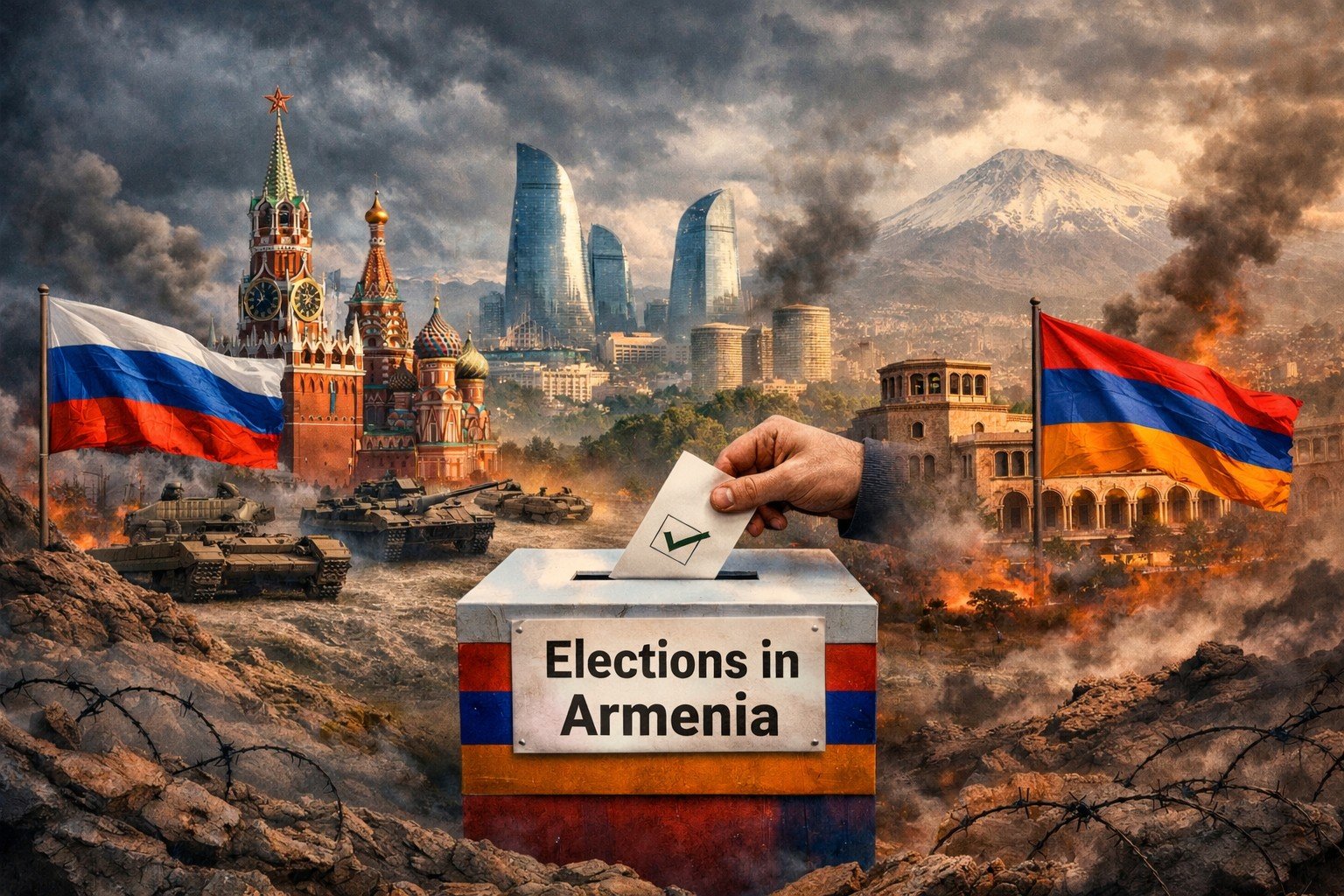
Armenia’s upcoming parliamentary elections are no longer just an internal political event. They are becoming a regional stress test.
The South Caucasus is entering a period in which several processes that once moved on separate tracks are now converging: a cautious recalibration in Azerbaijan-Russia ties, a fragile peace process between Baku and Yerevan, the growing strategic value of transport routes through Azerbaijan, and an increasingly visible struggle over Armenia’s political direction. The discussion in the source material makes clear that these issues are now being treated as part of one larger regional equation.
That is why the Armenian election matters far beyond Yerevan.
The central question is not simply whether Prime Minister Nikol Pashinyan can remain in power. The real question is whether Armenia stays on a path that keeps the peace track alive, preserves the logic of normalization, and avoids a return to the politics of provocation. In the source discussion, several speakers argue that a change in Armenia’s internal balance could directly affect the peace process, transport negotiations and the broader regional climate.
This is where the stakes become clear. The South Caucasus is slowly moving out of the old vocabulary of frozen conflict and into a harder world of logistics, trade routes, energy security and economic self-interest. That shift does not eliminate political risk. It makes it more immediate. Countries can no longer afford to speak only in slogans while ignoring the cost of blocking roads, delaying agreements or reviving maximalist agendas.
For Azerbaijan, that creates opportunity. Baku is not just defending the political results of the post-2020 period. It is trying to lock them in through infrastructure, transit and a new regional map built around connectivity. The source material repeatedly frames Azerbaijan as an increasingly important transport hub and emphasizes the role of routes linked to Zangilan, Nakhchivan, Turkey and the wider Middle Corridor.
That matters because the region’s geography is being revalued in real time.
Russia, too, appears to be adjusting. The tone in the discussion is pragmatic rather than sentimental: Moscow may still have unresolved disputes with Baku, but it also has fewer easy alternatives than before. Several participants describe Azerbaijan as a more valuable transit partner at a time when traditional routes are under greater pressure and regional instability has increased the importance of workable alternatives.
That does not mean Russia has abandoned its ambitions in Armenia. It means Moscow may now be operating with a more flexible hierarchy of goals.
One of the more revealing arguments in the source discussion is that Russia may no longer be focused solely on removing Pashinyan outright. A more realistic objective may be to limit him, pressure him, weaken his room for maneuver and ensure that pro-Russian forces remain inside Armenia’s political system even if he survives the vote. The speakers describe both a “minimum plan,” in which Russian-aligned forces gain leverage inside parliament, and a “maximum plan,” in which Pashinyan’s rule is replaced by a more Moscow-friendly coalition.
That distinction matters for the region.
A full return of openly revanchist forces in Armenia would not just complicate diplomacy. It could destroy the current peace framework altogether. The source material explicitly warns that opposition forces demanding outside guarantors for the talks or changes to the already agreed text would, in effect, blow up the bilateral process with Azerbaijan.
In that sense, the Armenian election is becoming a referendum on more than government performance. It is turning into a test of whether Armenian politics will accept the discipline of geopolitical reality.
That reality is uncomfortable but increasingly hard to deny. Even in the source discussion, the argument appears repeatedly that peace is beginning to produce tangible economic logic for Armenia itself, including in energy supply, trade and future transport opportunities. Several speakers say that the peace process is no longer just an abstract diplomatic formula but a question with visible economic consequences.
This is also why Azerbaijan must stay careful.
Baku’s interest is not in endorsing one Armenian politician over another. Its interest is in preserving a process that reduces the likelihood of renewed war and increases the cost of political sabotage. That is a crucial difference. Support for peace is not the same thing as support for Pashinyan personally. But under current conditions, the two can overlap in practice because the forces most hostile to him also appear more hostile to normalization with Azerbaijan and Turkey.
There is another layer to this moment: instability around Iran.
The source discussion argues that rising pressure on Iran has increased the strategic value of routes running through the South Caucasus while also exposing the vulnerability of older patterns of trade and transit. Some speakers say this has hurt imports and disrupted existing logistics, but they also argue that Azerbaijan’s role as an energy supplier and transit corridor has grown as a result.
That broader turbulence makes Armenia’s election even more consequential. When outside pressure rises, countries on strategic corridors face stronger incentives either to stabilize their environment or to become arenas for other powers’ competition. Armenia now stands between those two outcomes.
If it stays on a path of managed pragmatism, the region could move further toward a post-conflict order centered on connectivity, energy, trade and mutual restraint. If it turns back toward grievance politics, foreign dependency and deliberate disruption of negotiations, then the South Caucasus could once again become a zone of permanent volatility.
That is why the next Armenian election may prove decisive.
The region is no longer choosing between ideal outcomes. It is choosing between a difficult peace and another cycle of crisis. And for all the diplomacy, signals and summits, that choice may soon be made at the ballot box in Armenia.
AZE.US