AZE.US
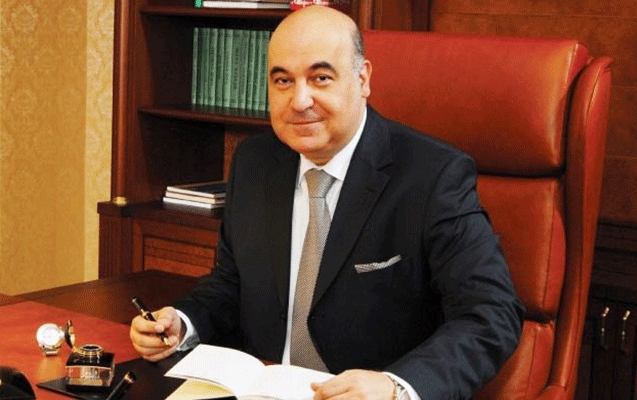
Azerbaijani People’s Writer Chingiz Abdullayev issued one of his sharpest warnings yet about Armenia’s internal political climate, saying the region should not confuse tactical restraint in Yerevan with any final abandonment of revanchist ambitions.
Speaking on CBC, Abdullayev argued that Armenia is still living through the consequences of what he described as a decades-long Karabakh adventure that drained the country’s resources, weakened its statehood and security, and left behind a volatile political environment that has not truly stabilized. He said even Prime Minister Nikol Pashinyan’s current rhetoric about the price Armenia paid reflects a reality that many outside Armenia had long recognized.
But Abdullayev’s message went well beyond criticism of the past. His real warning was about the future.
He said there may be no immediate interest in Armenia launching a new confrontation now, but that does not mean the danger is gone. In his view, weapons accumulated today could, within five or 10 years, end up in the hands of more radical forces if revanchists return to power with backing from diaspora money and entrenched nationalist networks. That, he suggested, is the scenario the region cannot afford to ignore.
The most alarming part of the discussion came when Abdullayev addressed rhetoric coming from Armenian political circles about not being afraid of war. He treated that language not as campaign theatrics, but as a serious red flag. When a politician tells society not to fear another war, he argued, the implication is obvious: there are still forces in Armenia prepared to imagine a new military attempt after past defeat.
That is why his warning was so stark: in his reading, Yerevan is playing with fire. Not necessarily because war is imminent, but because a dangerous political psychology remains alive – one that mixes grievance, militarization, diaspora influence and the illusion that history can somehow be reversed.
Abdullayev also made clear that the broader regional environment only makes this more dangerous. The South Caucasus is no longer operating in a calm geopolitical setting. With instability spreading across the wider region, from Armenia’s unresolved post-war politics to mounting tensions around Iran and the Middle East, any attempt to delay hard decisions or flirt with revanchist narratives carries heavier risks than before. The room for miscalculation is shrinking.
His core point was simple and harsh: Armenia has already paid a high price for its past course, but that does not automatically mean the story is over. As long as political forces inside the country continue to weaponize fear, nationalism and the promise of revanche, the threat of a future crisis remains real.
For Baku, that means one thing above all: no illusions. Calm rhetoric is not the same as strategic closure, and a region that has seen too much war cannot afford to ignore signals that others are still preparing their societies psychologically for another round.
AZE.US