By AZE.US Editorial Team
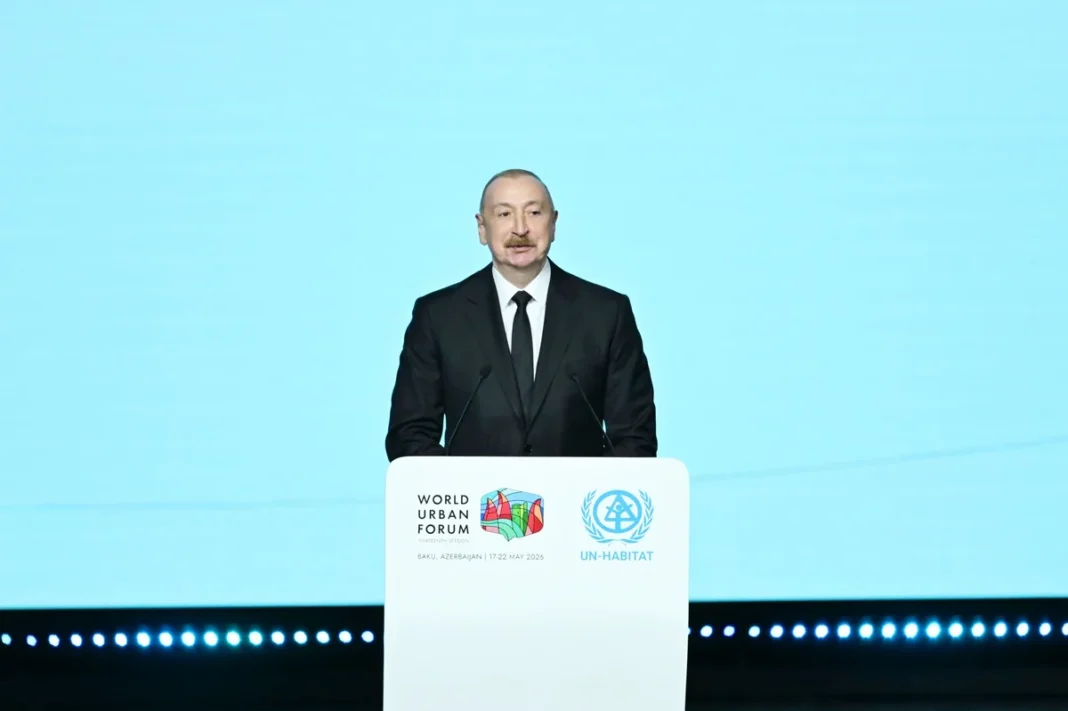
President Ilham Aliyev used the opening of the 13th World Urban Forum in Baku to present Azerbaijan’s urban development agenda as a balance between rapid modernization, environmental recovery, heritage preservation and large-scale reconstruction in Karabakh and East Zangezur.
Speaking at WUF13, Aliyev compared urban planning to the Formula 1 race in Baku, where cars exceed 300 kilometers per hour on the main straight before slowing sharply to pass through a seven-meter-wide section near the ancient fortress walls of the Old City.
For the Azerbaijani president, the comparison was not just a colorful metaphor. He used it to argue that city development requires both speed and restraint: leaders, he said, must be bold in modernization and improving living conditions, but cautious when it comes to protecting historical heritage.
That balance became the central message of his speech. Aliyev said Baku’s development should be understood not only through new construction, but also through public transport, micromobility, electric buses, green spaces, environmental cleanup and the preservation of the capital’s architectural identity.
According to Aliyev, Azerbaijan has created 100 parks and gardens in Baku over the past 20 years, while 19 of them have been fully reconstructed. He also said clean urban environments with rapid access to public transport, metro, micromobility and modern electric buses are being implemented as part of a single development concept for Baku and other cities.
The environmental section of the speech was one of the most pointed. Aliyev reminded the audience that Baku became the world’s first oil-producing city in 1846, and said environmental protection had received little attention for nearly 180 years afterward. He cited areas such as Black City, Bibiheybat and Boyukshor as examples of the heavy ecological legacy inherited by the capital.
Aliyev presented the transformation of the former Black City into White City as a symbol of that shift. He described White City as a modern example of urban planning and “a city within a city.” He also mentioned Sea Breeze as another model of contemporary urban development near Baku.
But the speech was not only about the capital. Aliyev placed the reconstruction of Karabakh and East Zangezur at the center of Azerbaijan’s urban development message. He said more than 85,000 Azerbaijanis now live and work in the formerly occupied territories, where the government is implementing the “Great Return” program.
The president said master plans for cities and villages have been prepared, and pointed to the scale of infrastructure works completed in the past five years. According to him, Azerbaijan has already built 70 kilometers of tunnels, with five more tunnels under construction. It has also built 435 bridges, while the total planned number is 500.
Aliyev said those projects have been carried out alongside the construction of power plants, water supply systems, reservoirs, homes, schools, hospitals, railways and three international airports. The figures gave his WUF13 speech a broader political dimension: Azerbaijan is presenting the reconstruction of Karabakh and East Zangezur not only as a national priority, but also as part of a global conversation about postwar recovery, urban planning and modern infrastructure.
That message fits the wider purpose of WUF13 for Baku. The forum, held in the Azerbaijani capital from May 17 to 22, is focused on housing, resilient cities and sustainable communities. Official materials describe WUF13 as one of the largest urban policy gatherings in the world, with ministers, city leaders, planners, experts, businesses and civil society representatives discussing housing, infrastructure and the future of urban life.
For Azerbaijan, hosting the event is also part of a broader effort to position Baku as a venue for major international discussions beyond energy and security. Officials have described WUF13 as the second-largest international event hosted by Azerbaijan after COP29, and reports said more than 45,000 participants from 182 countries were registered for the forum.
Aliyev also framed Azerbaijan’s geography as part of its urban identity. He said the country lies between Europe and Asia and has long been a meeting point of East and West, a position reflected in Baku’s architecture. He pointed to the contrast between the ancient walls of Icherisheher, the modern seaside boulevard now stretching for more than 15 kilometers, and 19th-century buildings designed by European architects.
The speech showed how Azerbaijan wants WUF13 to be read internationally. It is not presenting the forum only as a conference about cities. It is using it to link Baku’s transformation, green urban policy, heritage preservation and the rebuilding of Karabakh into one political and development narrative.
For Baku, that makes WUF13 both a showcase and a test. The showcase is clear: major international guests, large numbers, new infrastructure and a capital that wants to be seen as a modern urban platform. The test is harder: whether the language of sustainable cities translates into more livable neighborhoods, better transport, cleaner public space and development that serves residents as much as it impresses visitors.
AZE.US