AZE.US
Russia’s pressure on Armenia ahead of elections has become one of the key political signals in the South Caucasus, linking Yerevan’s domestic campaign directly to the future of the peace agenda with Azerbaijan.
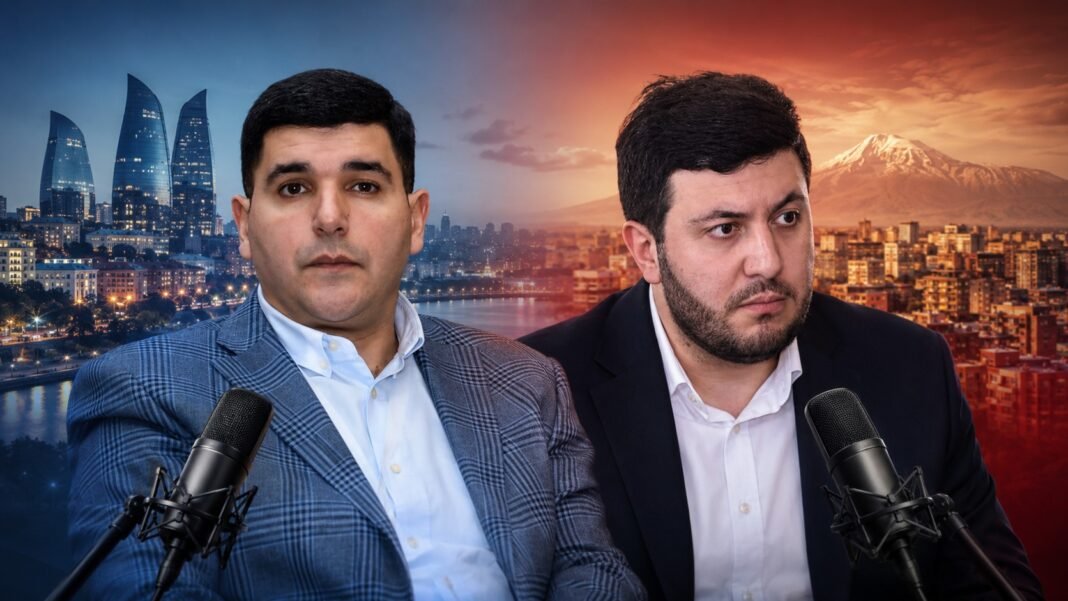
In a new episode of Press Clubs TV’s “Events of the Week,” Baku-based analyst Farhad Mammadov and Yerevan-based analyst Areg Kochinyan discussed Moscow’s recent statements toward Armenia, the role of pro-Russian forces, the TRIPP infrastructure project and the wider regional context.
Kochinyan said almost everything now happening around Armenia and its relations with Russia has an election-related character. In his view, Moscow is actively involved in Armenia’s election campaign, using different tools of influence, including the information space, economic ties, energy leverage and public statements by Russian officials.
According to Kochinyan, Russia has two possible goals. The maximum goal is to help remove Prime Minister Nikol Pashinyan’s team from power. The minimum goal is to prevent Pashinyan’s party from gaining a two-thirds constitutional majority in parliament.
That detail matters beyond domestic politics. Kochinyan said constitutional changes are important not only for Armenia’s democratic reforms, but also as one of the elements connected to the peace process with Azerbaijan.
Mammadov said Azerbaijan is watching the Armenian elections very closely because the result will affect the peace agenda and the formation of a new regional balance.
He argued that Armenia’s elections have increasingly taken on a geopolitical character. Foreign policy orientation, he said, has become more important in the campaign than many economic or internal political issues.
For Baku, the key question is how Armenian political forces will treat already signed documents and agreements. Mammadov noted that even if Pashinyan wins, pro-Russian forces are likely to be represented in parliament, and their position will remain important for Azerbaijan to monitor.
The two experts also discussed the TRIPP project. Kochinyan said a technical, not political, U.S. delegation had arrived in Armenia to study the ground situation, terrain, possible costs, resources and construction timeline. He described it as a move from documents and general discussions toward the first stage of practical planning.
Mammadov said Azerbaijan has already made major progress on its part of the infrastructure. According to him, railway work is about 72% complete, while readiness in some related areas is around 80%. He also said Azerbaijani construction capacity is now about five kilometers from Armenia’s border in the Zangilan district.
TRIPP, he said, is not only about a railway. The project may also include a road, a power transmission line, an internet cable and possibly a small-volume gas pipeline. Mammadov said that after the Armenian elections, the sides may move toward decisions on an operating company, its legal regime and the infrastructure model.
Another topic was Türkiye’s decision to allow Armenia to be listed as the final destination or country of origin for bilateral cargo. Kochinyan said trade between Armenia and Türkiye already existed through third countries, while the new step mainly changes the documentation.
In his view, Ankara is synchronizing its approach with Baku. Azerbaijan has already started documented trade with Armenia through a third country, and Türkiye has now made a similar bureaucratic move.
Mammadov agreed, calling Türkiye’s decision another step in preparation for the eventual opening of borders. He noted that trade turnover between Azerbaijan and Armenia has already exceeded $10 million and said preparation for the unblocking of communications is moving both in infrastructure and bureaucratic terms.
The discussion also touched on the UN World Urban Forum in Baku. Mammadov said that after COP29, it is one of the most representative international events hosted by Azerbaijan. He said the forum is important as the world’s urban population grows and modern cities increasingly require scientific planning.
He also mentioned the heavy rain in Baku, which created local problems in the city. Mammadov linked the event to climate change and said such rainfall volumes create new challenges for Baku and the Absheron Peninsula, where the climate is semi-desert.
The final regional topic was the “Turkic world” and the role of the Organization of Turkic States. Mammadov urged caution with terminology and said the OTS should not be turned into a political scarecrow.
According to him, the organization has evolved from summits into a more structured platform with a secretariat and related institutions. But he said it cannot currently be viewed as a full military-political or economic union because its members have different commitments, including NATO, the CSTO, the Eurasian Economic Union and Türkiye’s customs links with the European Union.
Mammadov said the OTS today is mainly about high-level political dialogue, transport and infrastructure projects, green energy, fiber-optic links and humanitarian cooperation. Military and defense-technical cooperation is developing, but mostly through bilateral and trilateral formats rather than under one OTS umbrella.
Kochinyan, speaking about Armenian perceptions of the Turkic world, said Armenia has lived for decades with many myths about pan-Turkism. He said Armenia needs to better understand what is really happening in its neighborhood and avoid looking at these processes only through someone else’s lens.
He stressed that this does not mean forgetting the problems and tragedies in relations with Türkiye and Azerbaijan. But, he said, Armenia needs to learn to live next to its neighbors, study real regional processes and build relations with nearby countries.
The broader message of the discussion was clear: Armenia’s elections are no longer only a domestic political event. They are directly tied to the peace agenda with Azerbaijan, transport projects, Russia’s role, Türkiye-Azerbaijan coordination and the future regional balance.
For Baku, the main question is whether Armenia will continue practical implementation of the peace agenda after the elections - or whether the process will again enter a period of uncertainty.
AZE.US