AZE.US
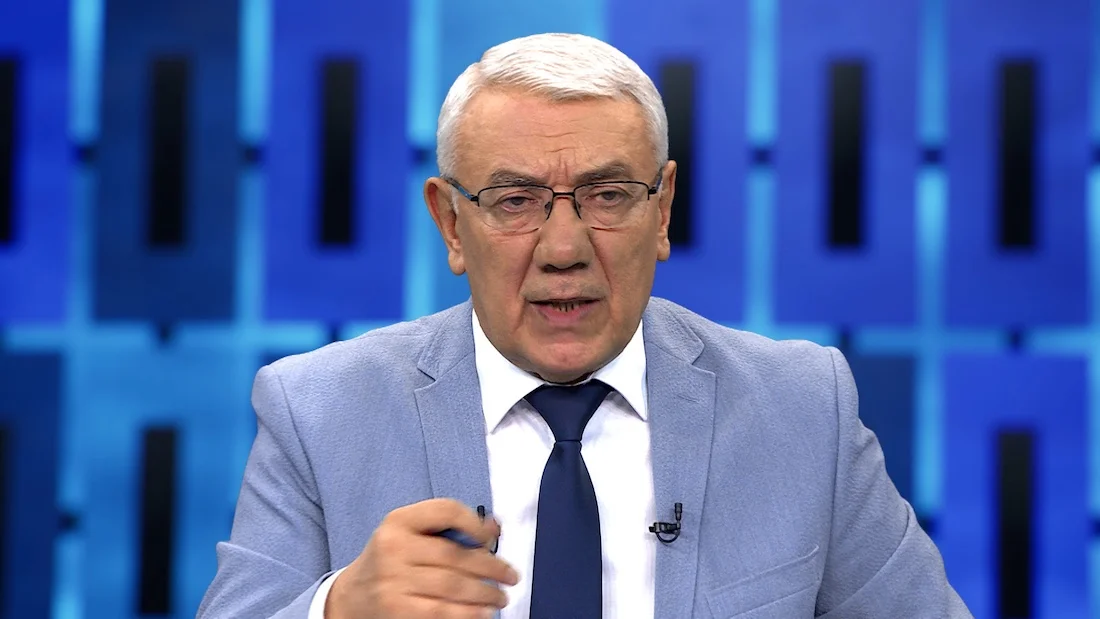
Political analyst Eldar Namazov says Iran is moving toward a possible deal with the United States not from a position of strength, but because the country is facing a severe internal crisis.
Speaking on the YouTube channel ITON-TV, Namazov said the Iranian regime urgently needs money and is trying to secure at least a temporary opening that would allow it to sell oil and ease pressure on the economy.
According to him, information coming from Iran shows that the country is close to a social explosion, with serious problems in food supply, electricity, energy and public stability.
Namazov pointed to recent remarks by Iranian President Masoud Pezeshkian, who reportedly spoke at a government meeting about the need to “change approaches” because the current situation threatens social order and the stability of the state.
“The situation there is really so difficult that they were in a hurry to reach some kind of agreement with Trump as soon as possible, so that he would lift the naval blockade and they could at least sell oil,” Namazov said.
He argued that Tehran is not looking first for a full long-term treaty, but for a fast memorandum that could help reopen ports, ease restrictions and provide access to financial resources. That is why, he said, the sides are discussing a preliminary document and a two-month negotiation period.
Namazov said the nuclear issue remains the central question for Washington. In his view, the United States would not agree to ease pressure on Iran and allow the regime to receive money unless it had already received preliminary guarantees on enriched uranium.
He suggested that, in addition to the public memorandum, there may be a second, non-public document outlining possible agreements on Iran’s nuclear program. That could include Iran’s readiness to destroy enriched uranium on its own territory under the supervision of the International Atomic Energy Agency.
“Without knowing clearly that there are answers to this question, Trump would not have gone for this agreement at all,” Namazov said.
He also said Israel was effectively presented with the situation after the fact, since direct negotiations with Israel were not conducted as part of the reported U.S.-Iran track. However, Namazov believes Israel’s participation will become unavoidable at the next stage, especially if the talks expand to Lebanon and Hezbollah.
According to him, no lasting security arrangement can be reached without Israel and Lebanon’s legitimate authorities. He said it would be unrealistic to demand one-sided commitments from Israel not to use force while terrorist infrastructure remains in place and attacks continue.
Namazov described Iran’s internal situation as extremely fragile. He said the latest phase of strikes on Iran added millions of unemployed people, damaged large parts of the military-industrial complex and created huge reconstruction costs.
In his view, the post-conflict period may be even more dangerous for the Iranian regime than the military phase itself. Tehran will have to address social and economic problems, feed the population, calm the merchant class and look for major outside investment.
“This regime in Iran will not survive the post-conflict period, when it will have to solve social and economic problems,” Namazov said.
He argued that Iran would have to reform in order to survive, but those reforms could undermine the system from within. Namazov compared the possible process to the late Soviet perestroika period, when an attempt to open the system and cooperate with the West led not to renewal, but to the collapse of the old regime.
Such systems, he said, are built on fear, the image of an external enemy and strict ideology. Once those pillars begin to weaken, the state loses stability.
“If they start a new ‘White Revolution’ with the help of Western companies, it will be Soviet perestroika with the same outcome,” Namazov said.
He added that even a partial unfreezing of funds would not solve Iran’s structural problems. For a country of around 90 million people, tens of billions of dollars would only provide short-term relief. Rebuilding the economy, he said, would require long-term investment on the scale of a new Marshall Plan.
Namazov’s assessment is that a U.S.-Iran deal may give Tehran a pause, but it does not answer the main question: whether the Iranian regime can survive a period in which it will be forced to change the very system that keeps it in power.
AZE.US