By AZE.US Editorial Team
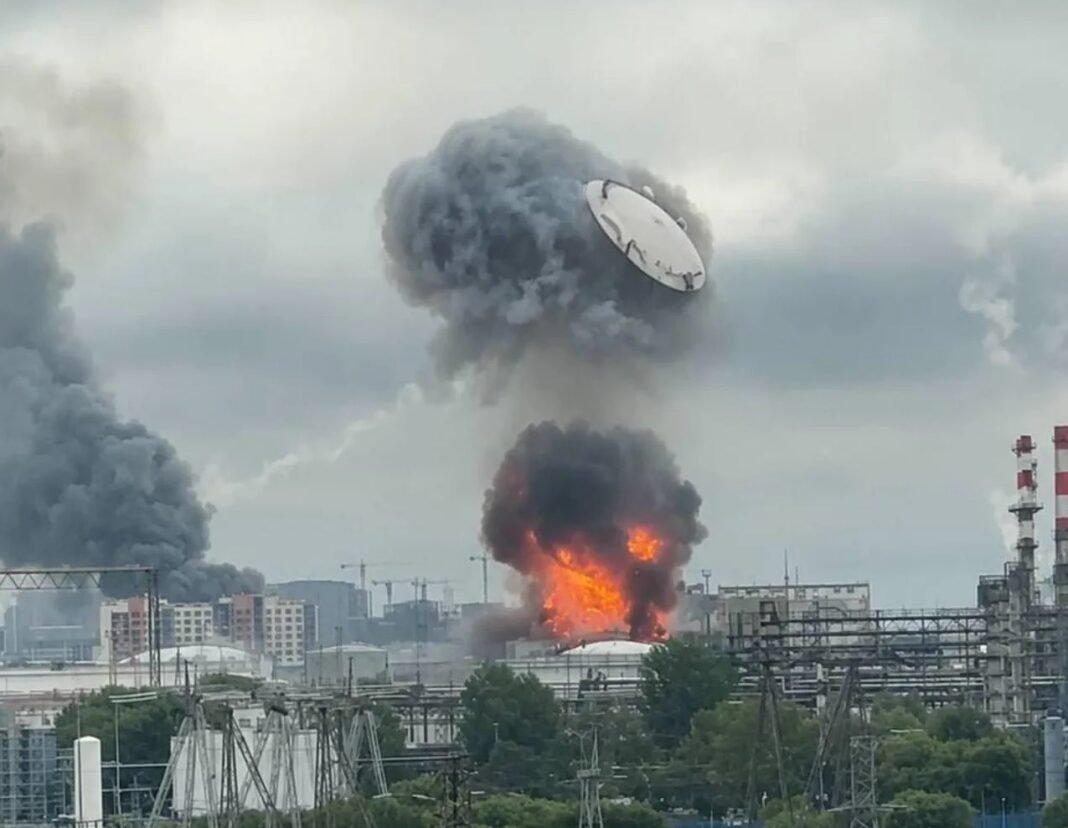
Moscow is burning, and not only in the literal sense.
The smoke rising over the Russian capital is also smoke over the political illusion that Vladimir Putin has been building since the first day of the war: the illusion that Russia can wage a devastating war against Ukraine while Moscow continues to live as if nothing is happening.
For years, that was the Kremlin’s unspoken deal with the capital.
The war was somewhere else. It was in Ukraine, in Russian border regions, in military reports, in propaganda studios, in funerals far away from the comfortable center of Moscow. But the capital itself remained a showcase of normal life: full restaurants, clean streets, concerts, traffic jams, shopping centers, bright lights and the carefully staged image of a country that was supposedly under control.
That image is now cracking.
The drone strike on the Moscow oil refinery in Kapotnya was not just another episode in the expanding war of drones. It was a strike on the Kremlin’s sense of invulnerability. It sent a simple message: if Kyiv, Kharkiv, Odesa, Dnipro and other Ukrainian cities can burn, Moscow cannot expect to remain forever untouched.
And this time, the message reached the capital in black smoke.
Kapotnya, explosions, fires, closed roads, disrupted airports, panic in local chats, videos from apartment windows and the familiar official formula that “everything is under control.” The authorities once again tried to turn a political shock into a technical incident. But this no longer works.
Putin is now trapped because every option available to him carries a cost.
If he continues the war at the same pace, Ukraine will keep looking for ways to hit deeper inside Russia, including strategic infrastructure near the capital. If he moves toward negotiations, he will effectively admit that pressure works and that Moscow is no longer dictating the tempo. If he responds with another wave of strikes on Ukrainian cities, Kyiv will use that response to make an even stronger case to Western allies: Russia does not want peace, Russia understands only strength, and Ukraine must be given more air defense, more missiles and more long-range capabilities.
That is the real trap.
For years, Putin sold Russians the image of a strong state. Yes, people were poorer. Yes, sanctions hurt. Yes, soldiers were dying. But the Kremlin’s core promise remained: Moscow is protected, the state is strong, air defenses are working, and the war will not come home.
Now it has.
The strike on the Kapotnya refinery is symbolically powerful because this is not some remote depot in the forest. It is a major industrial site inside the body of the capital region, tied to fuel supplies, logistics and the sense of security of Moscow itself. It is a reminder that a war launched as a televised “special operation” has become a reality of fire, smoke, debris and fear.
That is why the propaganda reaction is so nervous.
Instead of explaining why air defenses failed to protect a strategic facility, the system tries to punish those who film the aftermath. Instead of discussing whether residents are safe, propagandists demand arrests for people who post videos. This is the old Russian logic: if you cannot stop the explosion, try to ban people from seeing it.
But in 2026, that logic is almost absurd.
Moscow films itself. Smoke over the city cannot be hidden. A black sky cannot be declared fake. People see, hear, record, share and discuss. The harder the authorities try to impose silence, the clearer it becomes that the situation is not under control.
The most important effect of this attack is not military, at least not immediately. It is psychological and political.
Until now, the Kremlin counted on several things: Western fatigue, fear of escalation, and the passivity of Russian society. But if Ukraine can increasingly hit energy and military infrastructure deep inside Russia, the calculation changes. Moscow is no longer only the command center of the war. It is becoming part of the war.
For Putin, that is more dangerous than the loss of another warehouse or another damaged industrial unit.
His power is based not only on repression, but also on a myth: that he controls chaos. That he can bring war to others without bringing it home. That he can destroy Ukrainian cities while keeping Moscow in the atmosphere of an endless holiday. That he can make others live under sirens while his own capital lives under festival lights.
That myth is now burning with Kapotnya.
Of course, one strike will not end the war. Russia remains a huge military machine. The Kremlin can still respond brutally. But Putin’s strategic problem is becoming clearer: Ukraine no longer looks like a country that can simply be exhausted into surrender. It is defending itself, but it is also answering. And it is answering in a way that ordinary Muscovites can see.
That is the question now facing Russia’s capital.
Did people really believe that war would remain forever on television?
The Kremlin wanted Russians to get used to the suffering of others. Now it must deal with the fear of its own citizens. It wanted Moscow to live separately from the war. Now the war is arriving in Moscow. It wanted to force Ukraine to its knees. Instead, Putin has placed himself in a position where every next step exposes weakness.
Moscow is burning. And this is no longer just smoke over an oil refinery. It is smoke over Putin’s illusion of safety.
AZE.US