By AZE.US Editorial Team
A year ago, Washington helped Azerbaijan and Armenia lay the political foundation for peace.
The United States is now moving to the next stage: turning declarations into infrastructure, commercial interests and a long-term presence in the South Caucasus.
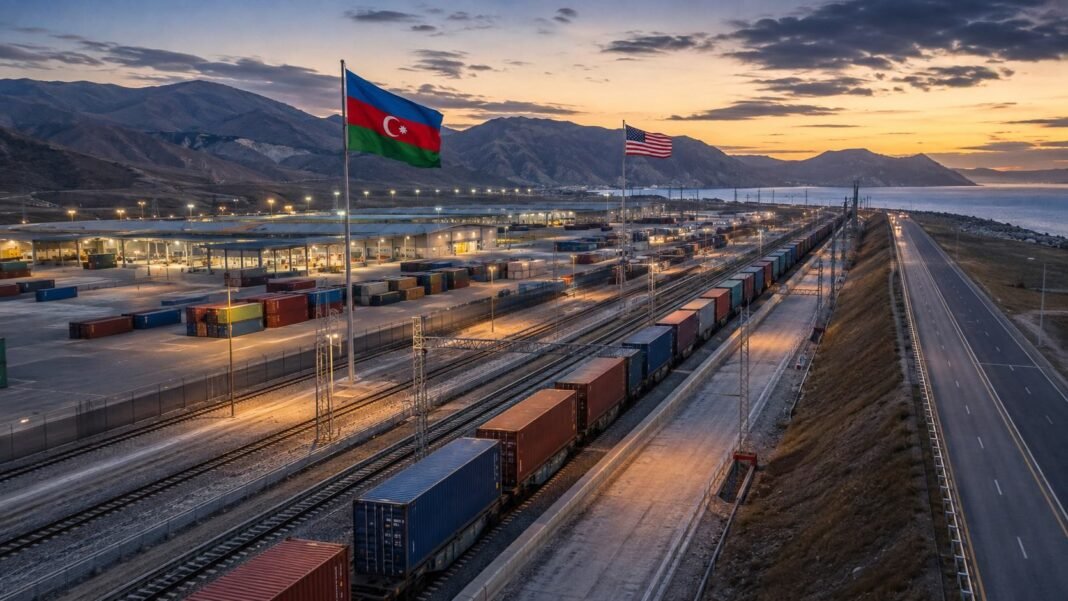
That is how the launch of the Trans-Caspian Enterprise Fund, capitalized with $201 million in US government funding, should be understood.
The money is not intended exclusively for the Trump Route for International Peace and Prosperity, or TRIPP, nor is it simply a construction grant for the roughly 27-mile section planned across Armenia.
The fund is designed to attract private investment along the wider Middle Corridor, extending from Central Asia across the Caspian Sea and the South Caucasus to Turkey and Europe.
TRIPP, however, is expected to become one of its most strategically important links.
A Short Route With Major Geopolitical Weight
On a map, the Armenian section looks almost insignificant. Several dozen miles of infrastructure would connect mainland Azerbaijan with its Nakhchivan exclave and then with Turkey.
Its strategic importance, however, cannot be measured in miles.
Russia’s war against Ukraine has made the traditional overland trade route through Russia politically and commercially risky. Maritime transportation is also facing growing instability, from the Red Sea to other potential conflict zones.
Against this backdrop, the Middle Corridor is no longer merely an alternative route. It is emerging as an independent Eurasian trade artery.
Washington understands that countries involved in developing the corridor’s infrastructure, financial mechanisms and operating standards will gain influence over the movement of goods between China, Central Asia and Europe.
Azerbaijani lawmaker Rasim Musabekov put the argument bluntly during an interview with Baku TV: by supporting the critical section of the route, the United States can gain influence over the Middle Corridor without spending amounts comparable to the cost of major global infrastructure programs.
In other words, $201 million is not the price of the entire route. It is the cost of securing a place in Eurasia’s emerging transportation architecture.
Why the Project Benefits Azerbaijan
Azerbaijan has already completed much of the required infrastructure work on its territory. New highway and railway links are approaching Aghband, where they are expected to connect with the planned section through Armenia.
For Baku, TRIPP would provide direct transit to Nakhchivan, strengthen access to Turkey and further consolidate Azerbaijan’s position at the center of the Middle Corridor.
Azerbaijan must nevertheless avoid becoming dependent on a single route. The alternative connection through Iran remains viable and could still be developed.
As Musabekov noted, two routes are more reliable than one.
Competition between transit options would work in Azerbaijan’s favor. If one country attempted to use access as political leverage, Baku would retain an alternative. Multiple connections, rather than a monopoly held by any single transit state, best serve Azerbaijan’s national interests.
Armenia’s Opportunity to Escape Isolation
For Yerevan, the project offers an opportunity to transform geography from a liability into a source of revenue.
Armenia could gain new railway infrastructure, transit income, foreign investment and access to regional trade. To achieve that, however, it must resolve problems that have been left untouched for decades.
A significant part of Armenia’s railway system remains under Russian management. Moscow and Yerevan continue to dispute the condition of the network, the value of Russian investments and the future of the concession.
Russia wants its interests taken into account, while Armenian officials have discussed bringing in other operators if the current arrangement cannot support the country’s new transportation plans.
The greatest challenge facing TRIPP may therefore not be the construction of 27 miles of track. Such a section can be built relatively quickly. The harder task will be settling questions of management, financing and integration with the existing railway network.
Russia and Iran Can Delay the Project, but Stopping It Will Be Harder
For Moscow, TRIPP represents another reduction of Russian influence over Armenia and the loss of its former dominance over regional communications.
Iran is concerned for different reasons. A US-supported transportation project near its northern border raises fears in Tehran about strategic exclusion and a lasting American presence in the region.
TRIPP does not necessarily have to exclude either Russia or Iran from regional trade. If Moscow or Tehran does not want to use a US-supported route, both retain the option of developing alternative connections.
The deeper change is that regional powers have historically been able to block communications and preserve the South Caucasus’ dependence on their decisions. TRIPP challenges that model by creating a route backed by American financing and political influence.
Attempts to delay the project remain possible. But once Washington has invested political capital, established financial mechanisms and tied private-sector interests to the route, derailing it becomes significantly more difficult.
From Personal Relations to Strategic Partnership
The telephone conversation between President Donald Trump and Azerbaijani President Ilham Aliyev, which reportedly lasted more than 40 minutes, demonstrated how far relations between Baku and Washington have moved beyond their low point under the Biden administration.
Personal rapport between the presidents, however, must be converted into institutional agreements.
For Azerbaijan, progress on a strategic partnership framework, stronger economic cooperation and the full repeal of Section 907 are more important than compliments from the White House.
The waiver of Section 907 remains temporary. Its continued existence is increasingly difficult to justify as Azerbaijan permits transit to Armenia, supplies energy products to the Armenian market and supports a peace process backed by Washington.
What Washington Wants Next
After peace, the United States does not simply want gratitude. It wants a durable transportation route connecting Central Asia with Europe and a lasting role in a region long dominated by Russia and Iran.
Azerbaijan wants the same corridor for different reasons.
For Baku, it is an opportunity to convert geography, restored territorial control and infrastructure investment into long-term political and economic influence.
There is no inherent threat in that alignment of interests. On the contrary, economic interdependence may be the most effective way to make peace irreversible.
Declarations can be revised, and governments can change direction. A route carrying goods, investment and revenue every day is much harder to close.
AZE.US