By AZE.US Editorial Team
Dates matter in diplomacy. On Aug. 8, 2008, Russia and Georgia went to war. Russian forces advanced deep into Georgian territory, and Moscow later recognized Abkhazia and South Ossetia as independent states. The conflict reinforced the perception that Russia had returned as the dominant power in the South Caucasus.
Exactly 17 years later, on Aug. 8, 2025, a very different message emerged from Washington. The leaders of Azerbaijan and Armenia signed a joint declaration at the White House, while their foreign ministers initialed the agreed text of a peace treaty.
A conflict that Moscow had managed for decades moved closer to resolution without Russia at the negotiating table.
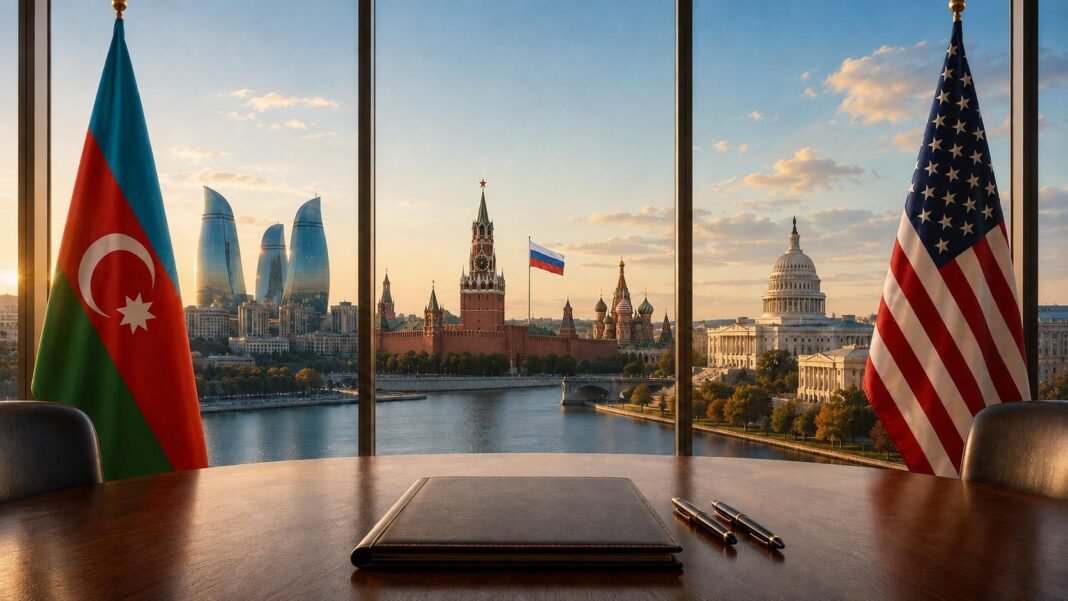
The contrast between the two dates captures the transformation of the South Caucasus. In 2008, Russia appeared capable of deciding the region’s future through military force. By 2025, Baku and Yerevan were negotiating a new regional order under U.S. mediation.
Russia has not disappeared from the South Caucasus. It remains a major power, an important economic partner and a direct neighbor. But its monopoly over regional diplomacy has been broken.
That shift cannot be explained solely by Russia’s war against Ukraine or its declining ability to project power. It also reflects Azerbaijan’s growing strength, Turkey’s expanding regional role and Armenia’s attempt to pursue a more independent foreign policy.
The withdrawal of Russian peacekeepers from Azerbaijan in 2024 became the clearest symbol of the changing balance.
For decades, the unresolved Armenia-Azerbaijan conflict gave Moscow leverage over both countries. Russia presented itself as the indispensable mediator, yet repeated negotiations failed to produce a lasting settlement. The absence of peace preserved both sides’ dependence on the Kremlin.
Once Azerbaijan restored control over its territory and direct negotiations began, much of that leverage disappeared.
This raises an obvious question: Why should U.S. mediation be considered preferable? Washington, after all, is also pursuing its own geopolitical and economic interests.
Of course it is.
The United States is not investing diplomatic capital in the South Caucasus out of charity. Washington wants functioning transport routes, access to the Middle Corridor, new investment opportunities and a stronger position in a region located between Russia, Iran and China.
But foreign policy is never based on altruism. The relevant question is not whether a major power has its own interests. It is whether those interests align with those of the countries involved.
At this stage, Washington’s objectives largely coincide with those of Baku.
The United States wants open borders, reliable infrastructure, commercially viable transit routes and a predictable security environment. The Middle Corridor and the Trump Route for International Peace and Prosperity, or TRIPP, cannot succeed amid renewed war.
American investment requires stability. Russia’s traditional model of regional influence, by contrast, often benefited from unresolved disputes and managed instability.
That is where the interests of Washington, Baku and, to a significant extent, Yerevan now intersect.
For Azerbaijan, opening regional transport links could strengthen its position as a critical hub connecting Central Asia with Turkey and Europe. For Armenia, it could provide new trade routes and reduce its geographic and economic isolation. For the United States, it could create an east-west corridor that is less dependent on Russia and Iran.
This is not friendship. It is an alignment of interests - something that can prove more durable in international affairs than declarations of brotherhood.
There is also a fundamental difference between Washington and Moscow: geography.
The United States can apply diplomatic pressure, impose sanctions or restrict economic cooperation. But it does not share a border with Azerbaijan, nor does it possess the regional military infrastructure and historical mechanisms of control that Russia inherited from the Soviet Union and the Russian Empire.
Russia is next door. Over the past two centuries, its presence in the South Caucasus has repeatedly involved military intervention, political pressure and limits on the sovereignty of neighboring states.
For Azerbaijan, this is not an abstract concern. It is rooted in historical experience, including the Soviet military crackdown in Baku in January 1990.
Placing Washington and Moscow in the same category therefore obscures more than it explains. Both pursue their own interests, but their geographic positions, historical relationships with the region and methods of influence are fundamentally different.
Still, replacing one mediator with another will not automatically produce an economic victory for Azerbaijan.
Washington may help secure peace and open transport links, but it is under no obligation to direct investment toward Baku. Capital will go where property rights are better protected, regulations are more predictable and political risks are lower.
That creates a domestic challenge for Azerbaijan. If Armenia offers a more competitive business environment, a significant share of U.S. and European investment associated with the region’s new transport architecture could flow to Yerevan - even if Azerbaijan remains the central transit state.
Baku must therefore do more than welcome the emerging geopolitical order. It must prepare to compete within it by improving investment protections, strengthening the legal system and offering transparent, predictable rules for business.
The decline of Russia’s diplomatic monopoly has opened a historic window for Azerbaijan. But that window will not remain open forever.
The real choice is not between treating Russia or the United States as a friend. Great powers are not required to be anyone’s friends.
Azerbaijan’s task is to use its current alignment with Washington without creating a new dependency - and to turn its geopolitical gains into lasting economic advantages.
AZE.US