By AZE.US Editorial Team
The Shanghai Cooperation Organization’s anniversary summit has revived a familiar question for Azerbaijan: Should Baku move closer to the East or remain economically and politically oriented toward the West?
The question itself is misleading.
Azerbaijan does not need to exchange one geopolitical camp for another. Its more ambitious objective should be to become a country without which reliable connections between East and West cannot function.
That is why President Ilham Aliyev’s participation in the SCO summit matters more than Azerbaijan’s formal status within the organization. Baku gains access to a platform bringing together China, Russia, Central Asia, India, Pakistan and Iran without abandoning its relationships with Europe, Türkiye and the United States.
Not an Eastern NATO
The SCO is often portrayed as an emerging eastern alternative to NATO or the European Union. In reality, it has no integrated defense system, single market or unified foreign policy.
Its members have sharply different interests. India and Pakistan remain strategic rivals. Russia is at war with Ukraine. Iran is locked in confrontation with the West, while Central Asian states are trying to avoid excessive dependence on either Moscow or Beijing.
The SCO has not become the primary mediator in disputes involving its members. It has not resolved Indian-Pakistani tensions, ended Russia’s war against Ukraine or established a credible regional security system.
Its more realistic function is maintaining a balance of power.
China’s presence gives Central Asian countries greater room to reduce their dependence on Russia. At the same time, the organization allows Moscow and Beijing to manage their competition without turning it into an open confrontation.
Azerbaijani lawmaker Rasim Musabekov noted in an interview with ITV that China now stands behind many of Central Asia’s largest infrastructure and transportation projects. Beijing’s economic influence is expanding as Russia’s capacity continues to decline.
Baku Needs a Seat at the Table
Azerbaijan has close ties with nearly every major state in the SCO area. Baku has developed allied relations with Kazakhstan, Uzbekistan, Kyrgyzstan and Pakistan, while deepening its strategic partnership with China.
This does not mean Azerbaijan is turning its back on Europe.
Musabekov estimated that about 70% of Azerbaijan’s foreign trade remains oriented toward Western markets, including the European Union, Britain and Türkiye. Europe also remains the leading destination for Azerbaijani energy exports.
Joining an explicitly anti-Western bloc would therefore contradict Azerbaijan’s national interests. Baku benefits more from cooperation among competing power centers than from confrontation between them.
The SCO should be treated as an additional route toward Asia, not as a geopolitical replacement for the West.
The Middle Corridor Changes Azerbaijan’s Weight
Azerbaijan’s greatest strategic asset is not its formal status in international organizations. It is geography.
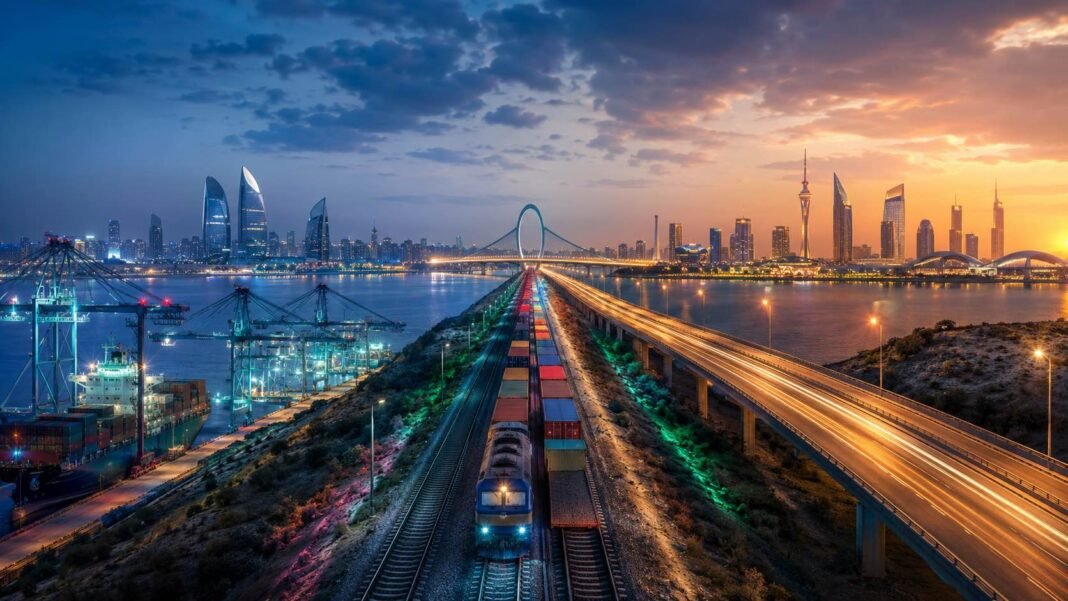
The Middle Corridor, linking China and Central Asia to Europe through the Caspian Sea, Azerbaijan, Georgia and Türkiye, cannot operate effectively without Azerbaijan.
Cargo can reach the Caspian’s eastern shore through Kazakhstan or Turkmenistan. Once it crosses the sea, however, it arrives in Azerbaijan before continuing toward the Black Sea, Türkiye and European markets.
Armenia could eventually become connected to this system as well. Reopening transportation links between Azerbaijan and Armenia would transform the South Caucasus from a region defined by conflict into a broader transit hub.
This is where geography becomes political power.
The more countries depend on Azerbaijani ports, railways, highways and energy infrastructure, the higher the cost of instability around Azerbaijan becomes.
Peace Must Become an Economy
Since the Washington agreements, Baku and Yerevan have increasingly discussed practical issues alongside borders and political declarations. These include freight transit, transportation routes and energy supplies.
Musabekov pointed to Azerbaijani petroleum shipments to Armenia and the possibility of broader energy cooperation. As Russia’s ability to supply regional markets comes under pressure, access to Azerbaijani fuel could become increasingly important for Armenia.
This is neither charity nor a retreat from Azerbaijan’s established positions. It is the construction of a new system of shared interests.
For decades, Russia maintained influence over Armenia through security guarantees and dependence in energy and transportation. Azerbaijan can now weaken that monopoly through alternative routes, fuel supplies and access to regional trade.
Economic interdependence does not automatically guarantee peace. It does, however, make a return to war more expensive for every party.
Azerbaijan Should Avoid a False Choice
The SCO remains far from becoming a fully integrated political or economic union. It has no common market, coordinated customs system, free movement of labor or shared currency framework. It also cannot provide reliable security guarantees for the South Caucasus.
Ignoring an organization whose countries represent roughly 40% of the world’s population would nevertheless be a strategic mistake.
Azerbaijan should participate in shaping new Asian trade routes, attract Chinese investment, deepen ties with Central Asia and preserve access to European markets and Western technology.
Baku does not have to choose between East and West.
Its real success will come when both East and West choose a route that passes through Azerbaijan.
AZE.US