By AZE.US Editorial Team
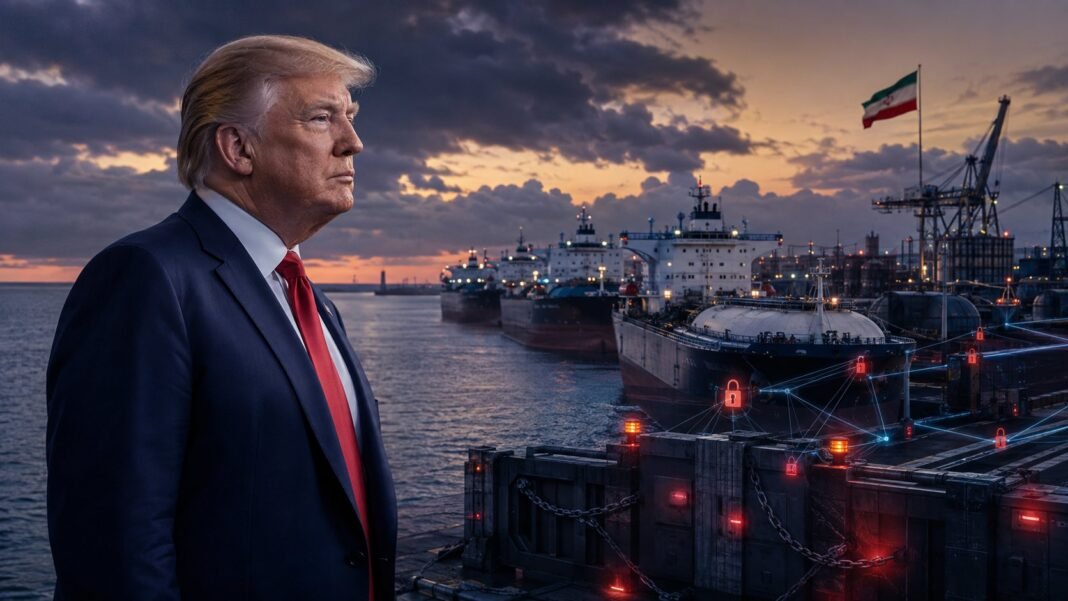
After 60 days of failed diplomacy, President Donald Trump has declared an “Economic D-Day” against Iran. But his most consequential warning was aimed beyond Tehran: Any country, bank or company helping Iran maintain access to the global economy could also face US retaliation.
The US-Iran war is entering a new phase. Washington is not yet launching another large-scale military operation. Instead, it is preparing to attack the infrastructure that keeps a modern state functioning: oil revenues, banking transactions, transportation routes, ship insurance and access to foreign currency.
That is the real meaning behind Trump’s declaration of an “Economic D-Day.”
The US president promised what he called the most crushing economic campaign ever undertaken against a country. He demanded an end to Iranian oil smuggling, cash transfers, swap arrangements, exchange houses, front companies and the use of foreign ship registries.
Trump also warned of “tremendous economic consequences” for any country that allows its financial institutions, businesses, airports or government entities to provide Iran with an economic lifeline.
In other words, America’s next target is not Iran alone. Washington is now targeting the entire international network that helps Tehran evade sanctions.
Diplomacy Ends With an Ultimatum
A memorandum signed on June 17 gave Washington and Tehran 60 days to reach a broader agreement on Iran’s nuclear program, US sanctions and navigation through the Strait of Hormuz. That deadline expired without a breakthrough.
Trump said there were no talks taking place or scheduled with Iran. He added that the US naval blockade of Iranian ports would remain in force, while insisting that the Strait of Hormuz was open and all sea mines had been removed or destroyed.
Tehran describes a different reality. Iranian leaders say the strait will remain effectively closed until Washington ends its blockade, lifts oil sanctions, releases frozen Iranian assets and stops military operations and threats.
A senior Iranian official told Reuters that the country was prepared to adopt a “fully offensive” posture and could launch an attack to break the US blockade if diplomacy failed.
Neither side is offering a realistic path out of the confrontation. Washington is demanding the dismantling of Iran’s nuclear threat and restrictions on its regional strategy. Tehran wants what would amount to recognition of its right to control the world’s most important energy corridor.
There is little room for compromise between those positions.
The UAE Shows How the New Pressure Could Work
The first major indication of how the campaign may unfold came from the United Arab Emirates.
After detecting two ballistic missiles allegedly launched from Iran toward maritime traffic, the UAE suspended all trade, commercial exchanges and financial transactions with Tehran. Both missiles landed in the sea, while Iran rejected the accusation as baseless.
The political decision, however, had already been made. One of Iran’s most important regional financial and commercial channels was cut off.
For Tehran, losing Dubai as a commercial and financial hub could prove more damaging than the destruction of an individual military base. For decades, Dubai served as a center for Iranian trade, currency transactions, re-exports and access to goods that sanctions prevented Iran from purchasing directly.
Military infrastructure can be rebuilt. International banking relationships, insurers and trusted commercial intermediaries are much harder to replace.
This is likely the effect Trump wants to reproduce elsewhere, either through cooperation with Washington or fear of secondary sanctions.
Asian refineries, shipping companies, banks, cryptocurrency platforms, foreign ports and firms registering tankers that transport Iranian oil could become the next targets.
Sanctions Do Not Produce Quick Victories
There is a major weakness in this strategy: Economic pressure takes time.
The Associated Press noted that Trump is effectively returning to a tool he previously dismissed as ineffective. Months of airstrikes have not produced the quick victory initially promised, some US weapons stockpiles have tightened and attempts to reach an agreement with Tehran have stalled. Washington is therefore betting on sanctions again.
Iran’s economy is undoubtedly under severe strain. According to figures cited by Reuters, consumer prices in July were 87.9% higher than a year earlier, while food inflation reached 128%.
The US Treasury says average loadings of Iranian oil have fallen from 1.8 million barrels per day before the war to less than 500,000 barrels per day.
Economic collapse, however, does not automatically lead to political surrender. Sanctions first affect ordinary people through higher food prices, unemployment, medicine shortages and the destruction of personal savings.
Washington hopes that mounting hardship will force Iran’s leadership to compromise or trigger mass protests. Tehran, by contrast, will attempt to present the population’s suffering as the result of foreign aggression and use the war to justify further repression.
“Economic D-Day” could therefore mark the beginning of a prolonged war of attrition rather than a short and decisive campaign.
Hormuz Remains Iran’s Weapon
The United States dominates the global dollar-based financial system. Iran possesses the geographic ability to threaten the Strait of Hormuz, through which roughly one-fifth of the world’s traded oil and liquefied natural gas passed before the war.
Each side is using its principal advantage. America is blocking money. Iran is threatening energy supplies.
Markets are already pricing in that risk. Brent crude traded near $92 per barrel on August 20, although investors did not appear to expect an immediate large-scale military operation.
One successful strike on a tanker, oil terminal or US warship could nevertheless push the confrontation beyond anyone’s control.
Azerbaijani lawmaker Rasim Musabayev told the “Diqqət Mərkəzi” program that he did not expect a major offensive in the immediate future. He argued, however, that both sides were using the pause to replenish weapons, strengthen air defenses and prepare for another potential escalation.
That may be the most realistic assessment. A major war may not be planned for tomorrow, but both sides are preparing as though they consider it increasingly unavoidable.
What It Means for Azerbaijan
The new US strategy creates particular risks for Azerbaijan, which shares a border with Iran, participates in regional trade and sits at the intersection of major transportation corridors.
Transparent shipments of food and other permitted civilian goods should be able to continue. But opaque financial arrangements, dual-use products or transactions that Washington considers sanctions evasion could create serious problems for Azerbaijani banks, carriers and private companies.
Trump is trying to impose a stark choice on the region: Maintain access to the US economy or help Iran.
Such pressure, however, may not eliminate all cooperation with Tehran. It could simply push some of it further underground.
The declaration of an “Economic D-Day” should not be mistaken for victory. It demonstrates that Washington has yet to find a rapid military or diplomatic solution.
America’s next target is not another country. It is every channel through which Iran receives money, oil revenue, technology and the means to continue resisting.
Unless negotiations resume, the war will continue - with fewer continuous airstrikes, perhaps, but with consequences that could prove no less destructive.
AZE.US