By AZE.US Editorial Team
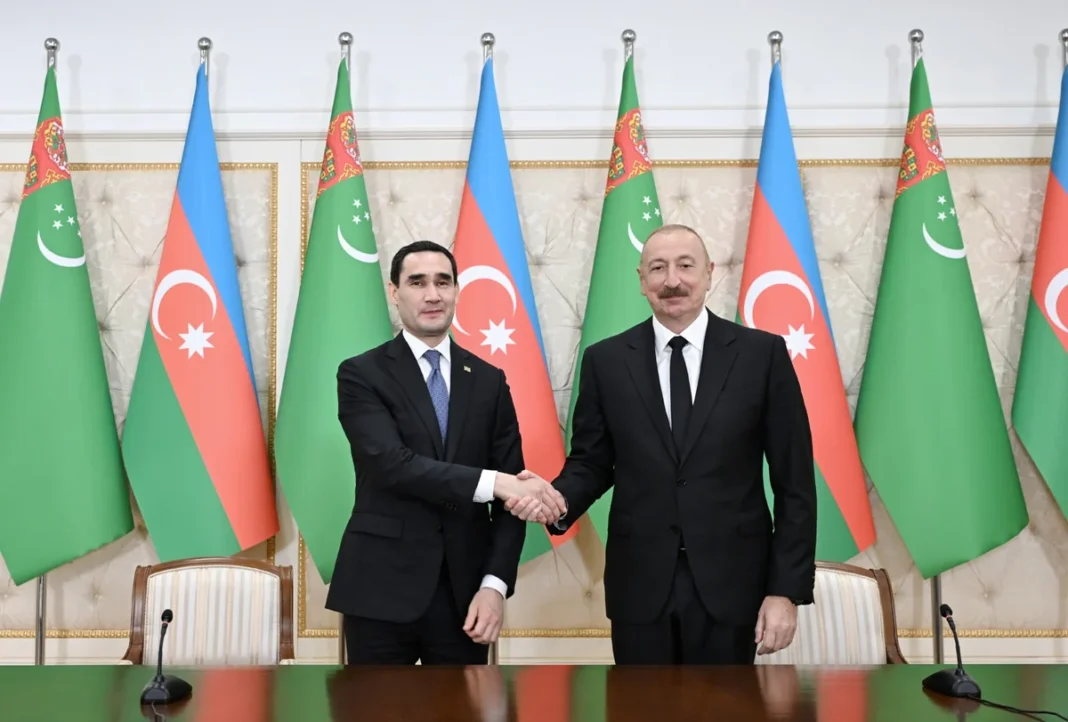
The visit of the president of Turkmenistan to Azerbaijan should not be seen as just another protocol event between two friendly countries. It is part of a much larger process in which the Caspian region, Central Asia, the South Caucasus and Turkey are gradually forming a new geopolitical structure.
The world has changed. Old routes no longer look automatically reliable. Conflicts in the Middle East, tensions around the Red Sea, the crisis around Iran, the Russia-Ukraine war, sanctions battles, energy risks and disruptions in supply chains have shown one thing clearly: logistics is no longer just about economics. A route is now a political asset. A corridor is now a security issue. Infrastructure has become an instrument of influence.
That is why Azerbaijan-Turkmenistan relations are gaining new weight.
Azerbaijan and Turkmenistan are connected not only by the Caspian Sea. They are linked by energy, transport, trade, humanitarian ties, historical closeness, Turkic identity and a shared interest in a stable Eurasia. The agreements signed in the fields of energy, transport, customs, health care, social policy and humanitarian cooperation show that Baku and Ashgabat are not limiting themselves to warm statements. They are turning political closeness into practical projects.
This is also the defining feature of Azerbaijan’s current foreign policy: fewer declarations, more substance. Not slogans, but roads, ports, railways, energy lines, customs mechanisms, investment and routes. This is the kind of approach the region needs today.
The Middle Corridor is becoming more than an alternative route between China and Europe. It is turning into a model of new cooperation, where the South Caucasus and Central Asia are no longer peripheral territories in other powers’ projects, but independent centers of decision-making.
This is the key point.
For years, the region was seen as a space between larger players: Russia, Iran, Turkey, China and the West. That picture is now changing. Azerbaijan, Kazakhstan, Uzbekistan, Turkmenistan, Georgia and Turkey are increasingly acting not as objects of external policy, but as participants in a new Eurasian architecture.
The C6 format, the idea of Greater Central Asia, the connection between Central Asia, Azerbaijan, Georgia and Turkey, the development of the Middle Corridor and the potential opening of the Zangezur route all point to the same trend: the region is looking for a pragmatic model of influence, not a conflict-driven one.
In this model, there is no need to choose between East and West. Its purpose is different: to connect East and West. To connect China and Europe, Central Asia and Turkey, the Caspian and Black Sea regions, energy and logistics, security and the economy.
Azerbaijan is at the center of this structure not by accident. It is the result of a long-term strategy that began taking shape in the 1990s. The Baku-Tbilisi-Ceyhan pipeline, the Baku-Tbilisi-Kars railway, the development of port infrastructure, stronger ties with Georgia and Turkey, the restoration of territorial integrity, and the new role of Karabakh and East Zangezur on the regional transport map are all parts of the same broader vision.
Today, that vision is acquiring a new scale.
Against this background, relations with Turkmenistan are especially important. Ashgabat has traditionally pursued a policy of neutrality, and Baku respects that choice. But Turkmenistan’s neutrality does not mean isolation. On the contrary, Turkmenistan is becoming an important part of the transport and energy logic of the Caspian region.
There is no contradiction here. A country can maintain a neutral status and still actively participate in economic, transport and humanitarian projects. This balance may be useful for all of Eurasia.
The visit of the Turkmen leader is also important because it comes at a time of growing turbulence around the region. U.S.-Iran talks, tensions around the Strait of Hormuz, the Lebanese track, Israel’s role, sanctions, Iran’s nuclear program, and mediation efforts by Qatar and Pakistan all directly affect the South Caucasus and Central Asia.
Iran is not an abstract point on the map for this region. It is a neighbor, a trading partner and part of the transport and energy geography. Any instability around Iran immediately affects security, logistics, prices, routes and investment.
That is why diplomacy is once again moving to the center of international politics.
Today, many say diplomacy has weakened, international law works selectively and the world increasingly resolves disputes by force. There is bitter truth in that. But there is another truth as well: every conflict, no matter how bloody, eventually returns to negotiations.
Wars are started by politicians, generals and ideologues. But they end at the negotiating table. Sometimes too late. Sometimes after enormous human losses. But without diplomacy, there can be no lasting peace.
Azerbaijan knows the price of this better than most. For decades, international law regarding the occupation of Azerbaijani territories existed on paper, but was not backed by real pressure. The world spoke about principles, but too often turned a blind eye when those principles were violated. The result is known: the conflict was resolved only when Azerbaijan restored justice itself.
That is why Baku today speaks so firmly about peace, security, communications and real guarantees. Not empty declarations, but mechanisms that actually work.
The new geopolitics of the region is not built on romantic statements. It is built on a very simple logic: whoever ensures the security of routes becomes indispensable. Whoever connects markets gains influence. Whoever offers stability in an age of chaos becomes a center of attraction.
This is exactly what Azerbaijan is doing.
Relations with Turkmenistan are not a separate track in this sense. They are part of a much bigger picture. The Caspian as a zone of cooperation. The Middle Corridor as a transport artery. Central Asia and the South Caucasus as a single space of opportunity. Turkey as the strategic continuation of the route toward Europe. China and Europe as the endpoints of a larger Eurasian connection.
Today, the world has too many conversations about blocs, sanctions, pressure and dividing lines. Azerbaijan’s model offers a different logic: do not divide, connect. Do not wait for decisions made elsewhere, build your own routes. Do not turn the region into a field of confrontation, turn it into a space of cooperation.
That is why the visit of Turkmenistan’s president to Baku matters beyond the bilateral agenda. It shows that the region is maturing politically. It no longer wants to be just transit territory between other centers of power. It wants to be an independent center through which trade, energy, diplomacy and security pass.
This is Azerbaijan’s new role.
Baku today is not simply participating in regional processes. It is becoming one of the architects of a new Eurasian connectivity. And the more chaos the world faces, the higher the value of countries that know how to build bridges instead of burning them.
AZE.US