By AZE.US Editorial Team
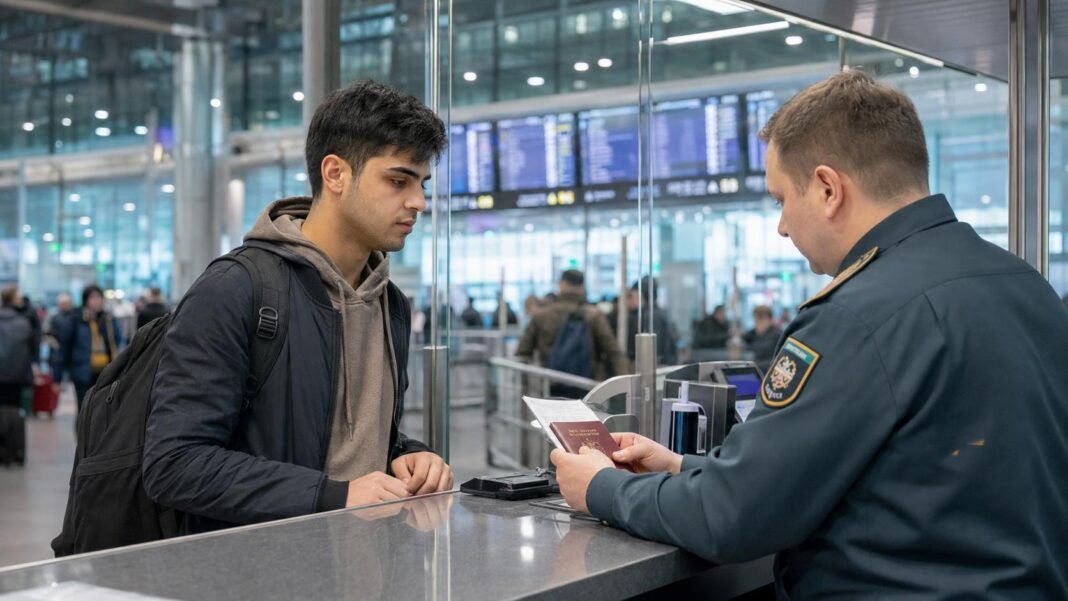
A prominent Azerbaijani lawyer has urged citizens to avoid traveling to Russia after reporting that a young Azerbaijani student was detained at a Moscow airport over an image found on his phone and later pressured to sign a military contract.
Akram Hasanov said the student, the son of one of his acquaintances, had been admitted to a university in Moscow.
According to the lawyer, Russian officers inspected the young man’s phone after his arrival and discovered a mocking image involving Chechen leader Ramzan Kadyrov.
“The student was arrested, and they are now forcing him to sign a contract to participate in the war against Ukraine,” Hasanov wrote on Facebook.
He called on Azerbaijani parents not to send their children to Russia, warning that even an apparently routine trip for education could carry serious and unpredictable risks.
Hasanov did not disclose the student’s identity, the airport where the alleged detention occurred, the date of the incident or the legal grounds for the arrest. The account therefore cannot yet be independently verified, and no public response from Russian authorities was cited.
However, the circumstances described by Hasanov resemble practices that have recently prompted official travel warnings from other countries.
In July 2026, Moldova’s Foreign Ministry reported an increase in extensive checks involving Moldovan citizens entering Russia. The measures were said to primarily affect men between the ages of 18 and 60, people traveling alone, dual citizens, holders of recently issued passports and individuals who had previously visited Ukraine.
Travelers were reportedly subjected to hours-long questioning, temporary confiscation of documents, biometric data collection and inspections of mobile phones and other electronic devices. Moldova’s state-run Moldpres news agency said the authorities had advised citizens to carefully assess whether travel to Russia was necessary.
The Moldovan Foreign Ministry also reported that some detained travelers had faced pressure to sign contracts with the Russian Defense Ministry. The ministry advised Moldovan citizens to reconsider travel to Russia.
The U.S. State Department currently maintains its highest-level travel advisory for Russia, warning American citizens not to visit the country because of the risks of wrongful detention, arbitrary enforcement of local laws and limited consular assistance.
The advisory specifically warns that Russian security services may monitor, seize and search electronic devices. It says foreign nationals have been detained over information found on their phones, including material created, transmitted or stored outside Russia. The State Department advises travelers to assume that their devices and electronic communications are monitored.
A smartphone carried through a Russian airport may contain years of private messages, photographs, political jokes, social media posts and channel subscriptions. Material that is legal in Azerbaijan or another country could be interpreted differently under Russian law, particularly when it concerns the war in Ukraine, the Russian military or senior officials.
Foreign citizens cannot be drafted into the Russian military solely because they enter the country. Russian law, however, allows foreigners aged 18 and older to join the armed forces by signing a contract. Such service is formally voluntary, making reports of pressure or coercion particularly alarming.
Students may be especially vulnerable. University admission, an invitation from relatives or possession of a return ticket does not guarantee entry into Russia or protection from additional questioning.
Those who cannot postpone a trip should inform relatives of their itinerary, keep the Azerbaijani Embassy’s emergency contact information readily available and avoid signing any document they do not fully understand. If detained, they should request an attorney, an interpreter and immediate notification of Azerbaijani consular officials.
Hasanov’s account remains an allegation concerning one unidentified student. Yet the broader risks it highlights - invasive phone searches, prolonged interrogation, detention and alleged pressure to sign a military contract - have been documented in official warnings.
For Azerbaijani families considering sending a child to study in Russia, the question is no longer limited to the quality or cost of education. They must also consider whether a journey that begins with a university admission letter could end in an airport interrogation room.
AZE.US