AZE.US
Heavy rainfall seen in recent days across Azerbaijan has triggered a new round of public debate over the Caspian Sea. In coastal areas especially, some residents have begun wondering whether intense downpours could directly raise the sea level.
According to ecologist Anvar Aliyev, that assumption is wrong.
Speaking to local media, Aliyev said short-term heavy rainfall cannot have any meaningful impact on the level of the Caspian. He noted that although the sea has no direct connection to the world’s oceans, it remains one of the largest enclosed water bodies on the planet and responds to long-term hydrological and climatic processes rather than a few days of bad weather.
“The Caspian collects water from a basin covering about 4 million square kilometers. One day of intense rainfall cannot significantly affect its level,” he said.
Aliyev argued that noticeable changes in the Caspian’s level would require years of sustained wet conditions, not isolated storms. In his view, the sea could begin showing a clearer upward trend only if stronger-than-normal precipitation continues over a period of 10 to 15 years.
He added that rainfall has already been increasing in Azerbaijan, with even the country’s driest zones seeing growth of roughly 30% to 50% in precipitation. That trend, he said, may continue.
The ecologist also said the Caspian’s fluctuations tend to follow long natural cycles lasting around 40 to 50 years, with alternating dry and wet phases.
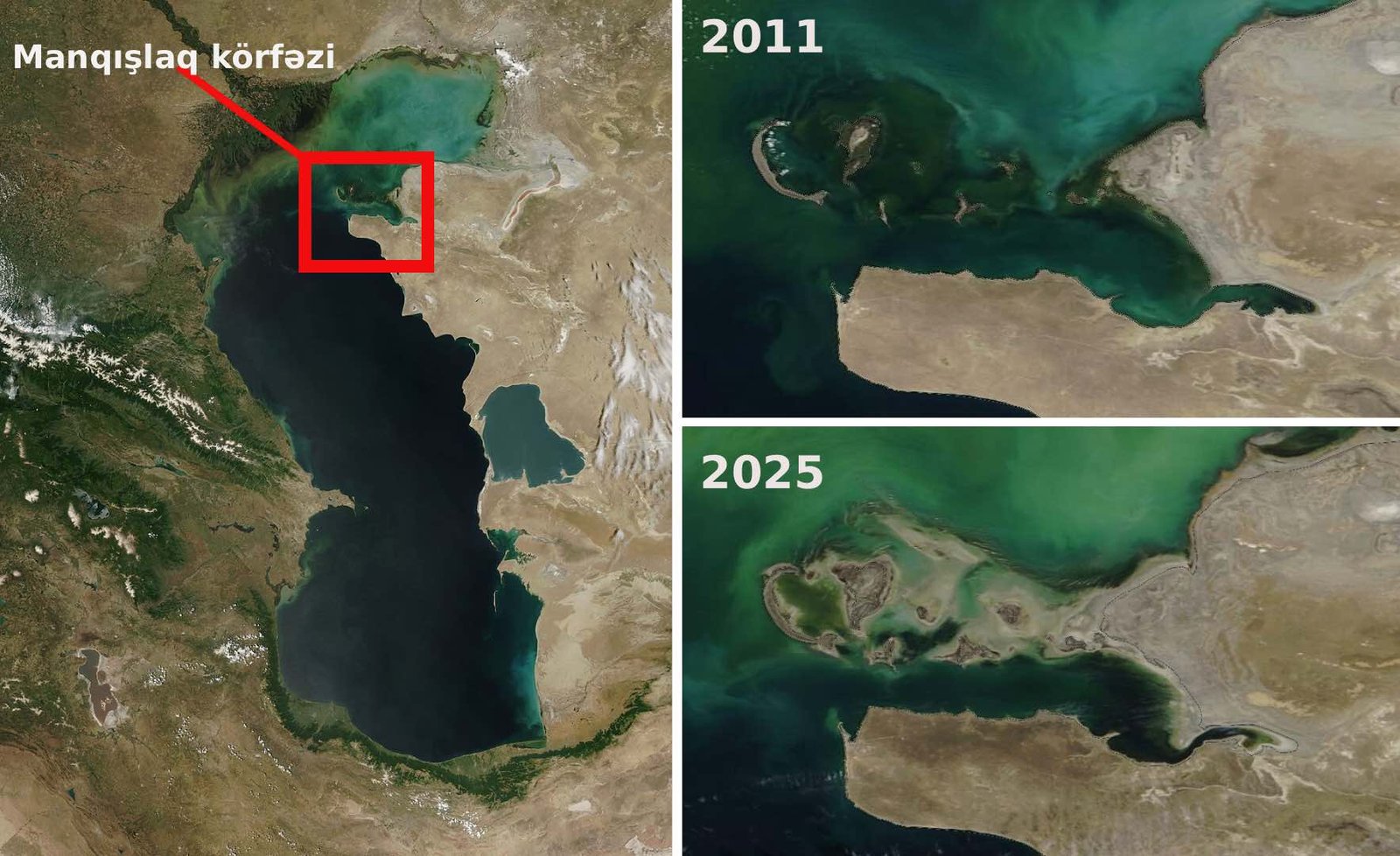
He believes the sea level may start rising gradually over the next five to 10 years and said the process may already be underway. Over a much longer period, he added, the Caspian could move closer to its earlier levels.
Aliyev warned, however, that both extremes create risks. The sea’s retreat has already affected water availability, infrastructure and ecosystems, while a sharp rise in water levels could also create serious pressure for coastal areas.
The key point, he said, is that the Caspian does not react dramatically to a single spell of rain. Any real shift in sea level is shaped by long-term climate patterns, not short-lived weather events.