By AZE.US Editorial Team
When Azerbaijan entered Eurovision in 2008, it looked like part of a larger cultural bid by a young state eager to be heard in Europe.
The first entry, Elnur and Samir’s “Day After Day,” was not just participation for the sake of participation. It was theatrical, visible and memorable. Azerbaijan did not enter the contest quietly.
Then came the years that now feel like a different era. AySel and Arash took third place with “Always” in 2009. Safura finished fifth with “Drip Drop” in 2010. Ell & Nikki brought Azerbaijan its Eurovision victory in 2011 with “Running Scared.” Sabina Babayeva came fourth in Baku in 2012 with “When The Music Dies.” Farid Mammadov finished second in 2013 with “Hold Me.”
That run was not an accident. Azerbaijan was seen as a country that prepared seriously, invested in production, understood the stage and competed for the result.
One can argue about musical taste, about the format of those songs, or about the European pop language of that period. But one thing is hard to deny: Azerbaijan had a strategy.
It also had weight. From 2009 to 2013, the country was almost always near the top of the scoreboard. Eurovision worked for Baku as a musical, diplomatic and image-building platform.
Today, that strategy is much harder to see.
The contrast is visible in the results. After the strong period of 2009–2013, Azerbaijan continued to reach the final for several years, but the momentum faded. Since 2023, the country has not reached the Eurovision final, which no longer looks like an isolated failure but a symptom of a deeper problem.
In recent years, Azerbaijan’s Eurovision participation has increasingly looked less like cultural diplomacy and more like administrative habit.
A performer is selected. A song is released. The country hopes for the best. Then Azerbaijan either fails to qualify or lands in a place that few remember a week later.
The question becomes unavoidable: if the contest no longer gives Azerbaijan a strong result, a strong cultural image or a real musical breakthrough, why continue by inertia?
The problem is not only the ranking. The problem is the decline of the whole approach.
The fall was not immediate after 2013. Azerbaijan still had respectable moments. In 2019, Chingiz returned the country to the top 10 with “Truth.” But those were flashes, not a system. The first serious symbolic blow came in 2018, when Aisel failed to reach the final with “X My Heart.” After 2022, the picture became harsher: Azerbaijan repeatedly got stuck in the semifinal, and the songs left little trace.
There were still talented singers, interesting voices and some successful staging decisions. But the larger line disappeared.
The songs increasingly sounded like products assembled for an abstract international market: without a real Azerbaijani intonation, without risk, without inner fire.
That is especially painful given Azerbaijan’s own musical wealth.
The country has mugham, a jazz tradition, a strong pop heritage, folk melody, a modern urban scene, composers and vocalists. But on the Eurovision stage, that richness too often turns into a pale English-language entry that could have been submitted by almost any other country.
As a result, a country with a powerful musical DNA appears on stage as if it has nothing of its own to say.
That is the real failure.
Eurovision has long stopped being just a song contest. Formally, organizers still speak about the non-political nature of the event. In practice, the contest increasingly lives through political scandals, boycotts, symbolic gestures and cultural wars.
Russia was excluded in 2022. Ukraine’s victory that same year was widely seen not only as a musical result, but also as a political signal. In recent years, the contest has again and again been surrounded by disputes over Israel’s participation, protests, neutrality rules and boycotts.
The stage that was supposed to unite through music has increasingly become an arena of political testing: who may participate, who must be condemned, who deserves sympathy, and which values must be publicly displayed.
For Azerbaijan, this raises a separate question.
Should the country participate in a contest where the cultural framework increasingly diverges from what a significant part of Azerbaijani society sees as its natural value space?
This is not about isolation. It is not about fear of Europe. It is not about rejecting music or closing the country off from international culture.
It is about something else: why should a state broadcaster send Azerbaijan to a platform where a song contest is increasingly turning into a showcase for other people’s ideological battles?
Azerbaijan does not need to fight Eurovision. But Azerbaijan also does not need to pretend that nothing has changed.
In 2008–2013, participation made sense. The country gained visibility, results, recognition and prestige. The 2011 victory became real media capital. Hosting the contest in Baku in 2012 was a major image event. Eurovision functioned as cultural diplomacy.
Today, the balance is different. Participation still requires money, attention and organizational resources. The return is weaker. If the song does not reach the final, if European audiences do not remember Azerbaijan, if the contest no longer excites the domestic audience as it once did, and if the stage itself has become more political and more distant from local cultural instincts, then “we have always participated” is not a serious argument.
Azerbaijan has three options.
The first is to continue by inertia. It is the easiest path and the least meaningful one: choose another performer, send another song, receive another weak result and pretend it was simply an unlucky year.
The second is to leave the contest or take a pause. Not as a loud protest. Not as an emotional gesture. Just as a sober recognition that the format no longer gives Azerbaijan what it originally came for. Sometimes a pause looks more mature than participation without purpose.
The third option is a full reset. If Azerbaijan stays in Eurovision, it should not be to dissolve into a generic pop template. It needs a song that carries Azerbaijani musical memory in a modern form.
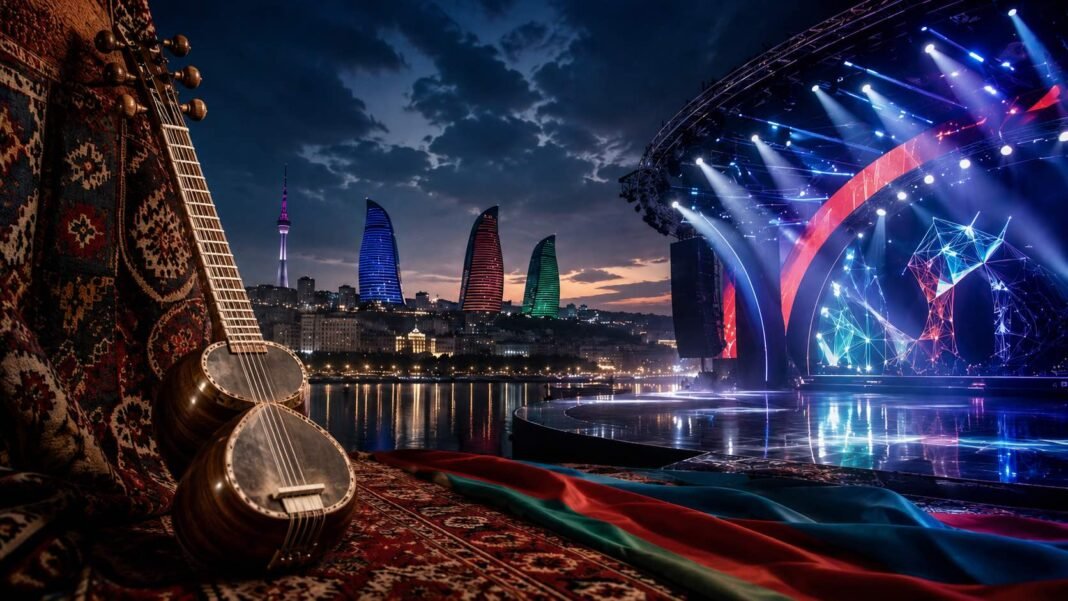
That does not mean carpets, tar, mugham and national symbols have to be placed on stage in a primitive way. That would be too easy. But the entry should have internal recognizability, musical honesty and the feeling that it is not a faceless export product, but the song of a country with its own voice.
A defeat is not a tragedy.
The tragedy is when a country with such a musical culture appears on an international stage without a face.
Eurovision can still be useful for Azerbaijan only if it becomes a platform for a strong national statement again. Not necessarily ethnic decoration. Not nostalgia. Not folklore for tourists. But a contemporary sound rooted in something real.
Without that, the question “Does Azerbaijan still need Eurovision?” is no longer provocative. It is a normal management question.
For now, the answer is uncomfortable: in its current form, probably not.
Not because Azerbaijan is too weak for Eurovision. Quite the opposite. Azerbaijan is too musically rich to appear year after year on that stage as a random participant without an idea, without a result and without a recognizable sound.
AZE.US