By AZE.US Editorial Team
Turkey is moving into a dangerous political phase. Elections still exist. Parties still operate. Parliament still meets. Courts still issue rulings. But real competition is increasingly being replaced by something else: when the opposition becomes too strong at the ballot box, it is weakened through courts, prosecutions and police force.
The latest crisis around the Republican People’s Party, or CHP, has made that pattern hard to ignore.
A Turkish court annulled the results of the CHP’s 2023 congress, which had elected Ozgur Ozel as party leader, and reinstated former chairman Kemal Kilicdaroglu. Reuters reported that the CHP denounced the ruling as a “judicial coup,” while Turkish markets fell after the decision.
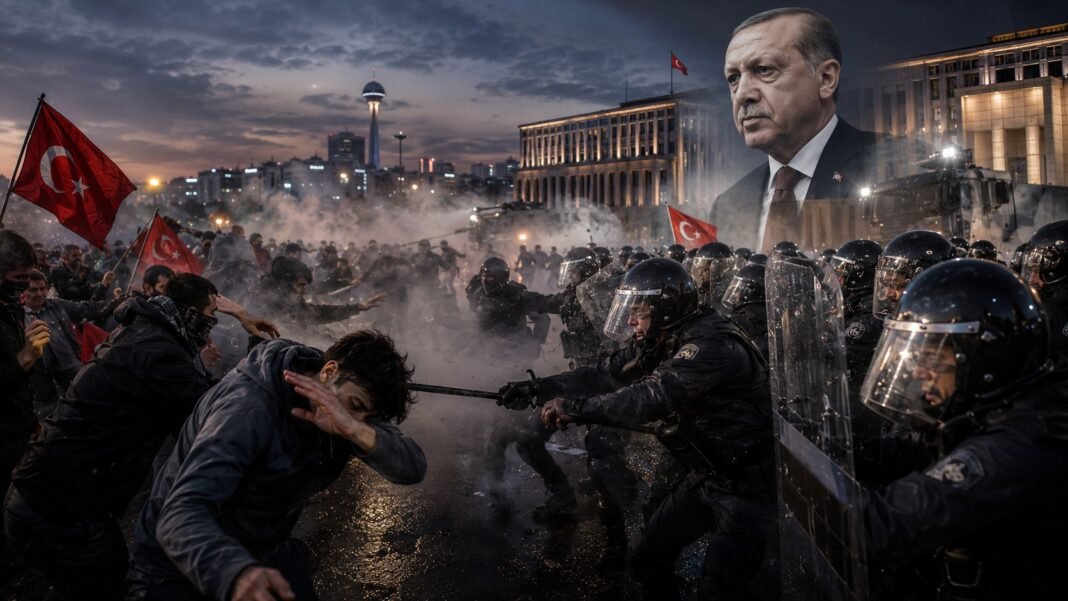
Then the legal crisis became a police operation. On May 24, Turkish police entered the CHP headquarters in Ankara after Ozel’s supporters resisted the transfer of the building to the court-backed leadership. AP reported that police used tear gas and rubber bullets. Reuters also reported that riot police used force and tear gas to evict the ousted leadership.
Formally, the government can describe this as a court matter, a procedural dispute and an internal party issue. But in Turkey’s political reality, it looks different. Legal decisions keep appearing exactly where President Recep Tayyip Erdogan faces a serious political problem.
The CHP became more dangerous to Erdogan after the 2024 municipal elections, when the opposition showed strength in Turkey’s biggest cities. Ozel was not just another party official. Under his leadership, the CHP regained energy and began to look like a party capable of winning more than symbolic battles.
For a system built around one dominant leader, that is a threat.
The clearest case remains Ekrem Imamoglu, the mayor of Istanbul and one of Erdogan’s most powerful potential challengers. Reuters has reported that Imamoglu is jailed and facing trial amid a broader crackdown on the CHP. The opposition and rights groups see the pressure as damaging to Turkish democracy, while the Turkish government insists the judiciary acts independently.
That distinction matters. Not every criminal case can be dismissed as politics. Every allegation should be judged on evidence. But when nearly every strong challenger to Erdogan eventually faces a court case, arrest, ban, removal or administrative intervention, it no longer looks like coincidence.
It looks like a method.
Modern authoritarianism rarely begins by abolishing elections in one dramatic decree. It is usually more sophisticated. The ballot boxes remain. Campaigns continue. Parties still hold rallies. But before voters make their choice, the state narrows the field.
A strong mayor? A criminal case.
A popular presidential rival? Prison and trial.
A revived opposition party? A court ruling over its congress.
Supporters refuse to accept it? Police enter the headquarters with gas, shields and rubber bullets.
On paper, it is legal procedure. In real life, it smells like political cleansing.
Erdogan was once a politician who won directly: through organization, discipline, charisma, conservative mobilization and a deep connection with large parts of Turkish society. But the current phase looks different. The government is not only trying to persuade voters. It is weakening the people voters might choose.
That damages more than the CHP. It damages the meaning of democracy in Turkey.
Elections matter only if the government can genuinely lose. If every dangerous opponent is hit before the vote by courts, prosecutors or police, elections become less a mechanism for changing power and more a performance with the cast edited in advance.
Turkey’s authorities continue to deny political interference in the judiciary. That is the official position, and it should be noted. But public trust is not built only on official statements. It is built on patterns. And the pattern is increasingly visible: where the opposition gains strength, the state hammer appears.
For Turkey, the cost will be high. The country remains a NATO member, a major regional power and a key player for the Black Sea, the South Caucasus, the Middle East, energy routes and transit politics. But the more Ankara resolves political competition through courts and police, the weaker its confidence looks.
A strong government goes to the voter. A nervous government goes to the judge.
Erdogan may still hold the system for a long time. He has the state apparatus, security institutions, media influence, loyal bureaucracy and years of political survival behind him. But every new blow against the CHP, Imamoglu, Ozel and other opposition figures shows not strength, but fear.
Fear that Turkey may one day vote differently.
If courts continue to do what the government does not want to risk at the ballot box, the main question will no longer be whether Erdogan wins.
The question will be whether Turkey still has a choice that cannot be cancelled by a court ruling.
AZE.US