By AZE.US Editorial Team
In Azerbaijan, the desire to buy an apartment is often described as a cultural habit. People are said to be attached to property, family homes and the idea that every young couple must eventually have its own place.
But the deeper reason may be less romantic.
For many Azerbaijanis, housing is not simply a dream. It is a form of survival.
Economist Natig Jafarli recently touched on this issue in a discussion on the YouTube channel Söz Arası. His point was uncomfortable, but familiar to many families: what society often calls “family values” is sometimes also the result of economic weakness.
In Azerbaijan, young adults frequently continue living with their parents well into adulthood. Several generations may share the same apartment. Parents often help children with housing, weddings, childcare and daily expenses. This is usually explained through tradition, respect for elders and close family bonds.
Those values are real.
But they do not tell the whole story.
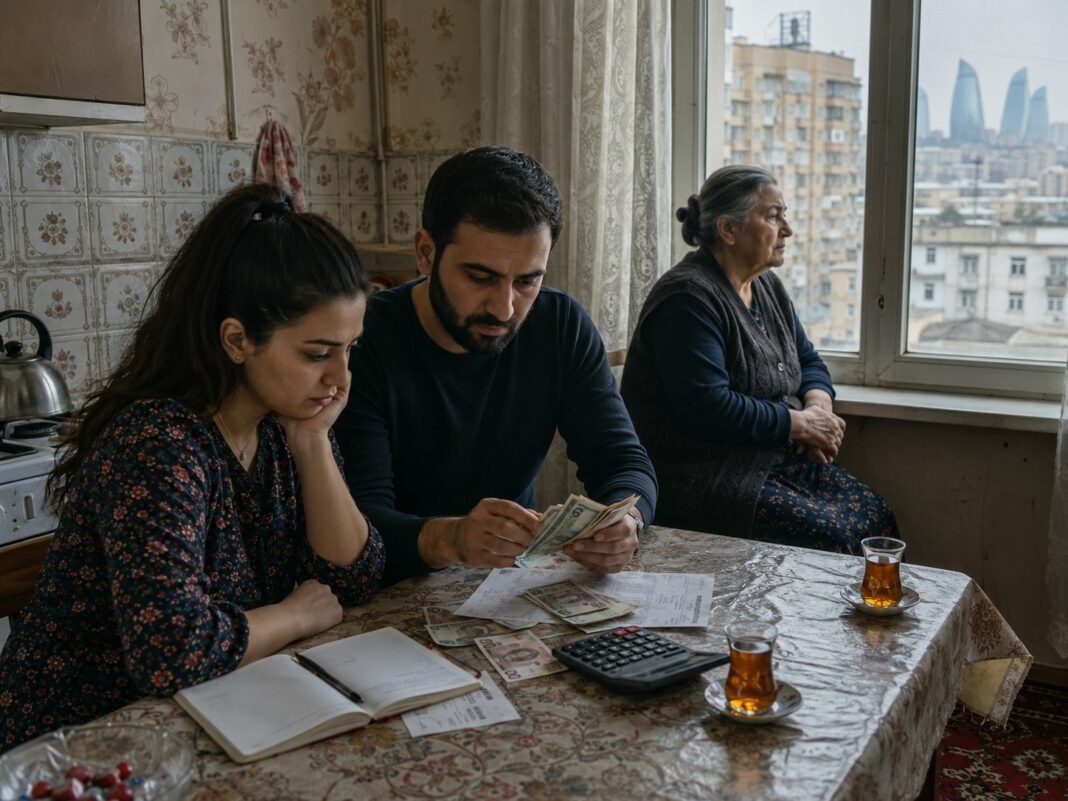
A young family that wants to live separately faces a brutal calculation. Renting an apartment in Baku can cost 600 to 700 manats a month, or about $353 to $412. If one salary is around 1,200 to 1,500 manats, about $706 to $882, rent alone can consume a huge share of household income.
After rent, there are still food, utilities, transport, clothing, healthcare, children’s expenses and debt payments. In that situation, independent living becomes less a normal stage of adulthood and more a financial risk.
This is why many young couples remain dependent on parents. It is not always because they want to. It is often because they have no realistic alternative.
Parents, too, are not always holding their children close only because of emotion. Many older people are worried about their own future. Pensions are limited, healthcare costs are real and confidence in old-age security is weak. A grown child living nearby or in the same household can become part of the family’s survival system.
So the family becomes a safety net, but also a trap.
The same logic explains why buying property has become such an obsession in Azerbaijan. For many citizens, real estate is the only investment they understand and trust. The stock market is not a mass tool for ordinary people. Long-term financial instruments are weak. Investment culture remains limited. Banks are mostly associated with deposits and expensive loans, not wealth-building.
If a person has savings, the most obvious choice is still an apartment or a piece of land.
That helps explain why housing demand remains high even when prices feel impossible. People buy property not only because they want comfort or status. They buy because they fear rent, instability and being left without anything solid.
In this sense, an apartment becomes much more than property. It becomes a symbol of adulthood, marriage, family honor, financial security and protection from poverty.
But when housing becomes the only reliable safety mechanism, society pays a price.
Young people delay marriage or children. Families remain crowded in small apartments. Parents and adult children stay economically tied to each other for too long. Women and men who might want more independence are forced to make decisions based not on personal choice, but on rent, mortgages and wages.
Azerbaijan often takes pride in strong family ties. That pride is understandable. Families do support each other. Parents sacrifice for children. Children are expected to care for parents. Compared with more individualistic societies, this closeness can feel humane and protective.
But it is also necessary to ask a harder question: how much of this is tradition, and how much is poverty?
If an adult child cannot move out because rent is too expensive, that is not only a cultural value.
If parents fear old age because they cannot rely on a pension, that is not only family loyalty.
If a young couple cannot plan a child because one apartment consumes most of their income, that is not only a personal problem.
It is an economic problem.
A healthy society should allow people to choose family closeness freely, not because they cannot afford independence. It should allow young adults to rent without humiliation, buy homes without lifelong fear of debt, invest money outside real estate and build families without depending entirely on parents.
Until that choice exists, the housing question in Azerbaijan will remain about much more than apartments.
It will be about wages. About trust in the future. About young people’s independence. About parents’ old age.
And about why poverty is sometimes hidden behind beautiful words about tradition.
AZE.US