By AZE.US Editorial Team
Washington has again waived the restriction, but it has not repealed it. For the Trump administration, Section 907 remains a useful source of leverage over Baku.
The U.S. State Department has notified Congress that it is extending the waiver of restrictions imposed on Azerbaijan under Section 907 of the Freedom Support Act.
The notification was sent to the Senate Foreign Relations Committee on July 28 and to the House Foreign Affairs Committee on August 10.
For Baku, this is undoubtedly positive news. As long as the presidential waiver remains in force, Section 907 does not block key areas of cooperation between Azerbaijan and the United States.
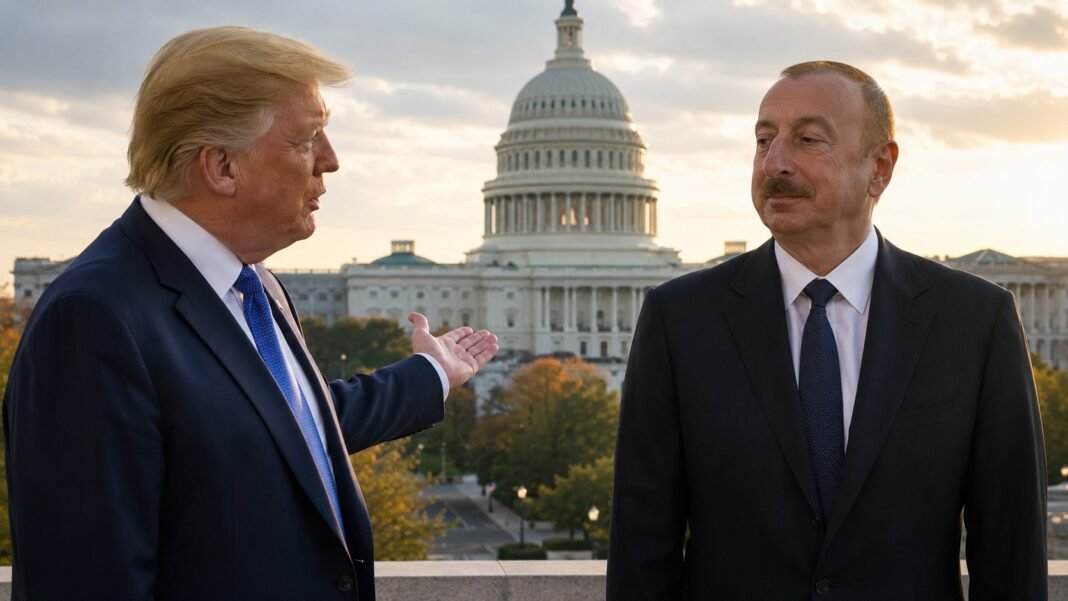
But the central question remains unanswered: If President Donald Trump considers Azerbaijan a strategic partner, if he has repeatedly demonstrated a friendly relationship with President Ilham Aliyev, and if Republicans control both chambers of Congress, why has Section 907 not been repealed permanently?
The uncomfortable answer is that Washington finds it useful to keep the restriction in reserve.
A Friend Should Not Have to Prove His Friendship Every Year
Section 907 was adopted in 1992, under entirely different political and military circumstances. It restricted direct U.S. government assistance to Azerbaijan, effectively assigning Baku responsibility for the blockade and use of force against Armenia.
From the outset, the measure was one-sided and unjust. It ignored the occupation of Azerbaijani territories, the displacement of hundreds of thousands of Azerbaijanis and Armenia’s role in the armed conflict.
After the September 11, 2001, terrorist attacks, Washington suddenly recognized Azerbaijan’s importance to U.S. security. Congress gave the president the authority to waive Section 907 annually.
In other words, the discriminatory restriction was not removed. The United States simply added a door through which the White House could pass whenever cooperation with Azerbaijan served American interests.
That arrangement remains in place today.
Trump extended the waiver on August 8, 2025, citing counterterrorism operations, border security and efforts to achieve peace between Azerbaijan and Armenia. The waiver is now being extended again.
But a genuine strategic partnership should not depend on an annual notification to Congress. A partner should not have to wait each year to learn whether the American president will sign another waiver.
Trump Cannot Repeal Section 907 by Executive Order
One important legal point must be acknowledged: Trump cannot repeal Section 907 on his own. Because the restriction is part of federal law, only Congress can remove it permanently.
That does not mean the president is powerless.
Republicans control both the House of Representatives and the Senate. Trump can publicly endorse repeal, make it a legislative priority, pressure Republican leaders and seek to include repeal language in a broader defense, foreign policy or spending bill.
The necessary legislation already exists.
In December 2025, Republican Rep. Anna Paulina Luna introduced H.R. 6534, which calls for the complete repeal of Section 907. The bill was referred to the House Foreign Affairs Committee.
The problem, therefore, is not the absence of a legal mechanism. It is the absence of sufficient political will to move that mechanism forward.
Republican control of Congress does not mean Trump personally commands every lawmaker. The Republican majority in the House is narrow, while Senate procedures often require support from at least some Democrats.
But when the White House truly considers an issue a priority, the president pressures lawmakers, negotiates with congressional leaders and publicly demands action.
That level of effort has not yet been visible on Section 907.
Friendship Ends Where Political Costs Begin
Repealing the restriction would provoke opposition from Armenian-American lobbying groups and some members of Congress. The White House would have to spend political capital, confront critics and persuade hesitant lawmakers.
Extending the waiver is much easier.
The administration can maintain cooperation with Baku, avoid an open confrontation with Armenian organizations and preserve a means of pressure on Azerbaijan - all at the same time.
Trump can suspend the restriction today. A future president can reactivate it tomorrow. That is why another waiver should not be presented as a final solution.
Keeping Section 907 in American law also allows Washington to remind Baku that bilateral relations depend not only on strategic interests but also on domestic political calculations in the United States.
It is a convenient lever, and Washington appears reluctant to give it up.
Nations Are Guided by Interests, Not Friendship
Baku frequently emphasizes the positive personal relationship between Aliyev and Trump. Such relationships matter. They can facilitate negotiations, open doors and reduce the risk of diplomatic crises.
But foreign policy is not built on personal affection.
Nations do not have permanent friends. They have interests.
Trump may speak warmly about Azerbaijan, welcome its president to the White House and view Baku as an important partner. Yet as long as Section 907 remains embedded in U.S. law, those words have limited value.
The real demonstration of a new relationship would not be another temporary waiver. It would be formal White House support for permanent repeal.
Washington cannot credibly describe Azerbaijan as a strategic partner, expand cooperation in energy, transportation and security, and simultaneously preserve a discriminatory restriction adopted more than three decades ago under circumstances that no longer exist.
The question, therefore, should be asked directly: Does Trump genuinely intend to correct this historical injustice, or does he merely prefer to suspend it while leaving the switch in Washington’s hands?
So far, the administration’s actions point to the second answer.
AZE.US