By AZE.US Editorial Team
The International Monetary Fund’s latest Article IV consultation on Azerbaijan is not a crisis report. That may be the most important thing about it.
The country is not facing a sudden collapse. Its current account is still expected to remain in surplus over the medium term. The state has buffers. The economy is still growing. On paper, Azerbaijan remains far more stable than many countries trying to navigate the same global uncertainty.
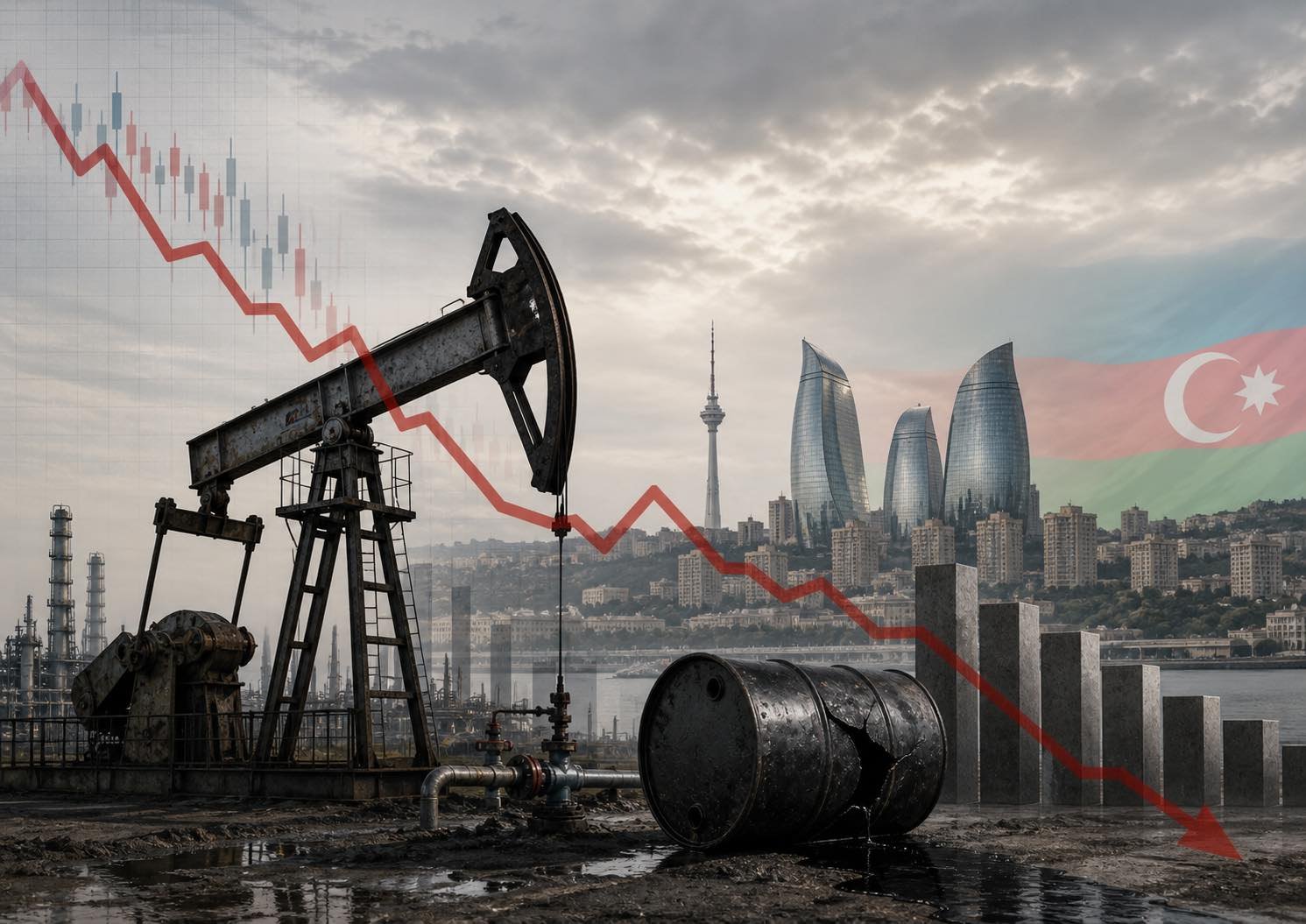
But the IMF’s message is hard to miss: Azerbaijan’s old growth engine is losing force.
The Fund expects the Azerbaijani economy to grow by only 2.1% in 2026, with declining hydrocarbon production weighing on the outlook. In the medium term, lower oil production is expected to keep overall growth at around 2.5%.
For a country that has spent years talking about diversification, logistics, industrial zones, tourism, agriculture and digital services, that is a sobering number.
The problem is not that Azerbaijan is weak. The problem is that its strongest economic pillar is no longer capable of carrying the whole structure at the speed the country wants.
Oil gave Azerbaijan money, sovereignty, leverage and room to maneuver. Gas still matters. Transit matters. The country’s position between Europe and Asia has become more valuable as trade routes shift and geopolitical risks reshape supply chains. But none of that automatically creates a modern private-sector economy.
That is where the IMF’s warning becomes sharper. The Fund says limited progress in private sector development, including reform of state-owned enterprises, could hold back diversification and lower Azerbaijan’s growth potential. This is the line that matters most.
Diversification is not just about building roads, ports and industrial parks. It is about whether businesses outside the state orbit can grow, compete and export without waiting for permission, protection or a privileged connection.
Azerbaijan has the advantage of time, but not unlimited time. Hydrocarbon revenues can still soften shocks. They can finance infrastructure, reconstruction, defense, social spending and strategic projects. But they cannot replace productivity. They cannot by themselves create thousands of competitive small and medium-sized firms. They cannot make the non-oil economy dynamic simply because official documents say diversification is a priority.
There is also a more immediate pressure point: inflation. The IMF expects inflation to rise to 6.0% by the end of 2026, before easing to 4.2% by the end of 2027, citing higher food prices amid rising global commodity prices. For ordinary households, this is the part of the report that will feel most familiar.
People do not experience the economy through current-account language. They experience it through meat, bread, rent, credit payments, school expenses and utility bills.
That creates a political and social gap. At the macro level, Azerbaijan can still look stable. At the household level, the same economy can feel more expensive, tighter and less forgiving. If wages, competition and productivity do not improve fast enough, official stability will not fully translate into public confidence.
The IMF also points to a complicated external environment. Global fragmentation and trade shocks could make diversification harder, although shifting investment and trade routes could also create new opportunities for the region. That is exactly the space Azerbaijan is trying to occupy: not just as an energy supplier, but as a transport, logistics and investment hub between larger blocs.
The opportunity is real. So is the risk of overestimating it.
Azerbaijan’s geography is valuable, but geography is not a reform program. A middle corridor does not automatically build a middle class. Strategic relevance does not automatically produce competition. Foreign interest does not automatically become domestic productivity.
That is why the IMF report should be read less as a warning of trouble and more as a warning against complacency. Azerbaijan has financial room, political stability and geopolitical weight. But the next stage of growth will require a different machine: more private investment, stronger competition, more transparent state-owned enterprises, better human capital and a business environment that rewards productivity rather than proximity to power.
The oil era is not ending overnight. It rarely does. It fades through lower growth, harder budget choices, more visible inflation and a growing need for sectors that can stand on their own.
For Azerbaijan, the number 2.1% is not a disaster. It is a reminder.
The country still has time to turn diversification from a slogan into an economic system. But the easy part of the oil story is already behind it.
AZE.US